


















Lesson 33 of 50 · Knowledge and Language
Chapter 6 Review: Knowledge and Language
Review concepts and categories, semantic networks, schemas, language comprehension and production, and linguistic relativity with a summary picture and a ten-question quiz.
This chapter followed knowledge from the way we group things, through the links and expectations that organize it, to the way we use it in language. This page gathers it into one picture and one table, then tests all four lessons.
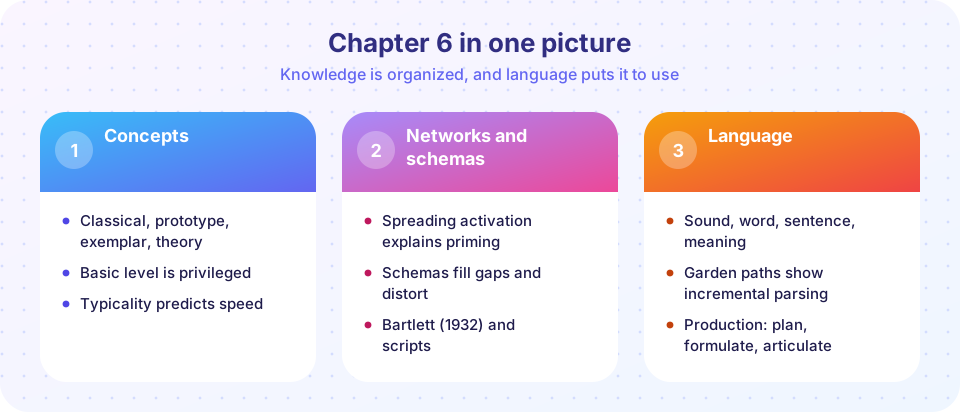
What you will review
- Classical, prototype, exemplar and theory-based views of concepts; the basic level.
- Spreading activation, priming, schemas and scripts.
- Speech perception, word recognition, parsing and situation models.
- Speech production, speech errors and linguistic relativity.
Recap table
| Topic | Key findings | Names |
|---|---|---|
| Classical view | Definitions fail for everyday categories | Wittgenstein |
| Prototype and typicality | Graded membership, family resemblance | Rosch 1975; Rosch and Mervis 1975 |
| Exemplar view | Categorize by similarity to stored cases | Medin and Schaffer 1978 |
| Theory-based view | Explanations link features; ad hoc categories | Murphy and Medin 1985; Barsalou 1983 |
| Basic level | Named first, most informative | Rosch et al. 1976 |
| Hierarchical network | Property verification time grows with links | Collins and Quillian 1969 |
| Spreading activation | Related words primed in lexical decision | Collins and Loftus 1975; Meyer and Schvaneveldt 1971 |
| Schemas and scripts | Fill gaps, distort memory | Bartlett 1932; Bransford and Johnson 1972; Schank and Abelson 1977 |
| Speech perception | Categorical perception; McGurk effect | Liberman 1957; McGurk and MacDonald 1976 |
| Words and sentences | Cohort model; garden paths; N400 | Marslen-Wilson 1987; Bever 1970; Kutas and Hillyard 1980 |
| Production | Conceptualize, formulate, articulate; slips follow rules | Levelt 1989; Fromkin; Dell |
| Language and thought | Weak influence yes, determinism no | Berlin and Kay 1969; Winawer et al. 2007 |
Try it
Press Run (or Ctrl + Enter) to see the console output here.
No output.
Check your understanding
Quick check · 10 questions
of 10 answered You scored / 10 · perfect!
-
1. Which finding most directly supports the prototype view?
Typicality gradients follow from similarity to a prototype. -
2. An exemplar model would predict that a new item very similar to one specific stored case is
Exemplar models rely on similarity to individual stored instances. -
3. The basic level of categorization is special because it is
Rosch et al. (1976) found that basic-level categories are the most efficient. -
4. Semantic priming in a lexical decision task shows that
Responses to 'nurse' are faster after 'doctor'. -
5. The Brewer and Treyens (1981) office study shows
People recalled books that were not in the room. -
6. Categorical perception means
VOT varies smoothly but is heard as /ba/ or /pa/. -
7. In the cohort model, a word is recognized at about
That is when only one candidate is consistent with the input. -
8. Which sentence is a garden path?
'Raced' is first read as the main verb, then 'fell' forces a re-analysis. -
9. A tip-of-the-tongue state is consistent with
You can have the meaning and partial form, but not the full sounds. -
10. The best-supported view of language and thought is that
Evidence such as Winawer et al. (2007) supports weak influence.
Summary
- Concepts are graded and flexible; prototypes, exemplars and theories each contribute, with the basic level most useful.
- Networks and schemas organize knowledge and shape what we notice, infer and remember.
- Comprehension runs through sounds, words, sentences and meaning at once; production plans, formulates and articulates.
- Language influences thought in modest, specific ways and does not determine it.
Next: Chapter 7 Overview: Reasoning, Judgment and Decision Making
Track your progress
Create a free account to tick off lessons and pick up where you left off on any device.
of Cognitive Psychology lessons completed