


















Lesson 44 of 50 · Problem Solving and Expertise
Chapter 8 Review: Problem Solving and Expertise
Review problem spaces, means-ends analysis, insight and fixation, analogy, chess expertise, deliberate practice, creativity and metacognition with a summary picture and a quiz.
Problem solving combines search, restructuring and knowledge. Experts do not so much search better as know more, organized into patterns, and creativity and good judgment can be supported by methods that work with the mind's limits. This page pulls the chapter into one picture and one table, then tests all three lessons.
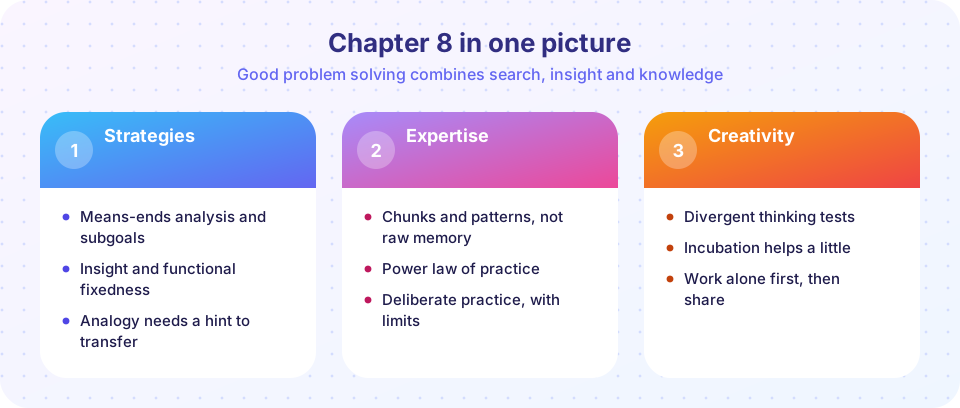
What you will review
- Problem spaces, means-ends analysis and the Tower of Hanoi.
- Insight, functional fixedness, mental set and analogy.
- Chunking, expert-novice differences, the power law and deliberate practice.
- Creativity, incubation, group brainstorming and metacognition.
Recap table
| Topic | Key findings | Names |
|---|---|---|
| Problem space | States, operators, goals; Hanoi needs 2ⁿ − 1 moves | Newell and Simon 1972 |
| Means-ends analysis | Reduce the difference; create subgoals | Newell and Simon |
| Insight | Sudden restructuring; warmth stays low until the end | Köhler 1925; Metcalfe and Wiebe 1987 |
| Fixation | Functional fixedness and mental set | Duncker 1945; Luchins 1942 |
| Analogy | Few notice the match without a hint | Gick and Holyoak 1980 |
| Chess expertise | Masters recall real positions, not random ones | de Groot 1946; Chase and Simon 1973 |
| Expert representation | Experts sort by principle, novices by surface | Chi, Feltovich and Glaser 1981 |
| Practice | Power law; stages; deliberate practice with limits | Newell and Rosenbloom 1981; Ericsson et al. 1993; Macnamara et al. 2014 |
| Intuition | Trustworthy in regular, feedback-rich environments | Kahneman and Klein 2009 |
| Creativity | Divergent thinking; incubation helps a little | Guilford 1950; Sio and Ormerod 2009 |
| Groups | Production blocking cuts brainstorming output | Diehl and Stroebe 1987 |
| Metacognition | Illusion of explanatory depth | Rozenblit and Keil 2002 |
Try it
Press Run (or Ctrl + Enter) to see the console output here.
No output.
Check your understanding
Quick check · 10 questions
of 10 answered You scored / 10 · perfect!
-
1. The minimum number of moves for a 7-disk Tower of Hanoi is
2^7 - 1 = 127. -
2. Hill climbing fails in the Tower of Hanoi because
Solving the puzzle requires temporary moves that seem unhelpful. -
3. Functional fixedness is best illustrated by
The usual function of an object blocks seeing a new use. -
4. In Gick and Holyoak's work, the main reason people failed to use the fortress story was
Hints greatly increased use of the story. -
5. Masters' advantage in remembering chess positions largely disappears when the pieces are
Random arrangements contain no familiar chunks. -
6. Novices in physics tended to sort problems by
Chi et al. (1981) found a shift to principle-based sorting with expertise. -
7. The power law of practice predicts that improvement is
Time per trial declines steeply at first. -
8. Skilled intuition is most reliable when the environment is
Kahneman and Klein (2009) set out these conditions. -
9. Incubation studies suggest the largest benefit when
Meta-analysis found larger effects with low-demand breaks after initial work. -
10. A good conclusion about group brainstorming is
This reduces production blocking while keeping the benefits of collaboration.
Summary
- Problems are searched and restructured; fixation and surface similarity obstruct, and hints, subgoals and comparison help.
- Expertise is organized, domain-specific knowledge built by practice, with limits and caveats.
- Creativity benefits from knowledge, incubation after effort, and working alone first.
- Metacognition is imperfect; testing, considering the opposite, pre-mortems and checklists improve judgment.
Track your progress
Create a free account to tick off lessons and pick up where you left off on any device.
of Cognitive Psychology lessons completed