


















Lesson 34 of 50 · Reasoning, Judgment and Decision Making
Chapter 7 Overview: Reasoning, Judgment and Decision Making
Preview the chapter on thinking under uncertainty: heuristics and biases, logical reasoning, probability and Bayes, prospect theory and framing, with a roadmap of each lesson.
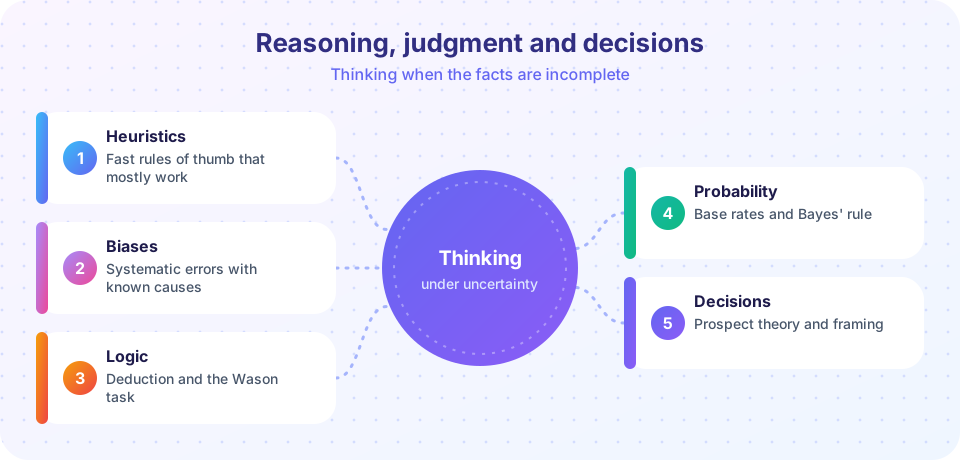
Most real decisions are made without full information: Should you take the job? Is this lump worrying? Will it rain? We rarely have a calculator and a table of probabilities, so the mind uses shortcuts. This chapter studies those shortcuts, shows where they work and where they predictably fail, and introduces the formal standards, logic and probability theory, against which human thinking has been compared. It also shows how a sensible-looking choice can flip when the same facts are described differently.
What you will learn
- The difference between reasoning, judgment and decision making.
- Why heuristics are both useful and error-prone.
- How the chapter's lessons build on each other.
- Why evidence about "biases" is read differently by different researchers.
Key terms
Reasoning: drawing conclusions from information, as in logic.
Judgment: estimating likelihoods or quantities under uncertainty.
Decision making: choosing among options.
Heuristic: a fast rule of thumb that usually, but not always, gives a good answer.
Normative standard: a rule, such as logic or probability theory, that says how one should reason.
The big picture
Psychologists in this area compare human thinking with normative models: logic for reasoning, probability theory for judgment, and expected utility for choice. In the 1970s Daniel Kahneman and Amos Tversky showed that people often depart from these models in systematic ways, and that the departures can be explained by heuristics. That program, known as heuristics and biases, won Kahneman a share of the 2002 Nobel Memorial Prize in economic sciences (Tversky had died in 1996).
Other researchers, such as Gerd Gigerenzer, replied that heuristics are not just flawed approximations: in the right environment, simple rules can be fast, frugal and accurate, and many apparent errors shrink when problems are stated in forms that the mind handles naturally. A third idea, dual-process theory, separates quick, intuitive thinking from slower, effortful, reflective thinking, though the "two systems" are best read as a handy description and not as two brain modules.
Three kinds of thinking
Heuristics
Fast, and sometimes biased.
Normative standards
Choice under risk
Prospect theory.
What each lesson covers
| Lesson | Central question | Key names |
|---|---|---|
| Heuristics and Biases | What shortcuts do we use? | Tversky, Kahneman, Gigerenzer |
| Logic and Reasoning | How well do we reason with rules? | Wason, Evans, Johnson-Laird, Cosmides |
| Probability and Bayes | How should evidence change belief? | Bayes, Eddy, Gigerenzer and Hoffrage |
| Decisions and Prospect Theory | Why do choices depend on description? | Allais, Kahneman and Tversky, Thaler |
| Chapter Review | Can you connect it all? | all of the above |
How this chapter connects
Working memory limits (chapter 5) and attention (chapter 3) shape which information enters a judgment. Categories and examples (chapter 6) determine what comes to mind first. In chapter 8 you will see that experts can overcome many of these biases in their domain, mainly because their experience gives them good cues. Your reading of research itself, including the replication issues covered in chapter 9, uses the same probability tools.
Try it
Press Run (or Ctrl + Enter) to see the console output here.
No output.
Check your understanding
Quick check · 4 questions
of 4 answered You scored / 4 · perfect!
-
1. A heuristic is
Heuristics trade some accuracy for speed and effort. -
2. A normative standard tells us
Normative models are benchmarks against which behavior is compared. -
3. Gigerenzer's response to the heuristics and biases program was that
He emphasized ecological rationality and natural frequency formats. -
4. The two systems of dual-process theory are best viewed as
The labels describe types of processing, not separate brain modules.
Summary
- Reasoning, judgment and decision making are studied against logic, probability and utility standards.
- The heuristics and biases program shows systematic departures; the ecological view shows when shortcuts work.
- Dual-process theory contrasts fast intuition with slow reflection, as a description and not a brain map.
- The chapter covers heuristics, logic, Bayes and prospect theory.
Next: Heuristics and Biases
Track your progress
Create a free account to tick off lessons and pick up where you left off on any device.
of Cognitive Psychology lessons completed