


















Lesson 21 of 50 · Perception and Pattern Recognition
Chapter 4 Review: Perception and Pattern Recognition
Review sensation and perception, top-down and bottom-up processing, Gestalt grouping, and object and face recognition with a summary picture, table and ten-question quiz.
This chapter followed information from the retina to recognized objects and faces. You met the inverse problem, the two directions of processing, the grouping rules the visual system uses before you consciously think, and the competing theories of how we recognize things. The picture and table below gather those ideas; the quiz tests the whole chapter.
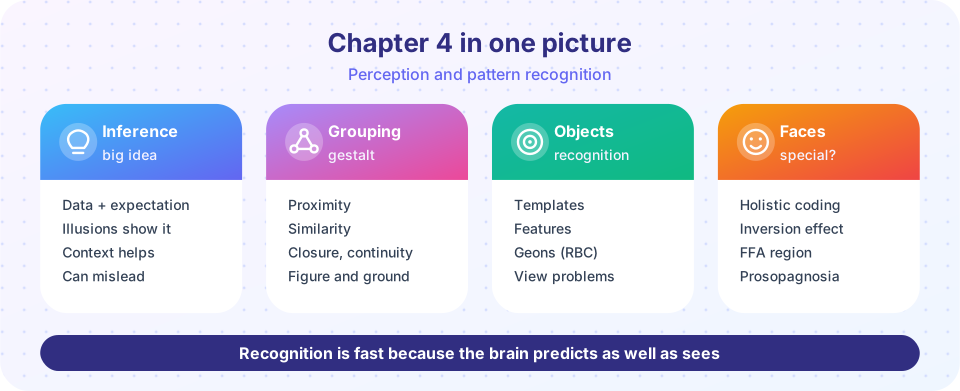
What you will review
- Sensation versus perception, constancy and the two streams.
- Bottom-up and top-down processing and context effects.
- Gestalt principles, figure-ground and illusory contours.
- Theories of object recognition and the special case of faces.
Recap table
| Topic | Key points | Names |
|---|---|---|
| Sensation and perception | Transduction; inverse problem; constancies; ventral "what" and dorsal "where/how" streams | Ungerleider and Mishkin 1982; Milner and Goodale 1992 |
| Direct versus inferential | Rich stimulus and affordances versus unconscious inference and hypothesis | Gibson; Helmholtz; Gregory |
| Context | Word superiority; scene context; perceptual set; Bayesian combination of priors and data | Reicher 1969; Palmer 1975; Bruner and Minturn 1955 |
| Gestalt | Proximity, similarity, closure, continuation, common fate, Prägnanz, figure-ground | Wertheimer 1912; Rubin 1915; Kanizsa 1955 |
| Neural grouping | Border-ownership cells; contour integration | Zhou et al. 2000; Field et al. 1993 |
| Object recognition | Template, feature, RBC (geons), view-based | Selfridge 1959; Hubel and Wiesel; Biederman 1987 |
| Agnosias | Apperceptive (perception fails) versus associative (meaning fails) | Lissauer's classification |
| Faces | Holistic; inversion; Thatcher; composite; FFA; prosopagnosia | Yin 1969; Thompson 1980; Kanwisher et al. 1997 |
Try it
Press Run (or Ctrl + Enter) to see the console output here.
No output.
Check your understanding
Quick check · 10 questions
of 10 answered You scored / 10 · perfect!
-
1. The inverse problem of vision is that
Ambiguity means the brain must choose the most probable interpretation using assumptions. -
2. The dorsal visual stream is associated with
It runs toward the parietal lobe and supports where-and-how vision. -
3. Which finding most directly supports top-down influence on letter perception?
Letters are identified better in words than alone, implying knowledge feeds back to letter-level processing. -
4. A Kanizsa triangle demonstrates
We see edges of a triangle that are not physically present. -
5. Which cue makes a region more likely to be seen as figure?
Smaller, surrounded, symmetrical, convex regions tend to be perceived as figures. -
6. In recognition by components, objects are described as
About 36 geons in different arrangements can describe many objects. -
7. Associative agnosia is when a patient
Perception is intact but the link to meaning is lost. -
8. The Thatcher illusion shows that
Local changes are hard to detect when the whole face is inverted, a sign of configural processing. -
9. The debate about the fusiform face area concerns whether it
Face selectivity versus the expertise hypothesis remains debated. -
10. From a Bayesian viewpoint, context has the strongest effect when
Priors weigh more when the data leave uncertainty.
Summary
- Perception solves an inverse problem using assumptions, constancies and context; it is mostly accurate and sometimes fooled.
- Grouping and figure-ground organization are early, automatic and rule-like.
- Object recognition combines structural descriptions, features and stored views; faces rely strongly on holistic processing.
- Brain damage and illusions are windows onto stages and assumptions.
Track your progress
Create a free account to tick off lessons and pick up where you left off on any device.
of Cognitive Psychology lessons completed