


















Lesson 43 of 50 · Problem Solving and Expertise
Creativity and Thinking Well
Explore divergent thinking, Wallas's stages, incubation research, why group brainstorming underperforms, the illusion of explanatory depth and practical debiasing habits.
Creativity seems like the opposite of the careful problem solving in the last two lessons, but psychologists find that the two share their machinery: knowledge, search, restructuring and persistence. This lesson looks at what the evidence says about creative thinking, including a few popular beliefs that do not hold up, and then at the broader skill of thinking well: noticing what you do and do not know, and using methods that guard against predictable mistakes.
What you will learn
- How divergent thinking is measured and what it does and does not capture.
- Wallas's four stages and what incubation studies show.
- Why real brainstorming groups tend to produce fewer ideas than the same people working alone.
- What metacognition is, and how overconfidence and the illusion of explanatory depth appear.
- A few evidence-based habits that improve judgment.
Key terms
Creativity: producing ideas that are both new and useful in context.
Divergent thinking: generating many different possible answers.
Convergent thinking: finding the single best answer.
Incubation: a break from a problem, after which a solution may come more easily.
Metacognition: knowledge about, and monitoring of, one's own thinking.
What is creativity and how is it measured?
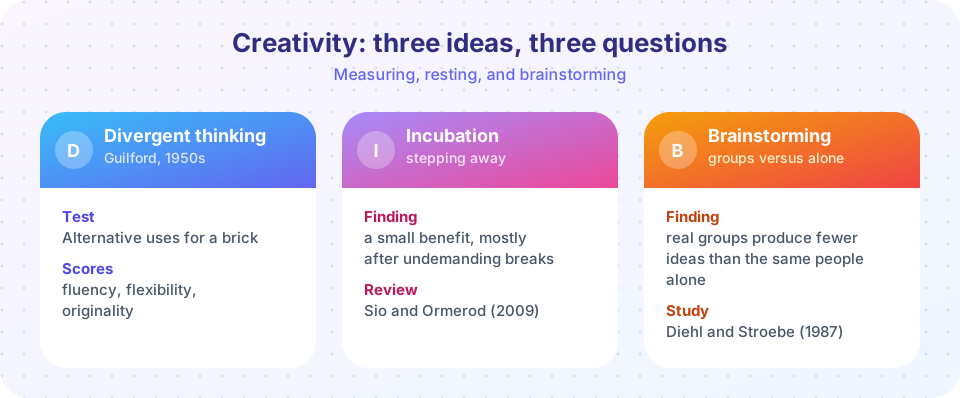
Most definitions require two things: the product must be novel and it must be appropriate or useful. J. P. Guilford's 1950 address to the American Psychological Association launched modern creativity research. He distinguished divergent thinking, which produces many answers to an open question, from convergent thinking, which narrows to one. The classic test is the Alternate Uses Task: "List all the uses you can think of for a brick." Responses are scored for fluency (how many), flexibility (how many different categories of use) and originality (how rare). E. Paul Torrance developed a widely used battery on these lines in the 1960s.
Divergent thinking tests predict some creative achievement but are limited: they are brief, artificial and ignore evaluation, which is the ability to recognize which ideas are good. Another classic task, Sarnoff Mednick's Remote Associates Test, measures convergent creativity: you get three words, such as cottage, swiss, cake, and must find the single word that links them (cheese). Real-life creativity also depends on deep domain knowledge, intrinsic motivation, persistence and the social setting. The study of eminent creators suggests that high output is the best predictor of a few great works: many ideas are weak, and a few are exceptional.
Stages and incubation
Graham Wallas (1926), drawing on accounts by scientists, described four stages: preparation (working hard on the problem), incubation (leaving it aside), illumination (the idea arrives) and verification (checking and refining it). Wallas's model is a description, not a tested process, but incubation has been studied experimentally. In a typical design, people work on a problem, then spend an interval on a different task, and then return to it. A meta-analysis of such studies (Sio and Ormerod, 2009) found a small to moderate positive effect of incubation. The effect was larger when the break involved a low-demand activity that allows the mind to wander, and when people had worked on the problem before the break long enough to get stuck. Explanations include forgetting a misleading fixation (the wrong approach fades), unconscious continued processing, opportunistic assimilation (a cue in the environment suddenly fits) and simple rest. No explanation has won, and it remains true that you only incubate on problems you have first worked on.
Do groups brainstorm better?
Alex Osborn (1953) popularized brainstorming: generate as many ideas as possible in a group without criticism. Surprisingly, in a long line of experiments, groups produced fewer ideas than the same number of people working alone whose lists were pooled afterward (nominal groups). Michael Diehl and Wolfgang Stroebe (1987) tested explanations and found the main one to be production blocking: only one person can speak at a time, so others wait and forget or abandon their ideas. Other contributors are evaluation apprehension (worrying about what others think) and social loafing (reduced effort in a group). Some remedies exist: writing ideas down individually first, brainwriting, electronic systems that remove blocking, and using groups later for selecting and developing ideas. The practical lesson, "work alone first, then share", is supported by evidence. This does not mean that teams are not creative: diverse knowledge and productive disagreement help with building on ideas and with evaluating them.
Thinking about your own thinking
Metacognition includes feelings of knowing, judgments of how well you have learned something, and the decision of when to stop studying or working. It is often inaccurate. Leonid Rozenblit and Frank Keil (2002) asked people to rate how well they understood everyday devices such as a zipper or a flush toilet, then to write detailed explanations, and then to rate again. Ratings dropped sharply after the attempt to explain: the illusion of explanatory depth. Similarly, after rereading a text, students feel they know it, because it is familiar, although retrieval tests reveal gaps (chapter 5). Overconfidence in judgment (chapter 7) is the same phenomenon. The Dunning-Kruger pattern, in which the least skilled overestimate themselves the most, is often cited; part of it is a statistical artifact of regression to the mean and of noisy self-ratings, and the practical lesson is simply that self-assessment is least accurate where you have the least experience and feedback.
Habits that help
Evidence-based practices include:
- Test yourself and explain ideas out loud to expose gaps.
- Consider the opposite: actively write down reasons why your first judgment might be wrong (Lord, Lepper and Preston, 1984). It reduces confirmation and anchoring effects.
- Pre-mortem (Gary Klein): before a project begins, imagine it has failed and list the reasons.
- Use base rates and reference classes: ask how similar projects have fared.
- Use checklists for routine, high-stakes steps. A checklist for inserting central lines greatly reduced infections in Michigan intensive care units (Pronovost and colleagues, 2006).
- Seek diverse views and feedback, and take breaks when stuck.
Common misconceptions
"Creativity is mainly a right-brain gift." Creative thinking involves widespread networks and a lot of learned knowledge; the "right-brain" story is a myth.
"Brainstorming in groups is the best way to get ideas." Alone-then-together tends to do better.
"If you feel you understand it, you do." Feeling of understanding can be an illusion; explanation and testing reveal it.
Try it
Press Run (or Ctrl + Enter) to see the result here.
Program input · what you'd type while the program runs
Type the answers before you press Run, one per line. Each time the program reads a line (with input()), it gets the next line from this box.
Check your understanding
Quick check · 5 questions
of 5 answered You scored / 5 · perfect!
-
1. On the Alternate Uses Task, 'flexibility' refers to
Fluency counts ideas, flexibility counts categories, originality counts rarity. -
2. In Wallas's model, the stage after incubation is
The four stages are preparation, incubation, illumination and verification. -
3. The main reason brainstorming groups underperform nominal groups is
Diehl and Stroebe (1987) found blocking to be the main factor. -
4. The illusion of explanatory depth is the finding that
Ratings fell after people tried to explain how everyday devices work. -
5. A pre-mortem asks teams to
It helps surface risks before they occur.
Summary
- Creativity needs novelty and usefulness; divergent thinking tests are informative but limited, and domain knowledge matters.
- Incubation gives a modest benefit, mainly after real effort and with low-demand breaks.
- Real brainstorming groups tend to underperform individuals pooled afterward, mainly because of production blocking.
- Metacognition is often inaccurate, as with the illusion of explanatory depth; testing, considering the opposite, pre-mortems and checklists help.
Track your progress
Create a free account to tick off lessons and pick up where you left off on any device.
of Cognitive Psychology lessons completed