


















Lesson 1 of 50 · Getting Started
Course Map: Cognitive Psychology
Start here: who the cognitive psychology course is for, how the nine chapters fit together, and how to study with experiments, simulations and quizzes.
Every second, your mind does things that feel effortless: you read this sentence, recognize the letters, pull word meanings from memory, and decide whether to keep reading. Cognitive psychology is the science of how that works. It asks what happens inside the mind between a stimulus (a sound, a word, a face) and a response (a smile, an answer, a choice), and it answers with experiments rather than guesses.
This course is a complete, friendly introduction. You do not need any background in psychology or statistics. If you can read a graph and are curious about why you forget where you parked, you are ready.
Educational information only. This course explains how the mind works according to research. It is not medical or psychological advice, and nothing in it can diagnose or treat anyone. If you are worried about your memory, attention or mood, talk to a qualified health professional.
What you will learn
- What cognitive psychology studies and how it differs from other parts of psychology.
- How the nine chapters of the course connect into one story.
- How to study each lesson so that the ideas stick.
- How the interactive demonstrations in this course should (and should not) be used.
Who this course is for
- Students aged about 15 and up who are taking or preparing for a psychology course (school, A Level, IB, AP, or a first-year university course).
- Curious adults who want to understand attention, memory, language and decision making.
- Designers, teachers and developers who want to build things that fit how people really think.
The course follows the common core of international psychology curricula, so the material is useful whichever syllabus you follow. It is written for an international audience with US spelling.
The nine chapters at a glance
Chapters 1 and 2: The toolkit
- Getting Started
- Methods and Architecture
Chapters 3 and 4: Taking in the world
- Attention
- Perception
Chapter 5: Memory Systems
Chapter 6: Knowledge and Language
Chapter 7: Reasoning and Decisions
Chapter 8: Problem Solving
Chapter 9: Projects and Practice
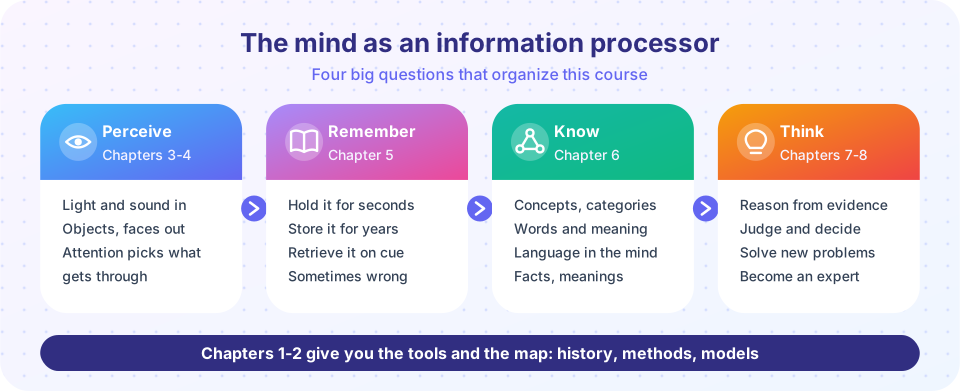
The story is a simple one. Chapters 1 and 2 give you the vocabulary and the tools. Chapters 3 and 4 follow information as it enters the mind: attention selects it and perception organizes it. Chapters 5 and 6 cover what the mind keeps and knows. Chapters 7 and 8 cover what the mind does with all of that: reason, decide and solve problems.
How to study each lesson
Every content lesson follows the same shape, so you always know where you are:
- What you will learn lists the outcomes. Read it first and check it again at the end.
- Key terms gives short definitions of the words you will meet. Cognitive psychology has a lot of vocabulary, and precise terms make the ideas easier.
- The body explains the idea with named studies and worked examples. Look at the illustration before reading the text around it.
- Common misconceptions points out popular beliefs that research does not support.
- Try it is where you run a small demonstration or simulation.
- Check your understanding is a short quiz. Treat a wrong answer as useful information, not as failure.
A study habit that research itself supports is retrieval practice: after reading a section, close it and try to write down what you remember, then check. You will meet the evidence for this in the memory chapter, and you can start using it today.
About the interactive demonstrations
You will run small programs and mini experiments in your browser. Please keep three things in mind.
- They are demonstrations. A real experiment needs many participants, careful controls and statistics. A five-minute toy in a web page cannot replace that.
- They are not tests. Nothing here measures your intelligence, memory or attention in a clinical sense, and none of them should be used to diagnose anything.
- Simulated data are labeled as simulated. When a program invents numbers, it is to show a method or a pattern, not to report a real result.
One trial tells you almost nothing, because reaction times vary a lot from trial to trial. In Chapter 2 you will see why researchers collect hundreds of trials and look at distributions, not single numbers.
Press Run (or Ctrl + Enter) to see the result here.
Program input · what you'd type while the program runs
Type the answers before you press Run, one per line. Each time the program reads a line (with input()), it gets the next line from this box.
Common misconceptions
"Psychology is just common sense." Many results are surprising. People are far worse at noticing changes in a scene than they believe, and far worse at multitasking. Common sense often gets the details wrong, which is why we run experiments.
"We use only 10% of our brains." This is a myth. Brain imaging shows activity across the whole brain over a day, and damage to almost any region has some effect.
Check your understanding
Quick check · 4 questions
of 4 answered You scored / 4 · perfect!
-
1. Cognitive psychology is best described as the study of
The field studies how the mind takes in, stores and uses information, using behavior and brain data as evidence. -
2. Which is the best use of the demonstrations in this course?
They are small demonstrations that illustrate methods and patterns. They are not tests or substitutes for research. -
3. Why does the reaction timer need many trials, not one?
Trial-to-trial variability is large, so researchers collect many trials and study the distribution. -
4. Which chapters cover the most basic intake of information?
Attention (Chapter 3) and perception (Chapter 4) deal with how information enters and is organized.
Summary
- Cognitive psychology studies how the mind perceives, attends, remembers, knows, reasons and solves problems.
- The course moves from tools (Chapters 1-2) through intake (3-4) and storage (5-6) to thinking (7-8).
- Each lesson has outcomes, key terms, worked ideas, misconceptions, demonstrations and a quiz.
- Demonstrations teach methods; they never diagnose or replace real research.
- Retrieval practice is a good way to study.
Track your progress
Create a free account to tick off lessons and pick up where you left off on any device.
of Cognitive Psychology lessons completed