


















Lesson 19 of 50 · Perception and Pattern Recognition
Gestalt Grouping and Figure-Ground
Learn the Gestalt laws of proximity, similarity, closure and continuity, figure-ground organization, illusory contours, and how modern research explains perceptual grouping.
Before you recognize anything, your visual system has to decide what belongs together. A scene arrives as millions of tiny patches of light and color, and you see a few objects on a background. The Gestalt psychologists of early twentieth-century Germany argued that this organization happens automatically and follows principles, and that the whole is perceived as something other than the sum of its parts. (Gestalt is German for form or shape.) Their principles are still among the most useful rules of thumb in psychology, and in design.
What you will learn
- The history and the central claim of Gestalt psychology.
- The main grouping principles and the law of Prägnanz.
- Figure-ground organization and illusory contours.
- What modern research says about when and where grouping happens.
Key terms
Gestalt: an organized whole with properties that its parts do not have on their own.
Prägnanz: the tendency to perceive the simplest, most stable organization.
Figure-ground: perceiving some parts of a scene as objects (figure) and the rest as background (ground).
Illusory contour: an edge you perceive even though there is no physical edge there.
Common fate: elements that move together are grouped together.
A short history
In 1912 Max Wertheimer published a study of the phi phenomenon: two lights flashed in succession at nearby positions are perceived as one light moving, although nothing moves between them. This shows that motion is not simply the sum of two static events. With Wolfgang Köhler and Kurt Koffka, Wertheimer developed the Gestalt approach, which opposed the idea (in the tradition of Wundt) that perception is built by adding up elementary sensations.
The grouping principles
Wertheimer and later authors proposed a set of principles for how elements are organized. The main ones:
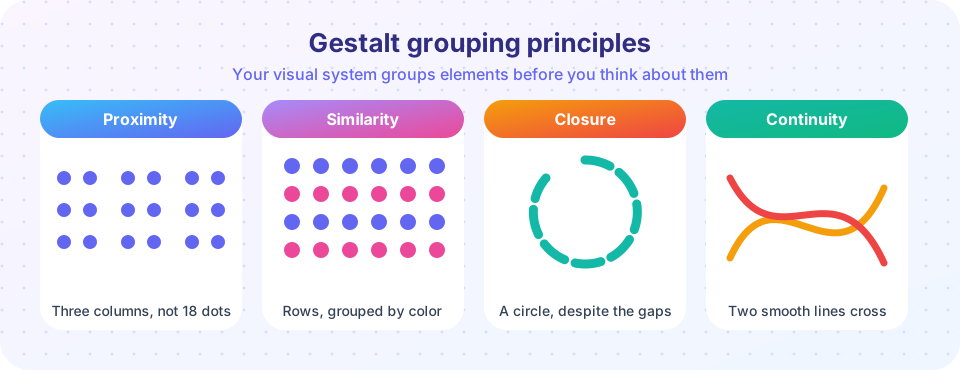
| Principle | What groups together | Example |
|---|---|---|
| Proximity | Elements that are close together | Dots spaced in pairs form columns |
| Similarity | Elements that look alike (color, size, shape) | Rows of alternating colors |
| Closure | Gaps are filled in to see complete shapes | A broken circle is still a circle |
| Good continuation | Elements along a smooth path | Two crossing lines are seen as two smooth curves, not four pieces |
| Common fate | Elements that move in the same direction | A flock of birds |
| Symmetry | Symmetric regions form a unit | Two mirrored curves enclose a figure |
| Connectedness | Elements joined by lines (Palmer and Rock, 1994) | Dots connected by lines form pairs |
| Common region | Elements inside the same enclosure | Items in the same box |
When principles compete, the outcomes can be predicted by how strong each is. In a grid where proximity says "columns" and similarity says "rows", which wins depends on how large the differences are. This is why designers use spacing and color consistently.
The law of Prägnanz
All of the principles are summed up by the law of Prägnanz (good form): of the possible organizations, perception tends to choose the simplest, most regular and most stable one. Five overlapping circles are seen as five circles, not as a collection of odd lens shapes. The idea is intuitive but vague; later researchers have tried to make "simplest" precise using information theory, for instance by saying we prefer the interpretation that needs the shortest description.
Figure-ground organization
At every edge, the visual system decides which side is the object (figure) and which the background (ground). The edge then "belongs" to the figure. Properties of the figure: it seems closer, has a definite shape, and the contour looks like its boundary; the ground seems to continue behind it.
Cues that make a region a figure include being smaller, surrounded, symmetrical, convex, and meaningful (familiar shapes tend to be seen as figures). Edgar Rubin (1915) made this famous with the vase-face figure: a black vase on a white background, or two white faces in profile facing each other on black. You cannot see both at once; perception flips. Which one you see first depends on small cues. The ambiguity shows that figure-ground is something the brain computes, not something printed on the picture.
Neural evidence. Rüdiger von der Heydt and colleagues (Zhou, Friedman and von der Heydt, 2000) recorded from neurons in monkey visual cortex (areas V2 and V4) whose responses depended on which side of an edge was the figure: border-ownership cells. This suggests figure-ground assignment starts at an early stage of cortical processing.
Illusory contours and completion
In 1955 Gaetano Kanizsa showed a figure in which three "Pac-Man" shapes and three V-shaped angles are arranged so that you see a bright triangle lying on top, with sharp edges, even though nothing is drawn there. These illusory contours show that the visual system fills in the most likely structure, one that would explain why the shapes are cut off: a nearer object is covering them. Cortical neurons in early visual areas respond to such contours, according to studies in monkeys and brain imaging in humans.
Related phenomena:
- Modal completion: you see the completed surface in front (the Kanizsa triangle).
- Amodal completion: you perceive the hidden part of an object behind another, such as a cat behind a fence, without "seeing" it. You do not think of the cat as cut into slices.
Evaluating the Gestalt approach
Strengths. The principles are easy to demonstrate, robust, and still used in graphic design, data visualization and user-interface layout. They anticipated ideas like context effects and the role of the whole.
Limits. They are largely descriptive: they say what is perceived but not how. They are hard to quantify and can conflict. Some modern accounts offer mechanisms:
- Contour integration. David Field, Anthony Hayes and Robert Hess (1993) showed that people easily detect a path of aligned elements embedded in randomly oriented ones, but only when the elements are close to aligned. This suggests a limited "association field" of connections between neighboring orientation-tuned cells in early visual cortex, a mechanism for good continuation.
- Probabilistic accounts argue that principles such as proximity and continuation reflect statistics of natural scenes: elements that are close or aligned are in fact more likely to belong to the same object.
- Timing and attention. Grouping by proximity and similarity seems to occur early and without attention, but other kinds may need attention; the extent is debated.
Using Gestalt in everyday design
- Group related controls close together and separate unrelated ones (proximity).
- Make links of the same kind look alike (similarity).
- Put related items inside a box or on the same panel (common region).
- Use alignment to guide the eye along a path (continuation).
Common misconceptions
"Gestalt means the whole is greater than the sum of its parts." The common slogan is slightly off. Koffka's point was that the whole is different from the sum, with its own properties.
"The Gestalt laws are scientific laws." They are better called principles or heuristics. They describe tendencies and can be outweighed.
"Figure-ground is about looking at pictures." It operates at every moment in ordinary scenes, and also in hearing (a voice as figure against background noise).
Try it
Press Run (or Ctrl + Enter) to see the result here.
Program input · what you'd type while the program runs
Type the answers before you press Run, one per line. Each time the program reads a line (with input()), it gets the next line from this box.
Check your understanding
Quick check · 5 questions
of 5 answered You scored / 5 · perfect!
-
1. Dots arranged in tightly spaced pairs are seen as pairs because of
Elements that are close together are grouped. -
2. The law of Prägnanz states that
Of the possible interpretations, we tend to see the simplest and most regular. -
3. Rubin's vase-face figure demonstrates
The same edge can belong to the vase or to the faces, so figure and ground swap. -
4. Border-ownership cells respond according to
These cells in V2 and V4 signal which side of an edge owns the border. -
5. A common criticism of the Gestalt principles is that they are
They describe what is perceived but did not specify mechanisms, which later research supplied in part.
Summary
- Gestalt psychology holds that perception organizes elements into wholes automatically, as in the phi phenomenon.
- Key principles include proximity, similarity, closure, good continuation, common fate, symmetry, connectedness and common region; they are summarized by Prägnanz.
- Figure-ground organization assigns each edge to one side and is computed early, as border-ownership cells show.
- Illusory contours and completion show that the visual system infers likely structure.
- Modern work explains some principles with mechanisms such as association fields and with statistics of natural scenes.
Track your progress
Create a free account to tick off lessons and pick up where you left off on any device.
of Cognitive Psychology lessons completed