


















Lesson 25 of 50 · Memory Systems
Encoding and Retrieval
Learn levels of processing, elaboration, encoding specificity, context effects, the testing and spacing effects, and a mini levels-of-processing experiment you can run.
Two students read the same chapter for the same time. One highlights and rereads. The other closes the book after each section and tries to write down what she remembers. A week later, the second student typically remembers more. The difference is not talent but how information is encoded and how it is later retrieved. This lesson looks at the two halves of remembering, and ends with the study habits that follow from the research.
What you will learn
- What the levels-of-processing framework claims and what evidence supports it.
- Why elaboration, self-reference and imagery help encoding.
- What encoding specificity and context-dependent memory say about retrieval.
- How retrieval practice and spacing outperform rereading.
Key terms
Levels of processing: the idea that memory depends on how deeply the material is processed for meaning.
Elaboration: connecting new material to what you already know.
Encoding specificity: recall is best when retrieval cues match the way the item was encoded.
Testing effect: retrieving information strengthens memory more than restudying it.
Spacing effect: spreading study over time beats cramming for long-term retention.
Encoding: what you do matters more than how long you look
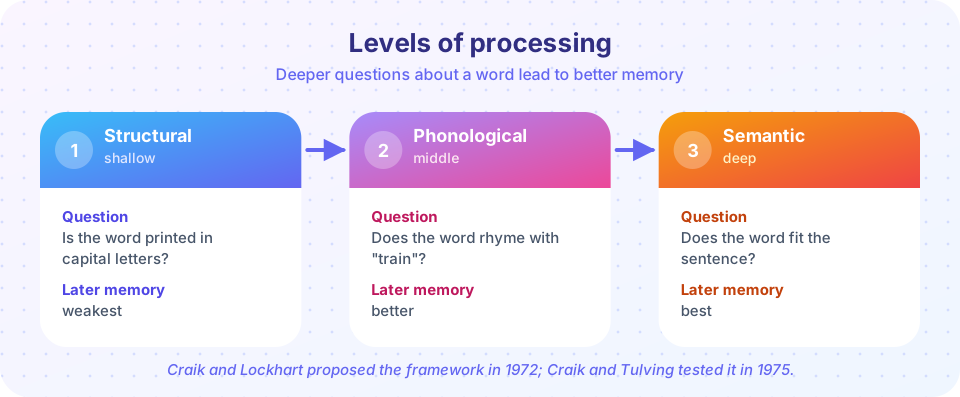
Fergus Craik and Robert Lockhart (1972) proposed that memory is a by-product of processing. Shallow, structural processing (is the word in capital letters?) leaves a weak trace. Phonological processing (does it rhyme with "train"?) leaves a better one. Deep, semantic processing (does the word fit in this sentence?) leaves the best. In a classic test, Craik and Tulving (1975) had people answer such questions about words and then run a recognition test. Words processed semantically were recognized far more often, even though people did not know a memory test was coming. That last point is important: intentional learning is not necessary, but deep processing is.
The framework has been criticized as circular, since "depth" is hard to define independently of the memory result, and later work refined it. What survives is a practical lesson: thinking about meaning helps.
Several techniques are cases of deep, rich encoding:
- Elaboration. Linking an item to knowledge you already have, or explaining why a fact is true, builds more retrieval routes.
- Self-reference. Rogers, Kuiper and Kirker (1977) found that deciding whether a word describes you produced better memory than other semantic judgments.
- Imagery and dual coding. Allan Paivio argued that concrete words are remembered better because they can be stored both verbally and as images.
- Organization. Material arranged into categories or hierarchies is recalled better than a random list. The method of loci, placing items mentally along a familiar route, uses spatial organization.
Retrieval: the cue has to fit the trace
A memory can be present and still fail to come to mind. Endel Tulving and Donald Thomson (1973) proposed encoding specificity: a cue works to the extent that it matches information stored with the item. In their experiments a target such as "cold" was studied beside a weak cue such as "ground". Later, a strong associate of the target ("hot") was a worse cue than the weak cue "ground" that had actually been present at study. Words that people failed to recognize in a list could even be recalled with the right cue. This led to the idea that "forgetting" is often failure of cues, not loss.
Context works the same way. In a famous study, Duncan Godden and Alan Baddeley (1975) had divers learn word lists either on land or underwater. Words were recalled best when the recall setting matched the learning setting. Effects of context-dependent memory are real but modest, and they are often much weaker for recognition tests or when people can reinstate the context mentally. There are also state-dependent effects, where mood or physiological state at recall matches that at learning, again modest and not always found. A related principle, transfer-appropriate processing (Morris, Bransford and Franks, 1977), says that memory is best when the processing at test resembles the processing at study. If your exam asks you to apply ideas, practice applying them.
Two retrieval experiences are worth naming. Recall (produce the answer) is harder than recognition (pick the answer), because recognition supplies a cue. And in the tip-of-the-tongue state (Brown and McNeill, 1966) you know that you know a word and may recall its first letter or syllables, which shows that retrieval can be partial.
Study strategies that work
Two of the most solidly established findings in applied memory research are:
- The testing effect. Henry Roediger and Jeffrey Karpicke (2006) had students read prose passages and then either restudy them or take free recall tests. After five minutes, the restudy group did slightly better. After a week, the tested group clearly did better. Retrieval is not just measuring memory; it changes memory, and effortful retrieval helps more than easy retrieval. Feedback improves it further.
- The spacing effect. Distributing practice over time gives better retention than massing it, a finding that goes back to Ebbinghaus. Cepeda and colleagues (2006) reviewed hundreds of results and found that the best gap between sessions grows with the time you need to remember: roughly, the longer the target interval, the longer the best gap.
Both effects conflict with intuition, because rereading and cramming feel productive: material seems familiar. That feeling of fluency is a poor guide to how well something is learned, which is why many students underuse testing and spacing. A related idea, desirable difficulties (Robert Bjork), says that conditions that make learning feel harder, such as spacing, testing and mixing topics, often yield better long-term results.
Common misconceptions
"Rereading and highlighting are the best ways to study." They feel good but produce weaker long-term retention than retrieval practice and spacing.
"Different people have different 'learning styles' and learn best when taught in their style." Reviews have found little evidence that matching instruction to a preferred style improves learning.
"If a memory fails, it is gone." Often the trace is present but the cue does not match.
Try it
Press Run (or Ctrl + Enter) to see the result here.
Program input · what you'd type while the program runs
Type the answers before you press Run, one per line. Each time the program reads a line (with input()), it gets the next line from this box.
Check your understanding
Quick check · 5 questions
of 5 answered You scored / 5 · perfect!
-
1. Which question produces the deepest processing of a word?
Semantic questions lead to richer, better-remembered traces. -
2. Encoding specificity says that a retrieval cue works best when it
A cue is effective to the extent that it overlaps with the stored trace. -
3. In Godden and Baddeley's diver study, words were recalled best when
Matching context at study and test improved recall. -
4. Roediger and Karpicke (2006) found that after one week, students who had taken recall tests
Restudying looked better at 5 minutes, but retrieval practice was better after a week. -
5. The spacing effect states that
Distributed practice generally produces better long-term retention.
Summary
- Deep, meaningful processing (levels of processing, elaboration, self-reference, organization) strengthens encoding.
- Encoding specificity and context effects show that retrieval depends on matching cues, and many "forgotten" items are still stored.
- Testing yourself and spacing study sessions work better than rereading and cramming, even though they feel harder.
- Fluency is a poor guide to learning: feeling familiar is not the same as being able to recall.
Track your progress
Create a free account to tick off lessons and pick up where you left off on any device.
of Cognitive Psychology lessons completed