


















Lesson 39 of 50 · Reasoning, Judgment and Decision Making
Chapter 7 Review: Reasoning, Judgment and Decision Making
Review heuristics and biases, logic and the Wason task, Bayes and natural frequencies, prospect theory and framing with a summary picture, recap table and ten-question quiz.
This chapter compared human thinking with the standards of logic, probability and expected utility. People turned out to be good at fast, approximate judgments, systematically fallible in predictable ways, and highly sensitive to the way problems are described. This page pulls the chapter into one picture and one table, then tests all four lessons.
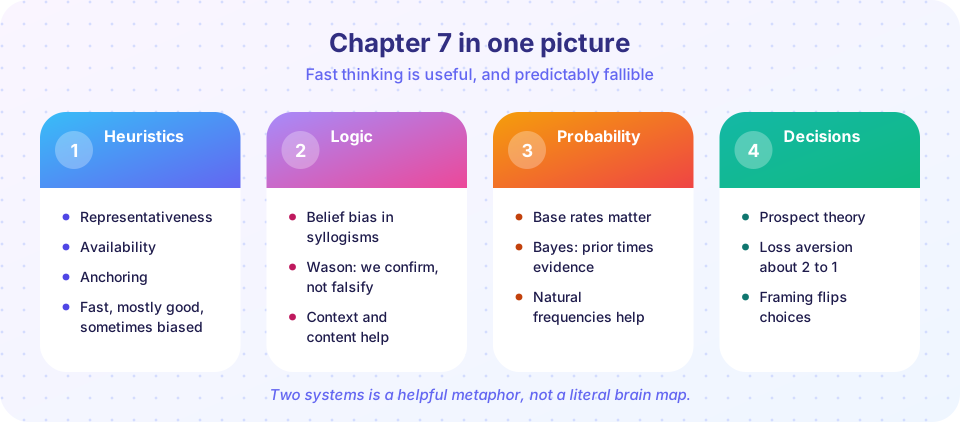
What you will review
- Representativeness, availability, anchoring and attribute substitution.
- Conditional reasoning, belief bias, the Wason and 2-4-6 tasks.
- Bayes' rule, base rates and natural frequencies.
- Expected utility, prospect theory, framing and defaults.
Recap table
| Topic | Key findings | Names |
|---|---|---|
| Representativeness | Base-rate neglect, conjunction fallacy (Linda) | Kahneman and Tversky 1973; Tversky and Kahneman 1983 |
| Availability | Ease of recall guides frequency judgments | Tversky and Kahneman 1973; Lichtenstein et al. 1978 |
| Anchoring | Random numbers pull estimates (25 versus 45) | Tversky and Kahneman 1974 |
| Fast and frugal | Heuristics can be ecologically rational; format matters | Gigerenzer; Hertwig and Gigerenzer 1999 |
| Conditional reasoning | Modus ponens easy, modus tollens hard, fallacies tempting | many |
| Belief bias | Believability affects judged validity | Evans, Barston and Pollard 1983 |
| Wason selection task | Confirmation, content effects, social contracts | Wason 1966; Griggs and Cox 1982; Cosmides 1989 |
| 2-4-6 task | Positive test strategy hides errors | Wason 1960 |
| Bayes | Posterior from prior and likelihood; 1% prevalence gives about 8% | Eddy 1982; Gigerenzer and Hoffrage 1995 |
| Prospect theory | Reference dependence, loss aversion, weighting | Kahneman and Tversky 1979; 1992 |
| Framing | 72% versus 22% choosing the sure option | Tversky and Kahneman 1981 |
| Choice architecture | Defaults, endowment effect, nudges | Johnson and Goldstein 2003; Kahneman, Knetsch and Thaler 1990; Thaler and Sunstein 2008 |
Try it
Press Run (or Ctrl + Enter) to see the console output here.
No output.
Check your understanding
Quick check · 10 questions
of 10 answered You scored / 10 · perfect!
-
1. Which judgment is an example of the conjunction fallacy?
A conjunction cannot be more probable than either of its parts. -
2. Anchoring is best described as
Estimates stay biased toward the initial value, even a random one. -
3. Which pair of cards correctly tests 'if a card has a vowel, it has an even number' for cards E, K, 4, 7?
Only a vowel with an odd number would break the rule. -
4. In the 2-4-6 task, a better strategy is to
Disconfirming tests can reveal that a hypothesis is too narrow. -
5. A rare condition and a decent test combine to produce
The large healthy group yields more false positives than the small sick group yields true positives. -
6. Natural frequencies improve Bayesian reasoning because
Counts out of a fixed group align with how we learn from experience. -
7. Loss aversion implies that
The value function is steeper for losses. -
8. The Allais paradox contradicts
The common choice pair A and D is inconsistent with any utility function. -
9. Which finding supports a framing effect?
The Asian disease problem shows a reversal of preference. -
10. Which statement best summarizes the research on heuristics?
Both the heuristics-and-biases and the ecological views are needed.
Summary
- Representativeness, availability and anchoring are efficient shortcuts that cause predictable errors.
- Logic problems show confirmation tendencies, content effects and belief bias.
- Base rates matter; natural frequencies and trees improve Bayesian reasoning.
- Prospect theory explains framing, loss aversion and defaults, and nudges apply it.
Track your progress
Create a free account to tick off lessons and pick up where you left off on any device.
of Cognitive Psychology lessons completed