


















Lesson 24 of 50 · Memory Systems
Long-Term Memory Systems
Explore episodic, semantic and procedural memory, priming, patient H.M., the serial position curve and consolidation, with a simulated rehearsal model and a classifier.
You can recall your last birthday, you know that Paris is the capital of France, you can still ride a bicycle after years without one, and a word you saw a minute ago feels easier to read. All four count as long-term memory, yet they behave differently and depend on different parts of the brain. The strongest evidence that they are separate systems comes from people who lose one and keep the others. This lesson maps the systems and shows the evidence.
What you will learn
- The main long-term memory systems and how they are classified.
- What patient H.M. revealed about the hippocampus and memory systems.
- How the serial position curve supports a distinction between short- and long-term stores.
- What consolidation means and how long memories can last.
Key terms
Declarative (explicit) memory: memory you can consciously recall and state, including episodic and semantic memory.
Nondeclarative (implicit) memory: memory shown through performance, including skills, priming and conditioning.
Anterograde amnesia: difficulty forming new long-term memories after an injury.
Retrograde amnesia: loss of memories from before the injury.
Consolidation: the process that stabilizes a new memory over time.
A taxonomy of long-term memory
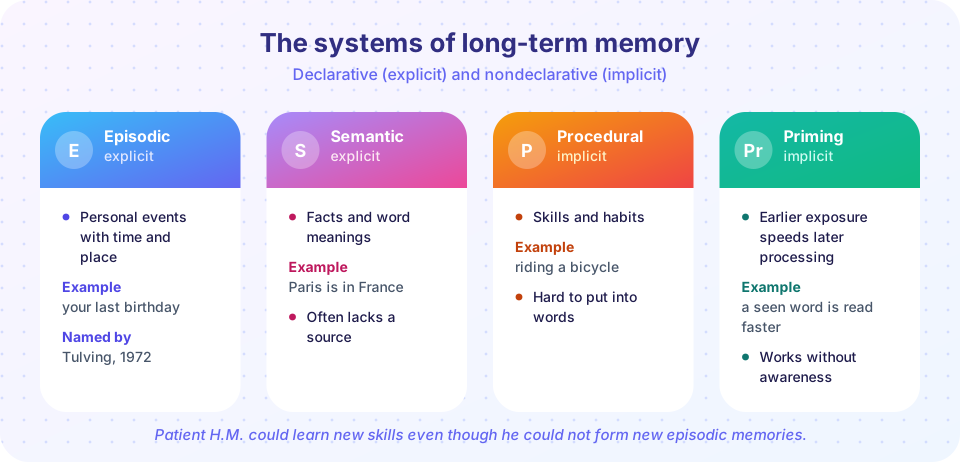
Endel Tulving (1972) distinguished episodic memory (events experienced at a particular time and place, remembered with a feeling of mentally reliving them) from semantic memory (general knowledge, facts and meanings, usually without remembering when you learned them). You may know that the Moon orbits the Earth (semantic) without having any memory of the day you learned it, and you can remember your first day at a new school (episodic) as a scene.
Larry Squire's influential scheme groups episodic and semantic memory as declarative (explicit) memory and contrasts them with nondeclarative (implicit) memory:
- Procedural memory: skills and habits, such as riding a bicycle, typing or playing scales. They improve with practice and are hard to describe in words.
- Priming: a change in processing because of earlier exposure, such as reading a word faster after seeing it, even if you do not remember seeing it.
- Classical conditioning: learned associations, such as a startle to a sound that preceded a shock.
The scheme is a working map. Researchers still argue about whether episodic and semantic memory are really separate systems or two ends of a continuum, and about whether implicit and explicit memory are truly independent. But the dissociations, cases where one is lost and the other kept, give the scheme its force.
Patient H.M.
In 1953, at age 27, Henry Molaison (known for decades as H.M.) had surgery to relieve severe epilepsy. The surgeon removed tissue from both medial temporal lobes, including most of the hippocampus. Brenda Milner and William Scoville (1957) described the result: H.M.'s seizures improved, but he could no longer form new episodic and semantic memories. This is severe anterograde amnesia. He also lost some memories of the years just before surgery, but his childhood memories were largely intact.
What he could still do is the scientific gold. His working memory was normal (he could repeat digits right after hearing them), his intelligence and language were largely preserved, and he learned new skills. In mirror drawing, tracing a star while seeing only its reflection, he improved over days, even though each day he insisted he had never done the task before (Milner, 1962). He also showed priming. His case provided strong evidence that:
- the hippocampus and nearby tissue are needed to form new declarative memories;
- short-term storage and long-term storage are separate;
- procedural learning and priming rely on other brain systems.
Later studies of H.M. and other patients refined these claims, including debates about how far semantic learning is possible without a hippocampus, but the basic dissociations have held up.
The serial position curve
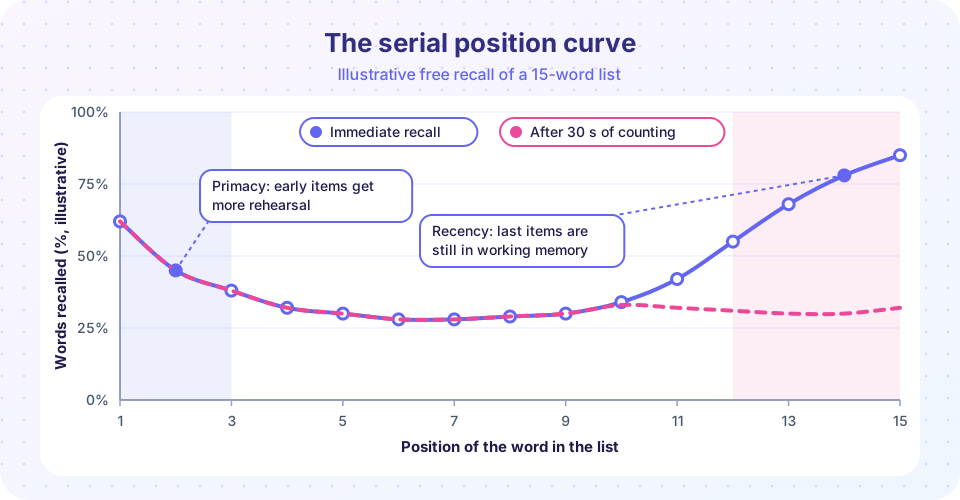
When people hear a list of words and then recall them in any order (free recall), the chance of recall depends on position in the list. The first few words are well recalled (primacy effect) and the last few are very well recalled (recency effect), while the middle words are recalled worst. Bennet Murdock (1962) documented the curve; Glanzer and Cunitz (1966) showed that the two ends behave differently. If recall is delayed by 30 seconds of counting, the recency effect vanishes while primacy remains. Slowing the list presentation improves primacy but not recency.
The usual explanation is the two-store account. Early items get more rehearsal and so enter long-term memory (primacy). The last items are still in short-term memory and can be dumped out first (recency). Counting backward flushes the short-term store. This account is not the whole story: recency effects also appear over long delays in some experiments (for instance, rugby players recalling matches), which suggests that recency can reflect more general distinctiveness of recent items.
Consolidation and how long memories last
New memories are fragile and become more stable with time, a process called consolidation. Sleep seems to help it, and damage to the hippocampus soon after learning disrupts recent memories more than old ones. Memories can nevertheless last extraordinarily long: Harry Bahrick (1984) tested people who had studied Spanish at school and found that, after an initial decline over about three to six years, a core of knowledge stayed stable for 25 years or more, a pattern he called permastore.
Common misconceptions
"Memory is one thing in one place." Different systems depend on different brain regions, as H.M. showed.
"If you cannot remember learning something, you did not learn it." Implicit learning and priming show effects without awareness.
"Long-term memory is a permanent perfect record." Memories can be forgotten and reconstructed (see the next lessons).
Try it
Press Run (or Ctrl + Enter) to see the result here.
Program input · what you'd type while the program runs
Type the answers before you press Run, one per line. Each time the program reads a line (with input()), it gets the next line from this box.
Press Run (or Ctrl + Enter) to see the console output here.
No output.
Check your understanding
Quick check · 5 questions
of 5 answered You scored / 5 · perfect!
-
1. Patient H.M. could not form new episodic memories but could improve at mirror drawing. This suggests that
Skill learning survived hippocampal removal, so it depends on other systems. -
2. Which item is semantic memory?
Semantic memory holds facts and meanings, usually without a sense of when they were learned. -
3. After 30 seconds of backward counting, the serial position curve typically shows
Counting flushes the short-term store (recency) while long-term storage (primacy) remains. -
4. Anterograde amnesia is difficulty with
'Anterograde' refers to the period after the injury. -
5. Bahrick's permastore refers to
Well-learned school knowledge, such as Spanish, was retained for 25 years or more after the early decline.
Summary
- Long-term memory has declarative (episodic, semantic) and nondeclarative (procedural, priming, conditioning) parts.
- Patient H.M. showed that the medial temporal lobe is needed for new declarative memories, while working memory, skills and priming can survive.
- The serial position curve (primacy and recency) supports a distinction between long-term and short-term stores, though recency has other causes too.
- Consolidation stabilizes memories, and well-learned knowledge can last for decades.
Next: Encoding and Retrieval
Track your progress
Create a free account to tick off lessons and pick up where you left off on any device.
of Cognitive Psychology lessons completed