


















Lesson 17 of 50 · Perception and Pattern Recognition
Chapter 4 Overview: Perception and Pattern Recognition
How the mind turns light into objects and meaning: sensation, organization, recognition and interpretation, constancy, illusions, and the chapter's lesson map.
Look at a coffee cup on a desk. In a fraction of a second you know what it is, where it is, how far away, which way the handle faces and roughly how heavy it is. Yet at the start of that process there is nothing but patterns of light falling on the back of your eyes, in a flat, upside-down, constantly shifting image. Perception is the set of processes that organize and interpret sensory information to produce a useful model of the world. This chapter focuses mostly on vision, the best-studied sense, and on pattern recognition: deciding what something is.
What you will learn
- The difference between sensation and perception.
- The main steps from light to recognized objects.
- Why perception is an active inference, and why illusions are informative.
- What each lesson in this chapter covers.
From sensation to perception
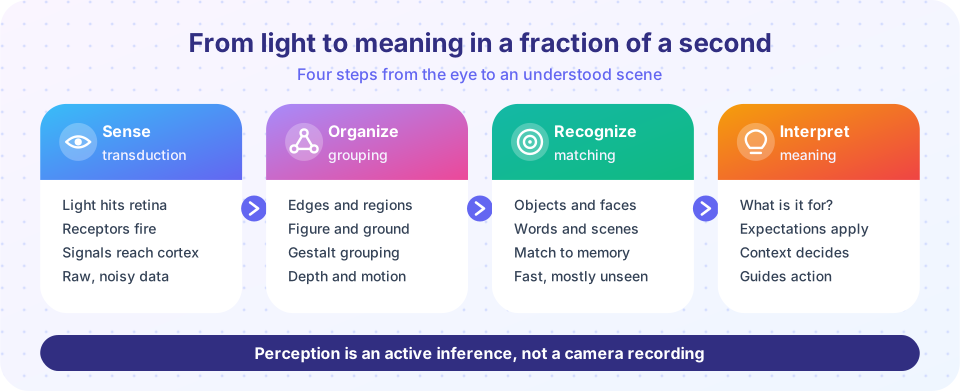
Sensation is the detection of physical energy by receptor cells and the passing of signals to the brain. In the eye, light is focused on the retina, which contains about 120 million rods (sensitive to dim light, no color) and about 6 million cones (color and fine detail, concentrated in the central fovea). This conversion of light to neural signals is transduction.
Perception is what the brain does next: grouping edges into surfaces, separating objects from background, estimating depth, recognizing familiar things and giving them meaning. Two ideas capture the challenge.
- The inverse problem. The same retinal image could be produced by many possible worlds (a small near object or a large far one). The brain must pick the most probable interpretation, using assumptions about how the world usually is.
- Constancy. Retinal images change drastically as an object moves or the light changes, yet you perceive stable objects. A white shirt in shadow still looks white (lightness constancy); a door seen at an angle still looks rectangular (shape constancy); a person walking away does not seem to shrink (size constancy).
Two streams
Visual information from the primary visual cortex flows into two broad pathways. Leslie Ungerleider and Mortimer Mishkin (1982) described a ventral stream ("what": object identity) running down toward the temporal lobe, and a dorsal stream ("where") running up toward the parietal lobe. David Milner and Melvyn Goodale (1992) refined the dorsal stream as "how": vision for guiding action. Their evidence included a patient, D.F., who after brain damage could not report the orientation of a slot but could post a card through it accurately. The streams are strongly interconnected in healthy people, so the distinction is a useful simplification.
Illusions as windows
Illusions are not mere tricks. They are cases where the visual system's useful assumptions produce a wrong answer, which reveals what those assumptions are. In the Müller-Lyer illusion, two equal lines look different in length because of the arrowheads at their ends. A common explanation is that the arrowheads resemble corners in 3D scenes, and the visual system treats the line as nearer or farther. Whether or not the explanation is complete, the illusion shows that perception is not a measurement of the image.
The big picture
Sense
Organize
Recognize
Interpret
What each lesson covers
| Lesson | What it covers |
|---|---|
| Bottom-Up and Top-Down Processing | Gibson versus Helmholtz, context effects (the word superiority effect), expectations and illusions |
| Gestalt Grouping and Figure-Ground | Proximity, similarity, closure, continuity, figure-ground and why grouping happens early |
| Object and Face Recognition | Template, feature and structural theories, geons, the view problem, faces and the fusiform area |
| Chapter 4 Review | One-page summary and a ten-question quiz |
Try it
Check your understanding
Quick check · 3 questions
of 3 answered You scored / 3 · perfect!
-
1. Transduction is
Receptor cells transduce light (or sound, pressure) into neural signals. -
2. Size constancy means
The brain compensates for distance, so a person walking away does not seem to shrink. -
3. The ventral stream is mainly associated with
The ventral 'what' pathway runs toward the temporal lobe and supports object identity.
Summary
- Sensation detects energy; perception organizes and interprets it, solving an inverse problem with assumptions about the world.
- Constancies keep objects stable despite changing images.
- Two visual streams support knowing what things are and acting on them.
- Illusions reveal the assumptions the visual system uses.
- The chapter moves from top-down and bottom-up processing through grouping to object and face recognition.
Track your progress
Create a free account to tick off lessons and pick up where you left off on any device.
of Cognitive Psychology lessons completed