


















Lesson 22 of 50 · Memory Systems
Chapter 5 Overview: Memory Systems
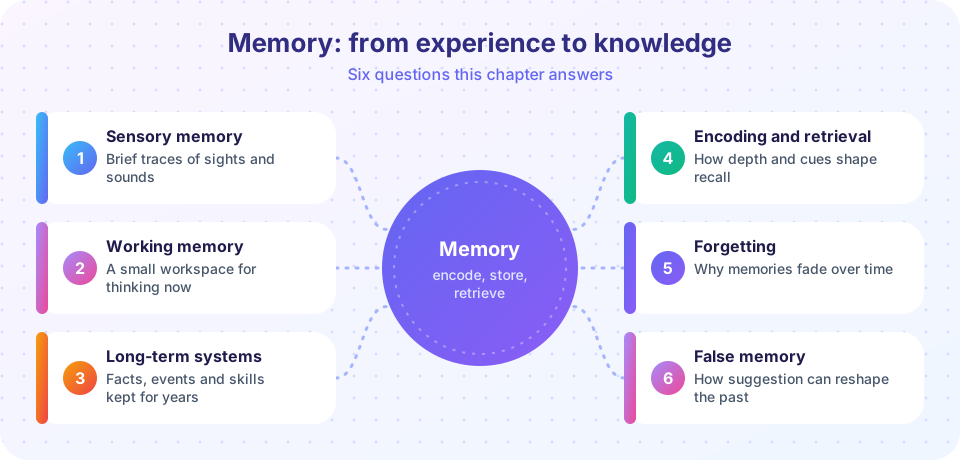
Preview the memory chapter: sensory and working memory, long-term systems, encoding and retrieval, forgetting and false memory, with the big picture and a lesson map.
You remember your own name, the way home, how to ride a bicycle and what you ate yesterday, and each of those feels like "memory". Yet they depend on different mental machinery, and some of them survive when others are lost. This chapter takes memory apart, shows what each part does, and explains why remembering is often a reconstruction rather than a replay. It is also the chapter with the most practical payoff: what cognitive psychologists have learned about memory can change how you study.
What you will learn
- The big picture: the stages of memory and why psychologists speak of several systems.
- The main ideas and names you will meet in each lesson of the chapter.
- Why the same memory can be strong in one test and absent in another.
- How this chapter connects to attention, knowledge and decision making.
Key terms
Encoding: turning an experience into a form the memory system can store.
Storage: keeping information over time.
Retrieval: bringing stored information back to mind.
Working memory: the limited-capacity system that holds and manipulates information for the task at hand.
Long-term memory: the large, durable store of facts, events and skills.
The big picture
Almost every theory in this chapter describes three jobs: encode, store, retrieve. A failure to remember can happen at any of them. You may never have encoded the information (you did not pay attention), it may have faded or been overwritten in storage, or it may be stored but out of reach because the available cues do not match. Treating "forgetting" as a single thing is one of the most common mistakes in everyday thinking about memory.
The oldest influential framework is the multi-store model of Richard Atkinson and Richard Shiffrin (1968). Input first enters a brief sensory store, attention carries a part of it into short-term memory, and rehearsal and meaningful processing move some of it into long-term memory. The model is a useful map, but later work changed it in two important ways. Alan Baddeley and Graham Hitch (1974) showed that short-term memory is better described as an active working memory with several parts, not a simple waiting room. And Endel Tulving, Larry Squire and others showed that long-term memory is not one store either: remembering an event, knowing a fact and performing a skill rely on different systems and different brain regions.
A second theme is reconstruction. In 1932 Frederic Bartlett argued that remembering is rebuilt from fragments plus general knowledge, and modern work on false memories, led by Elizabeth Loftus, strongly supports that view. A memory can feel vivid and certain and still be partly wrong.
Three jobs of memory
Forgetting can fail at any of the three.
Short-term stores
Long-term systems
What helps
What distorts
Confidence is not the same as accuracy.
What each lesson covers
| Lesson | Central question | Key names |
|---|---|---|
| Working Memory | How do we hold information while we use it? | Sperling, Miller, Baddeley and Hitch, Cowan |
| Long-Term Memory Systems | What kinds of long-term memory are there? | Tulving, Squire, Milner and H.M. |
| Encoding and Retrieval | What makes remembering more likely? | Craik, Tulving, Roediger |
| Forgetting and False Memory | Why do memories fade and change? | Ebbinghaus, Loftus, Roediger and McDermott |
| Chapter Review | Can you connect all of it? | all of the above |
How this chapter connects
Attention (chapter 3) decides what gets encoded at all, so poor attention is the most common cause of "forgetting" something you never really learned. Working memory is also the workspace where reasoning happens, so chapter 7 leans on it. The knowledge structures in chapter 6, such as concepts and schemas, are what long-term memory is made of. And the methods you learned in chapter 2 matter here, because many memory claims depend on carefully controlled experiments with free recall, recognition and reaction times.
Try it
Press Run (or Ctrl + Enter) to see the console output here.
No output.
Check your understanding
Quick check · 4 questions
of 4 answered You scored / 4 · perfect!
-
1. In the multi-store model of Atkinson and Shiffrin, information moves from
The model describes a flow from a brief sensory store, through attention into short-term memory, and with rehearsal into long-term memory. -
2. Which pair of terms best describes two different failures of memory?
Information may never have been encoded, or it may be stored but not retrievable with the available cues. -
3. Baddeley and Hitch's main change to the multi-store model was to describe short-term memory as
They proposed working memory with a central executive and separate subsystems. -
4. Bartlett's view that remembering is reconstruction means that
Reconstruction does not mean memory is useless; it means details can be filled in or altered.
Summary
- Memory involves encoding, storage and retrieval, and forgetting can occur at any stage.
- The multi-store model gave a map; working memory and multiple long-term systems refined it.
- Remembering is reconstructive, so vivid memories can still be wrong.
- This chapter covers working memory, long-term systems, encoding and retrieval, and forgetting and false memory.
Next: Working Memory
Track your progress
Create a free account to tick off lessons and pick up where you left off on any device.
of Cognitive Psychology lessons completed