


















Lesson 48 of 50 · Projects and Practice
Glossary of Key Terms
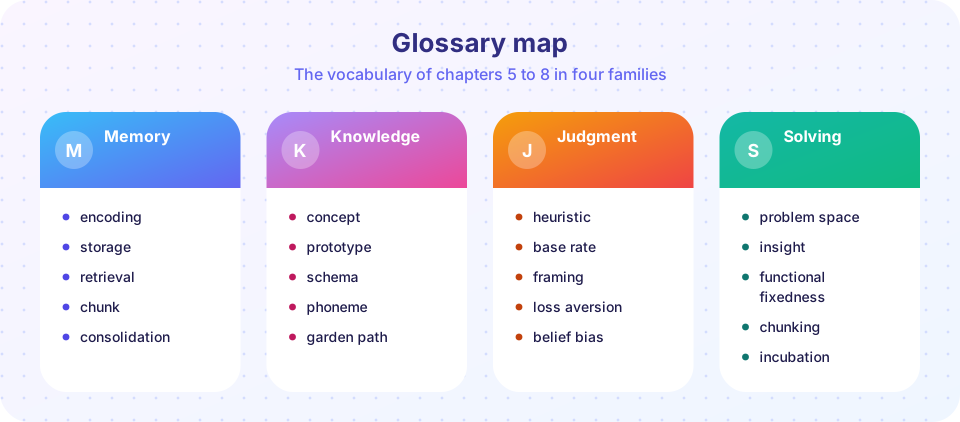
A glossary of about 90 key terms in cognitive psychology, grouped by topic: methods, attention, perception, memory, knowledge and language, judgment and problem solving.
Cognitive psychology has a large vocabulary, and each term packs a finding or an idea into a word. This glossary groups about ninety terms by topic with one-line definitions. Use it as a checklist: cover the right-hand column, say each definition aloud, then check. Terms are listed in the order you meet them, not alphabetically.
What you will learn
- The meaning of the core terms of the course in one line each.
- How the terms cluster into families of ideas.
- How to use the list for retrieval practice.
Key terms
Cognition: the mental processes of perceiving, attending, remembering, reasoning and using language.
Theory: an explanation that organizes findings and makes testable predictions.
Dependent variable: the outcome that is measured in an experiment.
Operational definition: a concrete way of measuring an abstract concept.
Methods and architecture
| Term | Definition |
|---|---|
| Information processing | Describing the mind as a system that takes in, transforms and outputs information |
| Mental chronometry | Using reaction times to infer the timing of mental stages |
| Independent variable | What the researcher manipulates |
| Control condition | A comparison condition without the manipulation |
| Random assignment | Placing participants into conditions by chance |
| Dissociation | One ability damaged while another is spared |
| Cognitive architecture | A theory of the structures and processes that make up the mind |
Attention and perception
| Term | Definition |
|---|---|
| Selective attention | Focusing on some information while ignoring the rest |
| Cocktail party effect | Following one voice among many; noticing one's own name in an ignored channel |
| Bottleneck | A processing stage that can handle only one task at a time |
| Stroop effect | Slower naming of ink color when the word names a different color |
| Feature search | Finding a target defined by one feature; it pops out |
| Conjunction search | Finding a target defined by a combination of features; search is slower |
| Inattentional blindness | Failing to notice an unexpected object while attention is elsewhere |
| Change blindness | Failing to notice a change in a scene |
| Bottom-up processing | Perception driven by the stimulus |
| Top-down processing | Perception driven by knowledge and expectation |
| Gestalt principles | Rules of grouping such as proximity, similarity and closure |
Memory (chapter 5)
| Term | Definition |
|---|---|
| Encoding | Turning experience into a storable form |
| Storage | Keeping information over time |
| Retrieval | Bringing stored information to mind |
| Iconic memory | A brief visual trace lasting about a second |
| Working memory | A limited system that holds and manipulates information in use |
| Central executive | The attention-controlling component of working memory |
| Phonological loop | The speech-based store with rehearsal |
| Visuospatial sketchpad | The store for images and locations |
| Episodic buffer | A component binding information into integrated episodes |
| Chunk | A meaningful unit holding several smaller items |
| Memory span | The longest list repeated correctly right away |
| Episodic memory | Memory for personal events in time and place |
| Semantic memory | General knowledge and word meanings |
| Procedural memory | Skills and habits |
| Priming | Faster processing after earlier exposure |
| Anterograde amnesia | Inability to form new long-term memories |
| Primacy and recency | Better recall of the first and last items in a list |
| Consolidation | Stabilization of a new memory over time |
| Levels of processing | Deeper meaning-based processing produces better memory |
| Encoding specificity | Cues work best when they match the encoding context |
| Testing effect | Retrieval strengthens memory more than restudying |
| Spacing effect | Spaced study beats massed study for retention |
| Proactive and retroactive interference | Old learning disrupts new, and new disrupts old |
| Misinformation effect | Later information alters memory reports of an earlier event |
| Source monitoring | Judging where a memory came from |
Knowledge and language (chapter 6)
| Term | Definition |
|---|---|
| Concept | A mental representation of a category |
| Prototype | A summary or best example of a category |
| Exemplar | A stored instance of a category |
| Family resemblance | Overlapping features with none shared by all members |
| Basic level | The most informative and commonly used level of categories |
| Spreading activation | Activation of one concept passing to related ones |
| Lexical decision | Deciding quickly whether a string of letters is a word |
| Schema | An organized package of knowledge about a kind of situation |
| Script | A schema for a routine event sequence |
| Phoneme | The smallest sound unit that distinguishes words |
| Categorical perception | Hearing a continuum of sounds as distinct categories |
| Cohort model | Word recognition by narrowing a set of candidates as sounds arrive |
| Parsing | Assigning grammatical structure to a sentence |
| Garden path sentence | A sentence that invites a wrong parse needing revision |
| Situation model | A mental representation of the described situation |
| N400 | A brain response larger for words that do not fit their context |
| Lemma | The abstract word entry before its sounds are chosen |
| Linguistic relativity | The idea that language can influence thought |
Judgment and decision making (chapter 7)
| Term | Definition |
|---|---|
| Heuristic | A fast rule of thumb that usually works |
| Representativeness | Judging by resemblance to a category |
| Availability | Judging by how easily examples come to mind |
| Anchoring | Insufficient adjustment from a starting value |
| Base rate | How common something is in the population |
| Conjunction fallacy | Judging a combination as more probable than one component |
| Attribute substitution | Answering an easier question in place of the hard one |
| Belief bias | Judging an argument by how believable its conclusion is |
| Confirmation bias | Seeking or favoring evidence that supports a belief |
| Posterior probability | Probability after considering the evidence |
| Natural frequencies | Information expressed as counts of people or cases |
| Loss aversion | A loss weighs more than an equal gain |
| Reference point | The status quo against which outcomes are judged |
| Framing effect | Choices change with the wording of equivalent options |
| Endowment effect | Valuing something more once you own it |
Problem solving and expertise (chapter 8)
| Term | Definition |
|---|---|
| Problem space | States, operators and a goal |
| Means-ends analysis | Reducing the difference between state and goal with subgoals |
| Insight | A sudden restructuring of a problem |
| Functional fixedness | Seeing an object only in its usual role |
| Mental set | A habit of using a previously successful method |
| Analogical transfer | Using a known solution on a new problem |
| Chunking | Grouping information into familiar units |
| Deliberate practice | Effortful practice targeting weaknesses, with feedback |
| Power law of practice | Performance time falls as a power function of practice |
| Incubation | A break from a problem that may help later solution |
| Divergent thinking | Generating many different ideas |
| Production blocking | Group members waiting to speak, losing ideas |
| Metacognition | Knowledge about and monitoring of your own thinking |
| Illusion of explanatory depth | Feeling you understand something until you try to explain it |
Try it
Press Run (or Ctrl + Enter) to see the console output here.
No output.
Check your understanding
Quick check · 4 questions
of 4 answered You scored / 4 · perfect!
-
1. Which term means 'judging by how easily examples come to mind'?
Availability uses ease of recall as a cue for frequency. -
2. A schema for a routine sequence of events is called a
Scripts organize knowledge of events such as visiting a restaurant. -
3. Production blocking refers to
It is the main reason real brainstorming groups underperform. -
4. The N400 is a brain response that is larger for
It reflects difficulty integrating a word with its context.
Summary
- The vocabulary falls into families: methods, attention and perception, memory, knowledge and language, judgment and decisions, problem solving.
- Each term compresses a finding or an idea; knowing the name helps you recall the evidence.
- Use the list for retrieval practice rather than rereading.
Track your progress
Create a free account to tick off lessons and pick up where you left off on any device.
of Cognitive Psychology lessons completed