


















Lesson 27 of 50 · Memory Systems
Chapter 5 Review: Memory Systems
Review working memory, long-term systems, encoding, retrieval, forgetting and false memory with a summary picture, a recap table and a ten-question quiz.
Memory is not one ability but a set of systems that encode, store and retrieve information in different ways, and that rebuild the past rather than replay it. This page pulls the chapter into one picture and one table, then tests all five lessons.
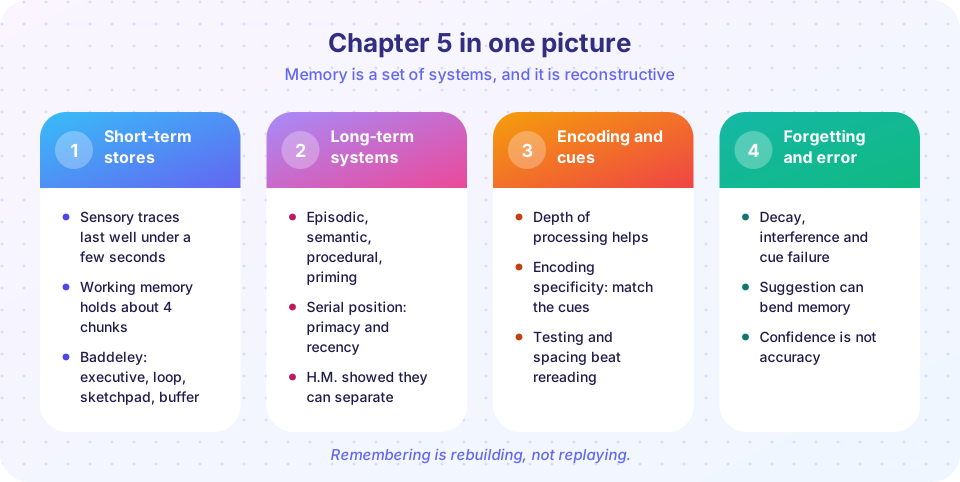
What you will review
- Sensory memory, working memory and Baddeley's model.
- Episodic, semantic, procedural and priming systems, and what H.M. showed.
- Levels of processing, cues, testing and spacing.
- Forgetting mechanisms, misinformation and false memory.
Recap table
| Topic | Key findings | Names |
|---|---|---|
| Sensory memory | Large, lasts about a second; partial report reveals it | Sperling 1960 |
| Working memory | Executive, phonological loop, sketchpad, episodic buffer | Baddeley and Hitch 1974; Baddeley 2000 |
| Capacity | About 7 in span tasks; about 4 chunks at the core | Miller 1956; Cowan 2001 |
| Long-term systems | Episodic, semantic, procedural, priming | Tulving 1972; Squire |
| H.M. | New declarative memories lost; skills and working memory spared | Scoville and Milner 1957 |
| Serial position | Primacy (long-term), recency (short-term) | Murdock 1962; Glanzer and Cunitz 1966 |
| Encoding | Deep, meaningful processing wins | Craik and Lockhart 1972 |
| Retrieval | Cues must match the trace; context helps a little | Tulving and Thomson 1973; Godden and Baddeley 1975 |
| Study methods | Testing and spacing beat rereading and cramming | Roediger and Karpicke 2006; Cepeda 2006 |
| Forgetting | Steep early loss; interference; cue failure | Ebbinghaus 1885; Tulving and Pearlstone 1966 |
| Distortion | Misinformation, false events, DRM lures, flashbulb errors | Loftus 1974, 1995; Roediger and McDermott 1995; Neisser and Harsch 1992 |
Try it
Press Run (or Ctrl + Enter) to see the console output here.
No output.
Check your understanding
Quick check · 10 questions
of 10 answered You scored / 10 · perfect!
-
1. Sperling's partial report method showed that sensory memory
Cued reports from any row were nearly perfect, so most letters were briefly available. -
2. The word-length effect supports which component?
The loop holds about what can be said in two seconds. -
3. Which is the best example of procedural memory?
Skills and habits are procedural. -
4. H.M.'s case is strongest evidence that
Spared skills, working memory and priming show that these rely on other systems. -
5. Delaying recall by 30 seconds with counting removes
Counting empties the short-term store. -
6. Craik and Tulving's (1975) results are explained by
Semantic questions led to better later recognition. -
7. After a week, students who took retrieval tests typically recalled
The testing effect grows with delay. -
8. Cue-dependent forgetting means that a forgotten item
Category cues in Tulving and Pearlstone's study raised recall. -
9. In the DRM procedure, the critical lure is
People often falsely report the lure, because it fits the gist. -
10. Which statement about flashbulb memories is best supported?
Neisser and Harsch found large changes with high confidence.
Summary
- Memory has several systems with different properties, and brain-injury cases show they can separate.
- Deep processing, matching cues, testing and spacing help; rereading and cramming mislead us with fluency.
- Forgetting is often cue failure or interference, not erasure.
- Memories are reconstructed, so confidence is not a guarantee.
Track your progress
Create a free account to tick off lessons and pick up where you left off on any device.
of Cognitive Psychology lessons completed