


















Lesson 6 of 50 · Methods and Cognitive Architecture
Chapter 2 Overview: How We Study the Mind
A map of the methods of cognitive psychology: behavioral experiments, neuroscience techniques, patient studies and computational models, and when to use each.
If the mind is a vending machine you cannot open, then method is everything. A good method turns a vague question ("does distraction hurt memory?") into something that can be measured and checked by another lab. This chapter introduces the main methods of cognitive psychology and the models that make theories precise. It is the toolbox that the rest of the course draws from, so even if you plan to skip ahead, the vocabulary here will make Chapters 3 to 8 much easier.
What you will learn
- The four families of method used in the field and what each can and cannot show.
- Why researchers rarely trust a single method and look for converging evidence.
- What each lesson of this chapter covers.
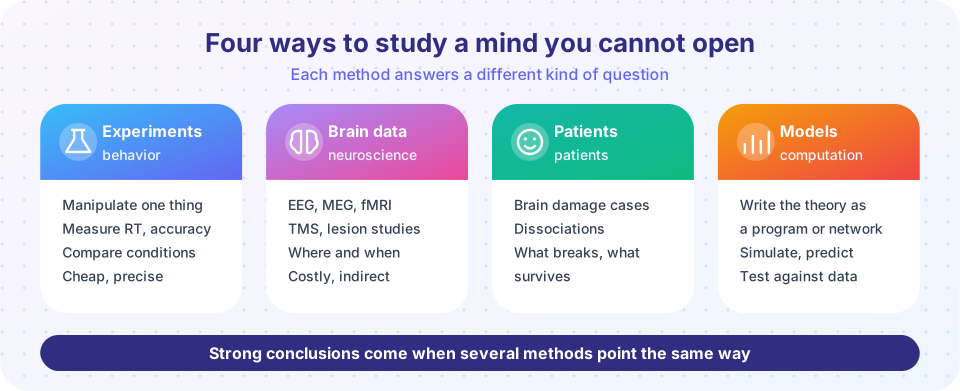
The big picture
Behavioral experiments
The workhorse of the field
Brain methods
Where and when, never why on their own
Patients
Computational models
Why more than one method?
Every method has a blind spot.
- Behavior is cheap and precise but says nothing about where in the brain something happens.
- Neuroimaging shows where and when, but a region lighting up does not by itself show that it is necessary for a task.
- Patients with brain damage show what is necessary, but the damage is rarely clean, and brains reorganize after injury.
- A model can capture a theory exactly, but a model that fits does not show the theory is true.
When several methods point to the same conclusion, confidence rises. This is called converging evidence, and you will see it again and again: the theory that attention filters information early, for example, is supported by behavior, by EEG and by patient data, and also challenged by each in specific ways.
What each lesson covers
| Lesson | What it covers |
|---|---|
| Reaction Times and Mental Chronometry | Measuring the speed of mental processes; the shape of RT data; speed-accuracy trade-offs; Donders and additive factors |
| Experimental Design and Statistics | Independent and dependent variables, confounds, within- and between-subject designs, and what statistics do and do not tell you |
| Cognitive Neuroscience Methods | EEG, MEG, fMRI, PET, TMS and lesion studies; time and space resolution |
| Computational Models and Cognitive Architectures | Symbolic, connectionist and Bayesian models; what a good model must do |
| Chapter 2 Review | One-page summary and a ten-question quiz |
Try it
Press Run (or Ctrl + Enter) to see the console output here.
No output.
Check your understanding
Quick check · 3 questions
of 3 answered You scored / 3 · perfect!
-
1. Which method is best for finding out whether a region is necessary for a function?
Disrupting a region and seeing whether the function fails tests necessity; activation alone is correlational. -
2. Converging evidence means
Different methods have different blind spots, so agreement across them is strong support. -
3. Which method is generally best at telling when something happens?
EEG and MEG resolve events to the millisecond.
Summary
- Four method families exist: behavioral experiments, brain methods, patient studies and computational models.
- Each has strengths and blind spots; converging evidence gives the best conclusions.
- This chapter covers timing, design, brain methods and models, then reviews them.
Track your progress
Create a free account to tick off lessons and pick up where you left off on any device.
of Cognitive Psychology lessons completed