


















Lesson 36 of 50 · Reasoning, Judgment and Decision Making
Logic and Reasoning
Study conditional and syllogistic reasoning, belief bias, the Wason selection and 2-4-6 tasks, social contracts and mental models, with a hypothesis-testing demo.
"If it rains, the match is cancelled. The match was not cancelled. So it did not rain." Most people find that conclusion easy, yet many fail the very next step of similar reasoning. Deductive reasoning asks what must be true if the premises are true, and it is the standard test of whether people can follow a rule. The results are surprising: people are good at some forms of logic, poor at others, and strongly affected by what the content is about.
What you will learn
- The basic forms of conditional reasoning and the common fallacies.
- What the belief bias shows about content and logic.
- What the Wason selection task and the 2-4-6 task reveal about confirmation.
- Competing explanations: social contracts, mental models and probabilistic accounts.
Key terms
Deductive reasoning: a conclusion follows with certainty if the premises are true.
Valid argument: one whose conclusion must be true if the premises are.
Modus ponens and modus tollens: valid forms "if p then q; p; so q" and "if p then q; not q; so not p".
Confirmation bias: seeking or favoring evidence that supports a hypothesis.
Mental model: a representation of a possible situation, used in reasoning.
Conditional reasoning
A conditional "if p then q" supports four inferences.
| Form | Reasoning | Valid? | How people do |
|---|---|---|---|
| Modus ponens | if p then q; p; so q | Yes | Nearly everyone gets it |
| Modus tollens | if p then q; not q; so not p | Yes | Much harder |
| Affirming the consequent | if p then q; q; so p | No | Often accepted |
| Denying the antecedent | if p then q; not p; so not q | No | Often accepted |
Two fallacies are common because, in everyday talk, "if" is often read as "if and only if". "If you finish your food you can have dessert" suggests that if you do not finish, you cannot. Everyday content makes the fallacies tempting and the valid modus tollens strangely hard.
Syllogisms and belief bias
A categorical syllogism has two premises and a conclusion, such as "All A are B; All B are C; so all A are C." Jonathan Evans, Julie Barston and Paul Pollard (1983) crossed logical validity with believability. People accepted valid conclusions that were believable most often, and rejected invalid unbelievable ones most often, but they also accepted many invalid believable conclusions and rejected many valid unbelievable ones. Content leaks into the logic: this is belief bias. The effect is stronger for invalid arguments, and people who reason more carefully show it less. Belief bias shows that people use knowledge to evaluate arguments, which is a sensible habit in life and a problem in a logic test.
The Wason selection task
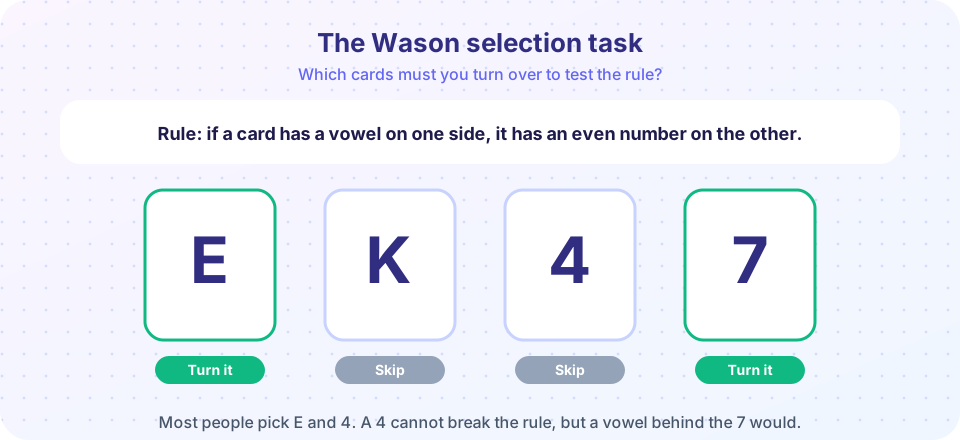
Peter Wason (1966) designed a task that has become the most studied in the field. Four cards each have a letter on one side and a number on the other. You see E, K, 4 and 7. The rule: if a card has a vowel on one side, it has an even number on the other. Which cards must you turn over to test whether the rule is true?
The right answer is E and 7. The E could have an odd number behind it, and the 7 could have a vowel behind it, and either would break the rule. K is irrelevant, because the rule says nothing about consonants. The 4 cannot break the rule: whether it has a vowel or consonant behind it, the rule is not violated. Typically only about one person in ten finds the right pair. Most choose E alone or E and 4, which tests whether the rule is confirmed and not whether it can be falsified.
Content matters. The same logical structure becomes easy when it is about a familiar rule. Richard Griggs and James Cox (1982) used a rule about drinking: "If a person is drinking beer, then that person must be over 19." Cards showed a drink on one side and an age on the other: "beer", "cola", "22 years", "16 years". Most people correctly turned over "beer" and "16 years". Explanations include:
- Pragmatic reasoning schemas (Cheng and Holyoak, 1985): we have general knowledge structures for permissions and obligations.
- Social contract theory (Leda Cosmides, 1989): human reasoning includes a specialized ability to detect cheaters in social exchanges ("if you take the benefit, you must pay the cost"). Critics note that reasoning about permissions and obligations may be explained more simply.
- Probabilistic accounts (Oaksford and Chater): people choose the cards that give the most information, given that p and q are usually rare, not the cards that matter for strict logic.
The 2-4-6 task: testing hypotheses
Wason (1960) gave participants the triple 2, 4, 6 and told them that it follows a rule they must discover. They could propose triples and be told whether each fits. Most people quickly guessed "add 2" or "even numbers increasing by two" and tested triples like 8, 10, 12 and 20, 22, 24, all of which fit. They announced the wrong rule confidently. The real rule was any ascending sequence. To discover it, one must test triples that the hypothesis says should not fit, such as 1, 2, 3 or 6, 4, 2. People mostly use a positive test strategy, which seeks cases that fit the hypothesis. This is not always irrational, but when the hypothesis is too narrow, it hides the error. Karl Popper's view that science progresses by trying to falsify theories is a deliberate correction to this habit.
Mental models
Philip Johnson-Laird proposed that people reason by building mental models of possible situations that the premises describe, and checking whether a conclusion holds in all of them. Problems that need one model are easy and those that need several are hard and error-prone, as the human working memory is limited. Mental model theory predicts illusions in which an inference seems valid but is not, and it connects reasoning to the working-memory limits of chapter 5. Alternatives include rule-based accounts and probabilistic accounts, and research increasingly supports the idea that ordinary reasoning is sensitive to uncertainty: people use "if" as a statement of conditional probability more often than as a strict logical connective.
Common misconceptions
"Reasoning problems measure intelligence only." Performance also depends on content, wording and willingness to think reflectively.
"People are irrational because they fail the Wason task." The abstract task is atypical; with familiar rules, performance is much better.
"Confirmation bias means people never change their minds." It is a tendency to test hypotheses with positive cases and to weight supporting evidence, which can be reduced by training and by seeking disconfirmation.
Try it
Press Run (or Ctrl + Enter) to see the result here.
Program input · what you'd type while the program runs
Type the answers before you press Run, one per line. Each time the program reads a line (with input()), it gets the next line from this box.
Check your understanding
Quick check · 5 questions
of 5 answered You scored / 5 · perfect!
-
1. Which conditional inference is invalid?
Affirming the consequent is a fallacy, since q could be true for other reasons. -
2. Belief bias is the tendency to
Evans, Barston and Pollard (1983) found that content affects acceptance of valid and invalid syllogisms. -
3. In the Wason selection task with the rule 'if vowel then even', the correct cards are
Only E and 7 could reveal a vowel paired with an odd number. -
4. In the 2-4-6 task, most participants fail because they
A positive test strategy never exposes a rule that is broader than the hypothesis. -
5. The drinking-age version of the selection task is easier because
Pragmatic schemas or social-contract reasoning direct attention to possible violations.
Summary
- People handle modus ponens easily, struggle with modus tollens and often accept affirming the consequent and denying the antecedent.
- Belief bias shows that content affects logical evaluation.
- The Wason task and the 2-4-6 task reveal a confirmation tendency; familiar rules, schemas and social contracts make reasoning easier.
- Mental models and probabilistic accounts explain why some problems are hard and why everyday "if" is rarely strict logic.
Next: Probability and Bayes
Track your progress
Create a free account to tick off lessons and pick up where you left off on any device.
of Cognitive Psychology lessons completed