


















Lesson 7 of 47 · Defining and Classifying Disorders
What Is Abnormal? Defining Abnormality
Compare statistical, social norm, dysfunction and ideal mental health definitions of abnormality, the four Ds, harmful dysfunction and the role of culture.
Imagine three people. One hears a voice at night, comforting, speaking in the dead grandmother's tone, a few weeks after her funeral. One is so good at chess that she plays at an international level. One washes his hands until they bleed. Which is "abnormal"? Most people would pick the third, a few would argue about the first, and nobody would call the second a disorder, though she is statistically the rarest. Each way of defining abnormality catches some cases and mislabels others. Clinicians therefore combine several criteria and add judgment about context.
What you will learn
- Four classic definitions of abnormality and their strengths and weaknesses.
- The four Ds: deviance, distress, dysfunction and danger.
- Wakefield's harmful-dysfunction idea.
- How culture and context change what counts as abnormal.
Key terms
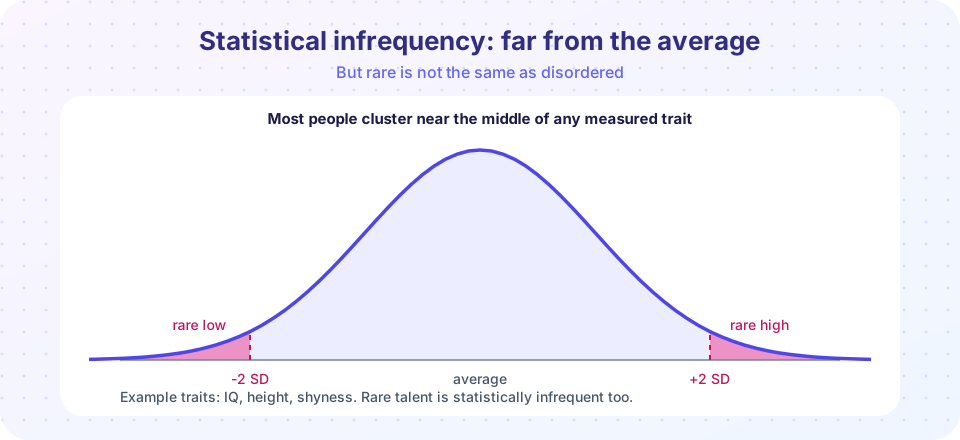
Statistical infrequency: defining abnormal as rare, usually more than two standard deviations from the mean.
Social norm: an unwritten rule about acceptable behavior in a group.
Dysfunction: impairment in daily living, such as work, relationships or self-care.
Cultural relativism: the view that behavior must be judged within its own culture.
Culture-bound syndrome: an older term for a pattern of distress found mainly in particular cultures; DSM-5 prefers "cultural concepts of distress".
Four classic definitions
1. Statistical infrequency. Many traits, such as height or IQ, follow a roughly bell-shaped curve. On a measure with mean 100 and standard deviation 15, a score below 70 (more than two SDs below the mean) is found in roughly 2 percent of people. This is objective and measurable, but arbitrary (why two SDs?) and it flags desirable rarity, such as genius, while missing common problems. Depression and anxiety are common, yet they cause real suffering.
2. Deviation from social norms. Behavior that breaks the unwritten rules of a society seems abnormal. This definition captures why odd behavior alarms us. But norms vary by place and time, and they can be misused. Historically, behavior such as same-sex attraction or political dissent has been labelled disordered. In 1851 the American physician Samuel Cartwright invented "drapetomania", a supposed illness that made enslaved people run away, a notorious example of social bias disguised as medicine.
3. Failure to function adequately. Rosenhan and Seligman (1989) suggested signs such as personal distress, maladaptive behavior, unpredictability, irrationality, observer discomfort and violation of moral standards. Functional impairment is central to clinical practice: Can the person work, study, maintain relationships and look after themselves? The weakness is that some people function well while suffering, and some function poorly because of poverty or discrimination, not disorder.
4. Deviation from ideal mental health. Marie Jahoda (1958) proposed criteria for positive mental health: a positive attitude to the self, personal growth, autonomy, accurate perception of reality, mastery of the environment and resistance to stress. It reminds us that health is more than the absence of illness. But the ideal is so demanding that almost everyone would fall short, and it reflects Western values on independence.
The four Ds
Clinicians often use a combination, summarized as four Ds.
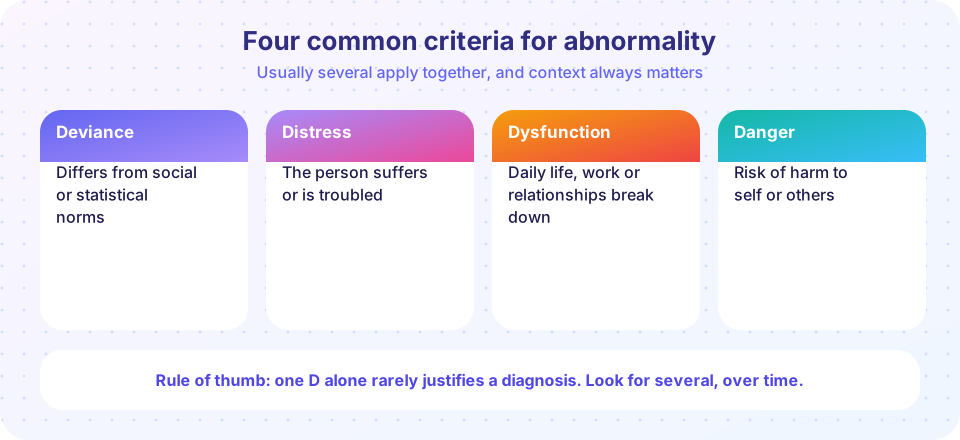
- Deviance from norms, statistical or social.
- Distress felt by the person (or others).
- Dysfunction in daily life.
- Danger to self or others.
Consider the chess prodigy: deviant, but no distress, dysfunction or danger. Now consider a woman who is terrified of leaving home: distress and dysfunction, perhaps without deviance from any norm. Using several criteria, and requiring duration and severity, reduces mistakes.
Harmful dysfunction
The philosopher Jerome Wakefield (1992) proposed that a disorder is a harmful dysfunction. "Dysfunction" means that an internal mechanism fails to do what evolution designed it to do (a factual, scientific part), and "harmful" means the failure causes harm as judged by society's values (a value part). Grief after bereavement is painful, but it is the mechanism working as designed, so it is not a disorder. Wakefield's view has been criticized because we rarely know the evolved function of psychological mechanisms, but it neatly shows that definitions mix facts and values.
Culture and context
Every definition above depends on a context. A few examples:
- Hearing the voice of a dead relative is a normal part of mourning in many cultures and can be a comforting experience, which is why the DSM includes cultural context in assessing psychosis.
- Cultural concepts of distress. Ataque de nervios in Latin American communities involves intense emotional outbursts, trembling and a feeling of losing control, often after a stressful event. Taijin kyofusho in Japan involves a fear of offending others by one's appearance or actions. Dhat syndrome in South Asia involves anxiety about semen loss. DSM-5 (2013) added a Cultural Formulation Interview to help clinicians ask how patients understand their problems.
- Research bias. Most psychological research has used samples from Western, educated, industrialized, rich and democratic (WEIRD) societies (Henrich, Heine and Norenzayan, 2010). Findings from such samples may not generalize.
The lesson is not that everything is relative. Severe psychosis, depression and suicidality are recognized in every culture studied. The lesson is that expression, meaning and acceptability vary, and clinicians must ask rather than assume.
Common misconceptions
"Abnormal means statistically rare." Rarity can mean talent. Many serious disorders are common.
"Abnormal behavior is always visible to others." Many people with serious distress look fine on the outside.
"If a behavior is normal in a culture it can never be a problem." Some culturally accepted practices still harm people, and some disorders occur everywhere. Context informs judgment but does not replace it.
Try it
The first demonstration computes how much of a bell-shaped distribution lies beyond a cutoff. Change cutoff to see how a stricter or looser rule changes who is "statistically abnormal".
Press Run (or Ctrl + Enter) to see the result here.
Program input · what you'd type while the program runs
Type the answers before you press Run, one per line. Each time the program reads a line (with input()), it gets the next line from this box.
The second demonstration is a vignette scorer for the four Ds. It adds up which criteria apply and prints a note. It is a thinking exercise: real assessments involve far more.
Press Run (or Ctrl + Enter) to see the console output here.
No output.
Check your understanding
Quick check · 5 questions
of 5 answered You scored / 5 · perfect!
-
1. What is a weakness of defining abnormality as statistical infrequency?
Rarity alone does not tell us whether something is harmful. -
2. Which of these are the four Ds?
They are common criteria used together. -
3. Wakefield's harmful dysfunction analysis says a disorder requires
It combines a factual part (dysfunction) and a value part (harm). -
4. Why is hearing a dead loved one's voice not automatically psychosis?
DSM includes cultural context when assessing psychotic-like experiences. -
5. What does WEIRD stand for in research on samples?
Henrich, Heine and Norenzayan (2010) showed most samples come from WEIRD societies.
Summary
- Statistical, social-norm, functional and ideal-health definitions each help and each fail.
- The four Ds combine deviance, distress, dysfunction and danger.
- Wakefield's harmful dysfunction mixes a factual and a value judgment.
- Culture shapes expression and meaning; core severe conditions appear worldwide.
Track your progress
Create a free account to tick off lessons and pick up where you left off on any device.
of Abnormal and Clinical Psychology lessons completed