


















Lesson 36 of 47 · Assessment and Therapy Approaches
Chapter 7 Review: Assessment and Therapy Approaches
Review chapter 7 with a one-picture summary, a recap table and ten mixed questions on assessment, CBT, other therapies, common factors and medication.
You now have a map of how clinicians assess problems and the major ways they try to help. This review puts it together: a single picture, a table you can scan before an exam, and ten mixed questions that jump between lessons the way real clinical reasoning does.
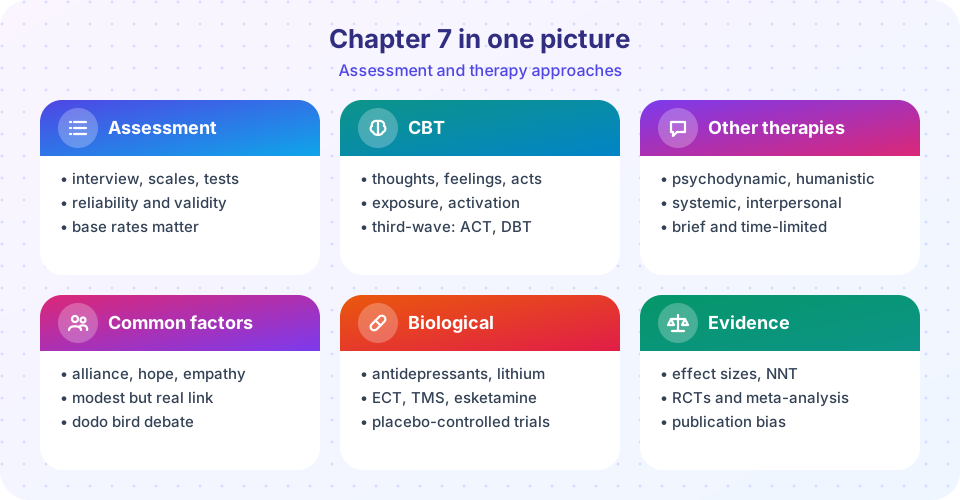
Recap table
| Topic | Key facts | Landmark names |
|---|---|---|
| Interview and MSE | Semi-structured interviews (SCID-5, MINI) improve agreement; the MSE describes the person now | |
| Rating scales | PHQ-9 range 0 to 27 with bands at 5, 10, 15, 20; GAD-7 range 0 to 21 | Kroenke, Spitzer |
| Tests | MMPI has validity scales; Rorschach evidence is mixed; Wechsler mean 100, SD 15 | Hathaway and McKinley, Rorschach |
| Base rates | Even 90 percent sensitive and specific tests give about 8 percent PPV at 1 percent prevalence | |
| Behavior therapy | Conditioning, counterconditioning, exposure, ERP | Watson, Jones, Wolpe |
| Cognitive therapy | Cognitive triad, automatic thoughts, thought records | Beck, Ellis |
| Third wave | ACT, DBT, MBCT | Hayes, Linehan, Teasdale |
| Other families | Psychodynamic, humanistic, systemic, interpersonal | Freud, Rogers, Minuchin, Klerman |
| Common factors | Alliance correlates about 0.28 with outcome; the dodo bird verdict | Wampold, Flückiger |
| Medication | Antidepressants, antipsychotics, lithium, benzodiazepines | Cipriani, Cade |
| Stimulation | ECT, TMS, DBS, esketamine | Cerletti and Bini |
| Evidence | RCTs, placebo, effect size, NNT = 1 / risk difference | Smith and Glass |
Try it
The demonstration below combines two ideas from the chapter: the base-rate problem (lesson 2) and the number needed to treat (lesson 5). Change the numbers to see how the answers move.
Press Run (or Ctrl + Enter) to see the console output here.
No output.
Check your understanding
Quick check · 10 questions
of 10 answered You scored / 10 · perfect!
-
1. Which tool is a semi-structured diagnostic interview?
The SCID-5 follows set questions and probes; PHQ-9 is a rating scale and the Wechsler scales are cognitive tests. -
2. A test has 90 percent sensitivity and specificity. If the condition affects 1 in 100 people, about what share of positive results are true?
Of 10,000 people, 90 true positives and 990 false positives give about 8 percent. -
3. Which pair fits Beck's cognitive triad?
The cognitive triad describes the negative thinking pattern in depression. -
4. Which technique rests on gradually facing feared cues without avoidance?
Exposure (including ERP for OCD) is built on extinction and inhibitory learning. -
5. Which approach emphasizes empathy, congruence and unconditional positive regard?
Carl Rogers's conditions for growth are central to person-centered therapy. -
6. What is the dodo bird verdict?
It is an observation about similar average outcomes, which common factors may explain. -
7. The correlation between therapeutic alliance and outcome in the Flückiger meta-analysis was about...
About 0.28 across nearly 300 studies. -
8. Who first described the effect of lithium on mania, in 1949?
John Cade, an Australian psychiatrist, reported it in 1949. -
9. If 45 percent respond to a treatment and 40 percent to placebo, the NNT is...
NNT = 1 divided by 0.05 = 20. -
10. Why is a placebo-controlled randomized trial important?
Random assignment and a comparison group separate treatment effects from time and expectation.
Summary
- Assessment combines several sources; scales and tests inform, but do not replace, clinical judgment.
- Base rates, reliability and validity decide whether a measure is useful.
- CBT, psychodynamic, humanistic, systemic and interpersonal therapies all have evidence; common factors such as the alliance are important.
- Medicines and brain stimulation help many people, and trial evidence (effect sizes, NNT, placebo controls) is how we judge them.
Next: Chapter 8 overview: prevention, ethics and mental health systems
Track your progress
Create a free account to tick off lessons and pick up where you left off on any device.
of Abnormal and Clinical Psychology lessons completed