


















Lesson 46 of 47 · Projects and Practice
Cheat Sheet: Chapters 5 to 9 on One Page
A one-page recap of chapters 5 to 9: key criteria, numbers, landmark studies and formulas for psychosis, neurodevelopment, personality, therapy and systems.
This page condenses chapters 5 to 9 into one picture and a short list of formulas. Use it the night before an exam, or as a quick orientation when you meet a topic in reading. Everything here is explained in detail in the lessons; if a line puzzles you, follow the link.
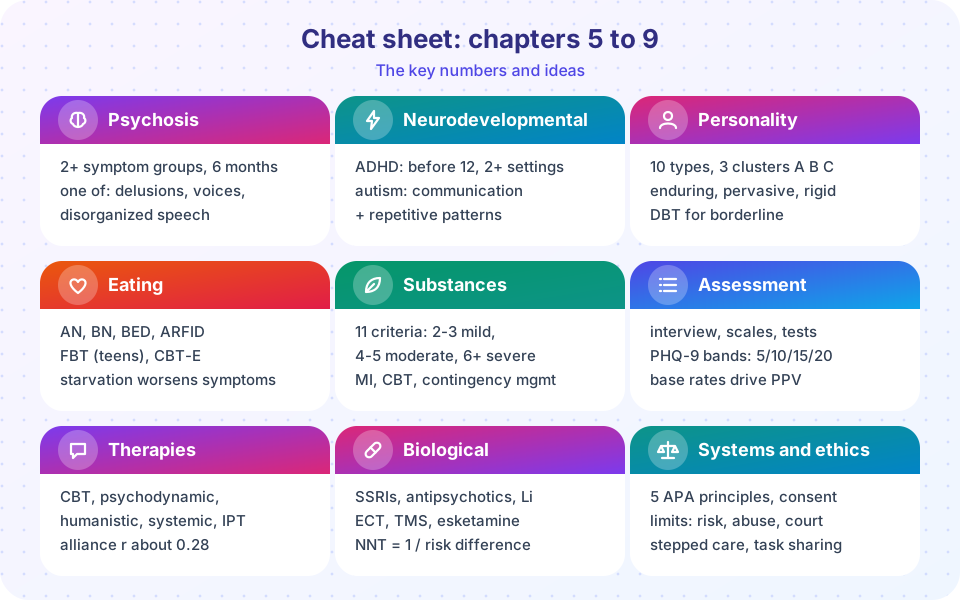
Time rules and counts to remember
| Rule | Value |
|---|---|
| Schizophrenia | 2 or more symptom groups (one of delusions, hallucinations, disorganized speech); at least 6 months of disturbance including 1 month of active symptoms |
| Schizophreniform / brief psychotic | 1 to under 6 months / 1 day to under 1 month |
| ADHD | 6 or more symptoms (5 from age 17), 6 months, several before age 12, in 2 or more settings |
| Autism | Social-communication differences plus restricted, repetitive patterns, from early development |
| Personality disorders | 10 types in clusters A, B, C; onset by early adulthood |
| Borderline | 5 of 9 criteria (256 combinations) |
| Bulimia and binge-eating disorder | Binges at least weekly for 3 months |
| Substance use disorder | 11 criteria: 2 to 3 mild, 4 to 5 moderate, 6 or more severe |
| PHQ-9 bands | 0-4, 5-9, 10-14, 15-19, 20-27 |
Formulas
- Sensitivity = true positives / all with the condition. Specificity = true negatives / all without it.
- PPV = true positives / all positives. It depends on prevalence.
- Youden's J = sensitivity + specificity - 1.
- NNT = 1 / (response rate treated - response rate control).
- Cohen's d = difference between means / pooled standard deviation. 0.2 small, 0.5 medium, 0.8 large.
- Falconer's heritability estimate = 2 x (identical twin correlation - non-identical twin correlation).
- Sample size per group (two groups, 5% level, 80% power) = 2 x (1.96 + 0.84)² / d².
- Cohen's kappa = (observed agreement - chance agreement) / (1 - chance agreement).
Landmark names
Kraepelin and Bleuler (schizophrenia), Gottesman (twin and family risk), Zubin and Spring (stress-vulnerability), Linehan (DBT), Keys (starvation study), Berridge and Robinson (wanting and liking), Beck and Ellis (cognitive therapy), Rogers (person-centered therapy), Cipriani (antidepressant meta-analysis), Rose (prevention paradox), Werner and Smith (Kauai resilience), Tarasoff (duty to protect), Chibanda (Friendship Bench).
Try it
The first demonstration collects several formulas in one place so you can check your own calculations. The second computes Cohen's kappa, which measures agreement between two raters beyond chance.
Press Run (or Ctrl + Enter) to see the console output here.
No output.
Press Run (or Ctrl + Enter) to see the result here.
Program input · what you'd type while the program runs
Type the answers before you press Run, one per line. Each time the program reads a line (with input()), it gets the next line from this box.
Check your understanding
Quick check · 3 questions
of 3 answered You scored / 3 · perfect!
-
1. How many criteria for substance use disorder make it 'severe'?
Two or three is mild, four or five moderate and six or more severe. -
2. What is the formula for the number needed to treat?
NNT = 1 / absolute risk difference. -
3. Which landmark study showed that many anorexia-like symptoms appear in healthy volunteers who are starved?
Keys and colleagues found food preoccupation, depression and withdrawal in healthy men on restricted diets.
Summary
- Keep the time rules, counts and formulas in this table at your fingertips.
- Link each landmark name to a finding and a lesson.
- Use code to check your calculations, and follow the lesson links when a line is unclear.
Next: Further study
Track your progress
Create a free account to tick off lessons and pick up where you left off on any device.
of Abnormal and Clinical Psychology lessons completed