


















Lesson 33 of 47 · Assessment and Therapy Approaches
Cognitive-Behavioral Therapies: From Conditioning to Mindfulness
Trace CBT from Pavlov and Little Albert to Beck and Ellis, learn exposure, behavioral activation and thought records, meet ACT and MBCT, and weigh the evidence.
Cognitive-behavioral therapy (CBT) is the most researched family of psychological treatments. Its core idea is simple and testable: the way we interpret situations and the things we do in response keep many emotional problems going, and changing them can relieve distress.
CBT grew from two traditions that were at first rivals. Behavior therapy applied learning theory, such as conditioning, to fears and habits. Cognitive therapy focused on thoughts and beliefs. By the 1980s they merged, and in the 2000s a "third wave" added acceptance and mindfulness.
Educational information only. This lesson describes methods used by trained therapists. It is not a self-help manual, and exposure work in particular should be done with professional guidance.
What you will learn
- Explain how classical and operant conditioning led to behavior therapy.
- Describe Beck's cognitive model and Ellis's ABC model.
- Name key techniques: exposure, behavioral activation, thought records, behavioral experiments.
- Describe the third wave: ACT, DBT and MBCT.
- Summarize the strength and limits of the evidence.
Key terms
- Cognitive distortion: a habitual thinking error, such as catastrophizing or all-or-nothing thinking.
- Automatic thought: a quick, often unnoticed thought that pops up in a situation.
- Exposure: facing feared situations or memories gradually and safely until fear decreases.
- Behavioral activation: scheduling rewarding and meaningful activities to lift mood.
- Homework: practice between sessions, a standard part of CBT.
Roots in conditioning
In 1920 John B. Watson and Rosalie Rayner conditioned an infant, "Little Albert", to fear a white rat by pairing it with a loud noise. The study is notorious for its ethics: Albert was never deconditioned. In 1924 Mary Cover Jones did the opposite with a boy called Peter who feared rabbits: she gradually brought a rabbit closer while he ate something he liked, a method called counterconditioning.
In the 1950s Joseph Wolpe developed systematic desensitization: the client builds a hierarchy of feared situations and imagines them step by step while relaxing. Later research suggested that the active ingredient is mainly exposure, which is why modern behavior therapy uses graded exposure directly. Two well-known versions are exposure and response prevention (ERP) for obsessive-compulsive disorder (clients face triggers without performing the compulsion) and prolonged exposure for post-traumatic stress.
Why does exposure work? A classic account is extinction: the learned link between a cue and fear weakens when the feared outcome does not occur. Newer inhibitory learning ideas (Michelle Craske, Mark Bouton) stress that extinction creates a new memory that competes with the old one, which is why fear can return and why varied practice helps. The simple model in the code below shows the first part of the story.
Beck's cognitive therapy
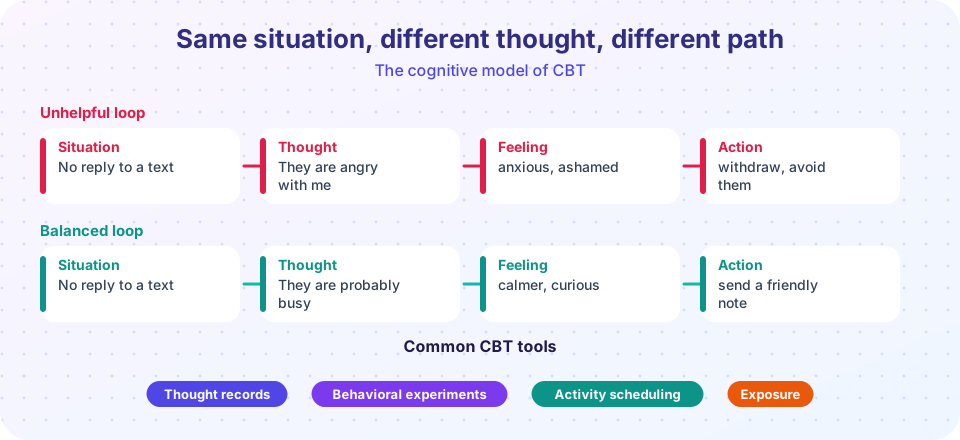
In the 1960s, psychiatrist Aaron T. Beck noticed that depressed patients often reported streams of negative thoughts. He proposed the cognitive triad: negative views of the self, the world and the future. These views arise from underlying beliefs, or schemas, and show up as automatic thoughts. Beck developed the Beck Depression Inventory (1961) and a structured therapy in which clients learn to catch thoughts, examine evidence for and against them and test alternatives.
Albert Ellis independently developed Rational Emotive Behavior Therapy (REBT) in 1955 with the ABC model: an Activating event leads to Beliefs, which lead to emotional and behavioral Consequences. Ellis argued that rigid "musts" ("I must always succeed") cause distress and should be disputed.
Common thinking errors include all-or-nothing thinking, catastrophizing, mind reading, overgeneralizing and emotional reasoning ("I feel it, so it must be true"). Naming them helps people step back, though the goal is not to think positively but to think more accurately.
The CBT toolkit
- Thought records. The client writes the situation, the automatic thought, the emotion and its strength, evidence for and against the thought and a balanced alternative.
- Socratic questioning. The therapist asks guiding questions ("What would you say to a friend in this position?") so the client finds new views rather than being told.
- Behavioral experiments. A belief is tested in real life: "If I speak up, people will laugh." The client predicts, tries and compares.
- Behavioral activation. Depressed people withdraw, which removes rewards and deepens low mood. Scheduling meaningful activities breaks the cycle. In a trial by Sona Dimidjian and colleagues (2006) it performed as well as antidepressant medication in severely depressed adults and compared well with full cognitive therapy.
- Graded exposure and response prevention for anxiety, phobias, OCD and PTSD.
- Session structure. An agenda, a review of homework, a focus on specific problems and feedback at the end.
The third wave
- Acceptance and Commitment Therapy (ACT). Developed by Steven Hayes and colleagues, ACT teaches people to notice thoughts and feelings without fusing with them, and to act on chosen values: "psychological flexibility" in place of battling thoughts.
- Dialectical behavior therapy (DBT). Marsha Linehan's blend of acceptance and change, covered in the personality disorders lesson.
- Mindfulness-based cognitive therapy (MBCT). Zindel Segal, Mark Williams and John Teasdale adapted mindfulness training to prevent depressive relapse. In a trial by Teasdale and colleagues (2000), people with three or more previous episodes had a lower relapse risk after MBCT, roughly one in three versus two in three over about a year.
How good is the evidence?
A review of 106 meta-analyses by Stefan Hofmann and colleagues (2012) found large effects of CBT for anxiety disorders, bulimia, anger problems and general stress, and moderate effects for many other conditions. Several cautions apply:
- Effects are usually larger against waiting lists than against active treatments, and often similar to other bona fide therapies.
- Studies show publication bias, and some analyses suggest that effects for depression have shrunk over time (Johnsen and Friborg, 2015).
- CBT works best when the person attends and practices. Dropout is common, and not everyone benefits.
- Guided internet-delivered CBT can work nearly as well as face-to-face therapy for several problems, which widens access.
Common misconceptions
"CBT just tells you to think positive." Good CBT is about accurate thinking and changed behavior, not forced optimism.
"CBT ignores the past." It focuses on the present but includes history when it explains current beliefs.
"CBT is a quick fix." Typical courses run 8 to 20 sessions and need practice between them.
Try it
The first demonstration is a simple learning model (Rescorla-Wagner, 1972) showing a fear response being acquired and then extinguished. It is a teaching model, not a patient simulation. The second is a click-through exercise on spotting thinking errors.
Press Run (or Ctrl + Enter) to see the result here.
Program input · what you'd type while the program runs
Type the answers before you press Run, one per line. Each time the program reads a line (with input()), it gets the next line from this box.
Check your understanding
Quick check · 5 questions
of 5 answered You scored / 5 · perfect!
-
1. What are the three parts of Beck's cognitive triad in depression?
Beck proposed that depressed people hold negative views about themselves, their world and their future. -
2. What does the ABC model in REBT stand for?
Ellis argued that beliefs about an event, more than the event itself, produce emotional consequences. -
3. Which technique schedules rewarding activities to lift mood?
Behavioral activation counters withdrawal by planning meaningful activities. -
4. In the extinction model, why does fear fall over trials?
When the cue appears without the feared outcome, the learned association is weakened. -
5. Which is a well-supported caution about CBT evidence?
Active comparators typically show smaller differences, and publication bias and dropout also matter.
Summary
- CBT grew from conditioning-based behavior therapy and Beck's and Ellis's cognitive models.
- Core tools include thought records, behavioral experiments, behavioral activation and graded exposure.
- The third wave (ACT, DBT, MBCT) adds acceptance and mindfulness.
- Evidence is strong for anxiety, OCD, PTSD and depression, with caveats about control conditions, bias and dropout.
Track your progress
Create a free account to tick off lessons and pick up where you left off on any device.
of Abnormal and Clinical Psychology lessons completed