


















Lesson 29 of 47 · Personality and Other Disorders
Substance Use Disorders: Criteria, Reward Circuits and Treatment
Learn the 11 DSM-5 criteria for substance use disorder, how dopamine and reward circuits drive use, what Vietnam-era studies showed, and which treatments work.
Alcohol, tobacco, cannabis, opioids, stimulants and other substances are woven into human culture. Most people who try them never develop a disorder. A substance use disorder is diagnosed when a person keeps using despite harm, and when control over use has been lost. It is a medical condition shaped by biology, psychology and social context, not a moral failing.
This lesson describes the DSM-5 criteria, the brain's reward circuits, factors that raise risk, and the treatments with the best evidence. It also covers behavioral addiction, with gambling disorder as the one recognized example.
Educational information only. If you or someone you know may be dependent on alcohol or other drugs, do not stop suddenly without medical advice: withdrawal from alcohol and some sedatives can be dangerous. Speak to a doctor or a local helpline.
What you will learn
- List the four groups of the 11 DSM-5 criteria and the severity bands.
- Explain the role of dopamine, "wanting" versus "liking" and the Koob and Volkow cycle.
- Describe risk factors, including genes, age of first use and environment.
- Summarize the Vietnam veterans study and what it tells us about context.
- Compare treatments: motivational interviewing, CBT, contingency management, medications and harm reduction.
Key terms
- Tolerance: needing more of a substance for the same effect, or a weaker effect from the same amount.
- Withdrawal: the symptoms that appear when use stops or falls sharply.
- Craving: a strong urge to use.
- Incentive salience: the quality that makes cues linked to a reward grab attention and drive wanting.
- Harm reduction: policies and practices that reduce the damage of drug use without requiring abstinence.
The DSM-5 criteria
DSM-5 (2013) merged the older categories of "abuse" and "dependence" into one substance use disorder with 11 criteria in four groups. The same criteria are applied to ten substance classes (alcohol, caffeine, cannabis, hallucinogens, inhalants, opioids, sedatives, hypnotics and anxiolytics, stimulants, tobacco and other), though caffeine has no use disorder diagnosis.
| Group | Criteria |
|---|---|
| Impaired control | Using more or for longer than intended; unsuccessful efforts to cut down; much time spent obtaining, using or recovering; craving |
| Social impairment | Failing to meet role obligations; continued use despite social problems; giving up important activities |
| Risky use | Use in physically hazardous situations; continued use despite physical or psychological problems caused or worsened by it |
| Pharmacological | Tolerance; withdrawal |
Severity depends on the count: 2 to 3 criteria is mild, 4 to 5 moderate and 6 or more severe. Tolerance and withdrawal do not count when a medicine is taken under proper medical supervision, which is why a person on prescribed opioids is not automatically dependent.
Gambling disorder moved into this chapter of DSM-5 because it activates reward systems like drugs. Internet gaming disorder appears in Section III as a condition for further study, while ICD-11 lists gaming disorder.
The brain's reward system
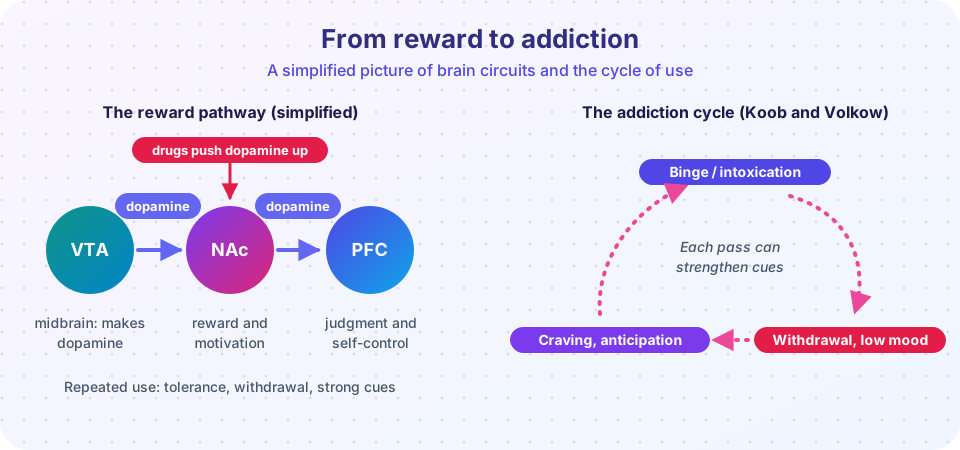
In 1954 James Olds and Peter Milner found that rats would press a lever hundreds of times an hour to receive electrical stimulation in certain brain areas, ignoring food. This pointed to a brain "reward" circuit. The mesolimbic dopamine pathway runs from the ventral tegmental area (VTA) in the midbrain to the nucleus accumbens, with links to the prefrontal cortex. Natural rewards such as food and social contact raise dopamine, and addictive drugs raise it more strongly or more quickly.
Kent Berridge and Terry Robinson (1993) drew an important distinction. Their incentive-sensitization theory says that dopamine drives wanting (the motivational pull toward a reward and its cues) more than liking (pleasure). With repeated use, wanting can grow stronger and more cue-driven even as liking fades. This explains why a person may crave something they no longer enjoy.
George Koob and Nora Volkow describe addiction as a three-stage cycle: binge and intoxication (reward and learned habits in the basal ganglia), withdrawal and negative affect (a drop in reward and a stress response in the amygdala) and preoccupation and anticipation (craving, with weaker control by the prefrontal cortex). Over time, use shifts from seeking pleasure to avoiding discomfort.
Who is at risk?
- Genes. Heritability for addiction is roughly 40 to 60 percent, varying by substance.
- Age. The adolescent brain, still developing control systems, is especially sensitive; starting to drink or use drugs at an early age is linked to higher risk of later disorder, although the link is partly confounded by other risks.
- Environment. Availability, price, peer use, adversity in childhood, poverty and mental health conditions all matter.
- Co-occurring conditions. Depression, anxiety, ADHD, trauma and other disorders raise risk, and substances can worsen them.
Context also shapes recovery. Lee Robins (1974) studied US soldiers returning from Vietnam, where heroin was cheap and widely used. Roughly one in five enlisted men who had used narcotics in Vietnam met criteria for addiction there. Yet back home only a small minority relapsed (about one in eight within three years). The result suggests that cues and context are powerful, and that addiction is not always a permanent state. It is not a simple model for everyone, though, because those soldiers were younger, many were not on a long, drug-seeking path, and heroin became far harder to obtain. A related idea, Bruce Alexander's "Rat Park" experiments (1970s to 80s), suggested that rats in enriched surroundings took less morphine. The work was not widely replicated in that form, so it remains an interesting hypothesis.
Treatments with evidence
- Motivational interviewing (MI). William Miller and Stephen Rollnick developed this collaborative style that helps people explore their own reasons for change instead of confronting them.
- Cognitive behavioral therapy and relapse prevention. Alan Marlatt's model teaches people to spot high-risk situations and cope without using.
- Contingency management. Rewards such as vouchers or prizes for drug-free test results have strong evidence, especially for stimulant and cannabis use, though effects fade when rewards stop.
- Mutual-help groups. 12-step facilitation did about as well as CBT and motivational enhancement in Project MATCH (1,726 people with alcohol problems), which found few differences between three treatments.
- Medications. For opioid use disorder, methadone and buprenorphine are associated with much lower risk of death (roughly halved in large reviews) and better retention in treatment; naltrexone blocks opioid effects. For alcohol, naltrexone, acamprosate and disulfiram are options. For tobacco, nicotine replacement, varenicline and bupropion improve quit rates.
- Harm reduction. Naloxone to reverse overdoses, sterile syringe programs and drug checking reduce deaths and infections and are not shown to increase use.
Many people with a past substance use disorder no longer meet criteria later in life, and a large share recover without formal treatment, but others cycle through relapses over years. Relapse is a common part of the course of a chronic condition and not a sign of failure.
Common misconceptions
"Addiction is just lack of willpower." Brain circuits for wanting, habit and stress change with repeated use; willpower matters, but biology makes it harder.
"Substitution medicines swap one addiction for another." Methadone and buprenorphine stabilize people, cut deaths and help them rebuild lives, much like insulin treats diabetes.
"Hitting rock bottom is necessary." People who enter treatment earlier tend to do better.
Try it
The first demonstration is an interactive curve showing how tolerance shifts a dose-response relationship. The second shows how drug levels build up with repeated dosing, depending on half-life. Both are general pharmacology illustrations, not models of any specific drug.
Press Run (or Ctrl + Enter) to see the result here.
Program input · what you'd type while the program runs
Type the answers before you press Run, one per line. Each time the program reads a line (with input()), it gets the next line from this box.
Check your understanding
Quick check · 5 questions
of 5 answered You scored / 5 · perfect!
-
1. How many criteria are there for substance use disorder in DSM-5, and how is a person with 6 or more rated?
DSM-5 uses 11 criteria; two or three is mild, four or five moderate and six or more severe. -
2. What does the wanting-versus-liking distinction mean?
Berridge and Robinson proposed incentive sensitization, in which cues become powerfully wanted. -
3. What did Robins' study of Vietnam veterans suggest?
Only a small minority relapsed in the years after return, pointing to the power of context and cues. -
4. Which treatment rewards drug-free test results with vouchers or prizes?
Contingency management uses incentives and has strong evidence, especially for stimulants. -
5. What did Project MATCH find?
The large trial found few differences between the three approaches on average.
Summary
- Substance use disorder has 11 criteria in four groups, graded by count into mild, moderate and severe.
- The mesolimbic dopamine pathway underlies reward and wanting, and addiction cycles through intoxication, withdrawal and craving.
- Genes, age of first use, environment and other disorders all affect risk; context shapes recovery.
- MI, CBT, contingency management, mutual help, medicines and harm reduction all have supporting evidence.
- Relapse is common, recovery is common too, and stigma is a barrier to help.
Next: Chapter review
Track your progress
Create a free account to tick off lessons and pick up where you left off on any device.
of Abnormal and Clinical Psychology lessons completed