


















Lesson 15 of 47 · Anxiety and Stress Disorders
Chapter 3 Review: Anxiety and Stress Disorders
Review anxiety disorders, OCD, PTSD and the stress response with a recap table, flashcards and a ten-question mixed quiz covering the whole chapter.
Chapter 3 covered fear, worry, rituals, trauma and stress. The same ideas keep returning: learning and avoidance keep fear alive; thinking patterns inflate threat; biology sets a baseline of sensitivity; and treatments work by breaking the cycle, especially through exposure. Use this review to link the pieces together.
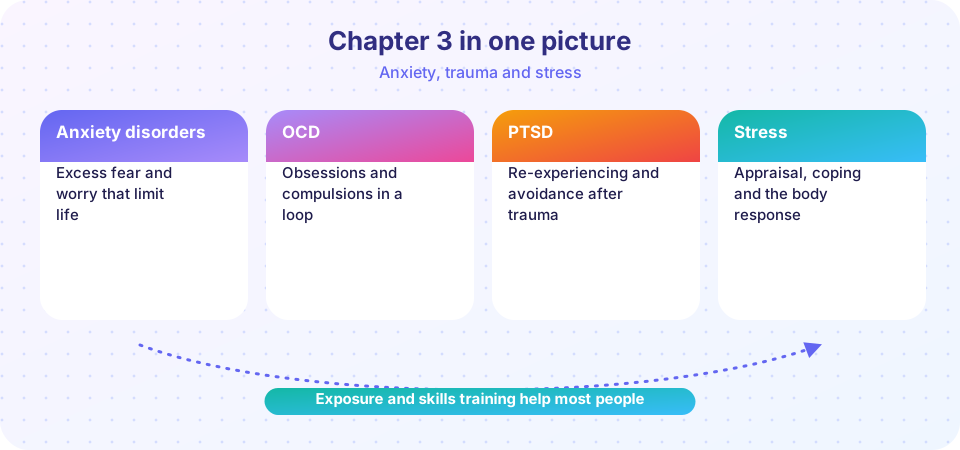
What you will review
- The anxiety disorders and what distinguishes them.
- OCD and PTSD: loops, clusters and treatments.
- Stress: GAS, appraisal, coping and health effects.
Recap table
| Topic | Key ideas | Names and numbers |
|---|---|---|
| Fear and anxiety | Present versus possible threat; panic attack peaks in minutes | Yerkes-Dodson (1908) |
| GAD | Worry on more days than not for 6+ months, plus tension symptoms | Borkovec, intolerance of uncertainty |
| Panic and agoraphobia | Unexpected attacks plus worry; catastrophic misinterpretation | Clark (1986) |
| Social anxiety, phobias | Fear of scrutiny; specific fears; safety behaviors | Clark and Wells (1995), Watson and Rayner (1920), Mowrer (1947), Seligman (1971) |
| OCD | Obsession, anxiety, compulsion, relief loop; ERP and SSRIs | Salkovskis, Rachman, Wegner |
| PTSD | 4 clusters, over 1 month; trauma-focused CBT, EMDR; debriefing not helpful | Foa, Ehlers and Clark, Shapiro |
| Stress | Cannon, Selye (GAS), HPA axis, appraisal and coping, life events | Lazarus and Folkman (1984), Holmes and Rahe (1967), Marmot |
Try it
Flip the flashcards. Cover the back, answer, then check.
Check your understanding
Quick check · 10 questions
of 10 answered You scored / 10 · perfect!
-
1. A person has repeated, unexpected surges of terror and now avoids exercise because it raises their heart rate. Which model best explains the cycle?
Panic is maintained by reading harmless sensations as dangerous. -
2. Which treatment component is shared by exposure therapy for phobia, ERP for OCD and prolonged exposure for PTSD?
Planned, repeated contact with the feared stimulus is the common mechanism. -
3. Why does reassurance often worsen OCD?
Reassurance brings brief relief and strengthens the loop. -
4. Which stage of Selye's GAS comes after resistance if a stressor continues?
Reserves run low and vulnerability to illness rises. -
5. A person feels the demand is large and their resources small. In Lazarus and Folkman's model this is most likely a
Demands exceeding resources lead to a threat appraisal. -
6. Which finding about psychological debriefing is correct?
Guidelines favor supportive, practical help. -
7. In which condition is a diagnosis made with more than one month of intrusion, avoidance, negative mood and thinking, and arousal?
These are the four PTSD clusters. -
8. What is a safety behavior?
Safety behaviors prevent disconfirming the fear. -
9. Which is a limitation of the Holmes-Rahe scale?
Appraisal and context matter. -
10. Which best summarizes the diathesis-stress logic for anxiety disorders?
Multiple factors interact.
Summary
- Anxiety disorders vary in focus but share fear, avoidance and impairment.
- OCD and PTSD are related but distinct; loops and clusters explain their persistence.
- Stress is a transaction between demands and resources, with body and mind components.
- Exposure-based approaches are a common thread in treatment.
- Chapter 4 turns from fear to mood: depression and bipolar disorder.
Track your progress
Create a free account to tick off lessons and pick up where you left off on any device.
of Abnormal and Clinical Psychology lessons completed