


















Lesson 45 of 47 · Projects and Practice
Glossary: Key Terms from Chapters 5 to 8
A plain-language glossary of fifty key terms from psychosis, personality, eating and substance disorders, assessment, therapy, prevention and ethics.
Clinical psychology has a lot of vocabulary, and the same word can mean different things in everyday speech and in a textbook ("psychotic", "reliable", "tolerance"). This glossary collects the key terms from chapters 5 to 8 in plain language, with a pointer to the lesson where each is explained.
Use it for revision, for checking a word while you read research, or as the raw material for flashcards. The two demonstrations at the end turn it into a lookup tool and a flashcard deck.
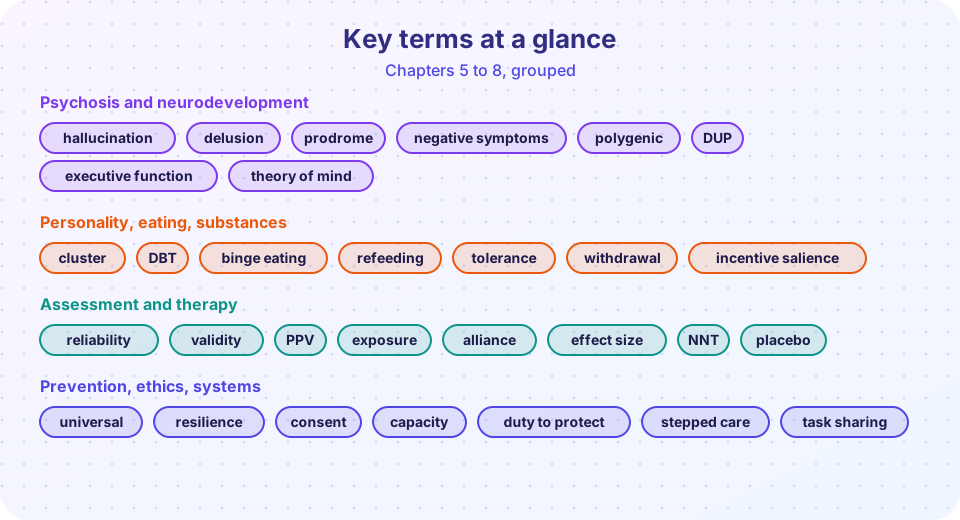
Glossary
| Term | Meaning | Lesson |
|---|---|---|
| Aberrant salience | The idea that dysregulated dopamine makes irrelevant things feel important | Psychosis causes |
| Alliance (therapeutic) | The collaborative bond between client and therapist, with agreed goals | Other therapies |
| Automatic thought | A quick, often unnoticed thought that arises in a situation | CBT |
| Avolition | Reduced drive to start or finish activities | Schizophrenia |
| Base rate | How common a condition is in the group being tested | Assessment |
| Behavioral activation | Scheduling rewarding and meaningful activities to lift mood | CBT |
| Binge eating | Eating an unusually large amount with a sense of losing control | Eating disorders |
| Capacity | Ability to understand, weigh and communicate a decision | Ethics |
| Catatonia | Marked changes in movement, from rigid stillness to purposeless agitation | Schizophrenia |
| Cluster (personality) | A grouping of personality disorders by shared style (A, B, C) | Personality |
| Cognitive triad | Negative views of the self, the world and the future | CBT |
| Common factors | Ingredients shared by all therapies, such as alliance and hope | Other therapies |
| Compensatory behavior | Actions to prevent weight gain after eating | Eating disorders |
| Contingency management | Rewards for meeting treatment goals such as drug-free tests | Substance use |
| Delusion | A fixed belief that persists despite clear evidence against it | Schizophrenia |
| Dimensional model | Describing problems as positions on scales instead of yes-or-no categories | Personality |
| Duration of untreated psychosis (DUP) | Time from first psychotic symptoms to treatment | Psychosis causes |
| Duty to protect | Duty to take steps to protect a person at serious risk from a client | Ethics |
| Effect size | How big a difference or relationship is, in standard units | Assessment and therapy overview |
| Executive function | Mental skills for planning, switching tasks and holding back impulses | ADHD and autism |
| Exposure | Facing feared cues gradually until fear decreases | CBT |
| Formulation | A hypothesis-based explanation of a person's difficulties | Case formulation |
| Hallucination | A perception without an outside source | Schizophrenia |
| Harm reduction | Practices that cut the damage of drug use without requiring abstinence | Substance use |
| Heritability | Share of differences in a population linked to genetic differences | ADHD and autism |
| Incentive salience | The pull that reward cues exert; "wanting" | Substance use |
| Informed consent | Voluntary agreement given with understanding and capacity | Ethics |
| Mental status examination | Structured description of how a person presents now | Assessment |
| Negative symptoms | Reductions in normal functions such as expression and motivation | Schizophrenia |
| Neurodiversity | The view that neurological differences are part of human variation | ADHD and autism |
| Number needed to treat (NNT) | People treated for one extra person to benefit | Biological treatments |
| Placebo | An inactive treatment used as a comparison | Biological treatments |
| Polygenic | Influenced by many genes, each of small effect | Psychosis causes |
| Positive predictive value (PPV) | Share of positive results that are correct | Assessment |
| Prevention paradox | Most cases come from the many at modest risk, not the few at high risk | Prevention |
| Prodrome | Early phase of subtle changes before full symptoms | Schizophrenia |
| Psychosis | A set of symptoms involving loss of contact with shared reality | Chapter 5 overview |
| Reliability | Consistency of a measure | Assessment |
| Resilience | Doing well despite adversity | Prevention |
| Sensitivity | Share of people with a condition whom a test correctly flags | Assessment |
| Specificity | Share of people without a condition whom a test correctly clears | Assessment |
| Stepped care | Least intensive effective option first, stepping up if needed | Care systems |
| Stress-vulnerability model | A disorder appears when vulnerability plus stress passes a threshold | Psychosis causes |
| Task sharing | Training non-specialists to deliver parts of care | Care systems |
| Theory of mind | Understanding that others have beliefs and wishes different from your own | ADHD and autism |
| Tolerance | Needing more of a substance for the same effect | Substance use |
| Transference | Feelings from past relationships directed at the therapist | Other therapies |
| Validity | Whether a measure assesses what it claims to assess | Assessment |
| Withdrawal | Symptoms that appear when use stops or falls sharply | Substance use |
Try it
The first demonstration is a tiny lookup function. Paste in more terms from the table to build your own. The second is a flashcard deck: click a card to flip it.
Press Run (or Ctrl + Enter) to see the console output here.
No output.
Check your understanding
Quick check · 4 questions
of 4 answered You scored / 4 · perfect!
-
1. Which term means 'the share of positive results that are correct'?
PPV depends on sensitivity, specificity and the base rate. -
2. Which term describes the pull of reward cues, wanting more than liking?
Berridge and Robinson used incentive salience to describe cue-driven wanting. -
3. A 'prodrome' is...
The prodrome often precedes a first psychotic episode. -
4. Which term describes training non-specialists to deliver parts of mental health care?
Task sharing extends the reach of limited specialists.
Summary
- Many clinical terms have special meanings that differ from everyday use.
- Group terms by theme (symptoms, causes, measurement, treatment, ethics) to remember them.
- Use flashcards and short code lookups to rehearse definitions actively.
Next: Cheat sheet
Track your progress
Create a free account to tick off lessons and pick up where you left off on any device.
of Abnormal and Clinical Psychology lessons completed