


















Lesson 32 of 47 · Assessment and Therapy Approaches
Clinical Assessment: Interviews, Scales, Tests and Base Rates
Learn how clinicians assess problems with interviews, rating scales such as the PHQ-9 and tests, and why reliability, validity and base rates matter.
Before a clinician can help, they must understand. Clinical assessment is the process of gathering and combining information about a person's problems, strengths, history and context. It is closer to detective work than to taking a temperature: no single clue decides the case, and the picture often changes as new information arrives.
This lesson covers the main assessment tools, the properties that make a measure trustworthy, and one idea that surprises almost everyone: even an accurate test can give mostly wrong positive results when the condition is rare.
Educational information only. The scoring demonstration in this lesson shows how a rating scale works. It is not a screening test and cannot tell you whether you have a condition. If you are worried about your mental health, talk to a professional.
What you will learn
- Describe the clinical interview, the mental status examination and structured diagnostic interviews.
- Explain how rating scales such as the PHQ-9 and GAD-7 are scored and used.
- Distinguish personality inventories, projective tests and cognitive tests.
- Define reliability, validity, sensitivity, specificity and positive predictive value.
- Explain the base-rate problem in screening.
Key terms
- Reliability: consistency of a measure over time (test-retest), between raters (inter-rater) and across items.
- Validity: whether a measure assesses what it claims to assess.
- Sensitivity: the share of people with a condition whom the test correctly flags.
- Specificity: the share of people without the condition whom the test correctly clears.
- Positive predictive value (PPV): among people who test positive, the share who truly have the condition.
The interview and the mental status examination
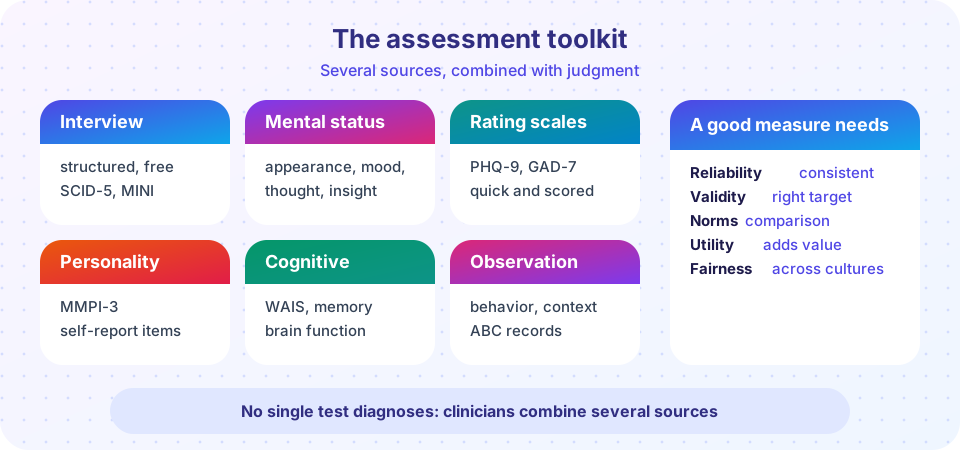
The clinical interview is the heart of assessment. In an unstructured interview the clinician follows the person's story. In a semi-structured interview such as the SCID-5 (Structured Clinical Interview for DSM-5) or the shorter MINI, the clinician follows set questions and probes, which improves agreement between clinicians. Interviews also explore history (family, school, work, relationships, trauma, medical problems, substance use), strengths and current stressors.
The mental status examination (MSE) is a structured description of how a person presents at that moment: appearance and behavior, speech, mood and affect, thought process (is it logical and goal-directed?), thought content (delusions, obsessions, thoughts of self-harm), perception (hallucinations), cognition (orientation, memory, attention) and insight and judgment. It is the clinical equivalent of a physical examination.
Risk assessment is part of every assessment where safety is a concern. Research shows that no scale predicts suicide or violence precisely (see the base-rate section below), so clinicians rely on an ongoing conversation, protective factors and safety planning rather than a single score.
Rating scales
Rating scales are short questionnaires that turn symptoms into numbers.
- The PHQ-9 (Kroenke, Spitzer and Williams, 2001) has nine items about the past two weeks, each scored from 0 (not at all) to 3 (nearly every day), giving a total from 0 to 27. The usual bands are 0 to 4 minimal, 5 to 9 mild, 10 to 14 moderate, 15 to 19 moderately severe and 20 to 27 severe. A score of 10 or more is often used as a screening cut-off.
- The GAD-7 has seven items on anxiety, scored 0 to 3, total 0 to 21, with bands at 5, 10 and 15.
- Other examples include the Beck Depression Inventory, the Edinburgh Postnatal Depression Scale and the Y-BOCS for obsessive-compulsive symptoms.
Scales are quick, cheap and good for tracking change, but a high score is a reason to look closer, not a diagnosis.
Personality, projective and cognitive tests
- Personality inventories. The MMPI (Hathaway and McKinley, 1943) and its updates, the MMPI-2 (567 items) and MMPI-3 (335 items), contain many true-false statements and validity scales that detect careless, exaggerated or defensive responding. Items were selected for how well they separated clinical groups from others.
- Projective tests. The Rorschach inkblot test (Hermann Rorschach, 1921) and the Thematic Apperception Test ask people to interpret ambiguous images. They are used less than they once were. Reviews, notably by Scott Lilienfeld, James Wood and Howard Garb (2000), found that most scores have weak evidence of validity, although some Rorschach indices (for example for disordered thinking) hold up better.
- Intelligence and cognitive tests. The Wechsler scales (WAIS for adults, WISC for children) are standardized so that the average score is 100 and the standard deviation is 15. Neuropsychological tests examine memory, attention and executive function when brain injury, dementia or developmental conditions are suspected.
- Behavioral assessment. Observing behavior and its context, for example with ABC records (Antecedent, Behavior, Consequence), reveals what triggers and maintains a problem.
Reliability and validity
A measure must give consistent results (reliability) and measure the right thing (validity). Reliability is necessary for validity but not sufficient: a bathroom scale that always reads 3 kilograms too high is reliable and invalid. Kinds of validity include content (covers the topic), criterion (predicts an outside standard) and construct (behaves as theory expects).
Agreement between clinicians is often measured with kappa, which corrects for chance agreement (0 is chance, 1 is perfect). The field trials for DSM-5 reported only modest agreement for some common diagnoses; for major depressive disorder kappa was around 0.3, which sparked debate about the reliability of diagnosis. Structured interviews improve it.
Culture and fairness. A test developed in one culture may not work in another. Words translate imperfectly, ideas of distress differ, and norms from one population may mislead for another. DSM-5 includes a Cultural Formulation Interview to explore how a person understands their problems.
The base-rate problem
Suppose a test has sensitivity 90 percent and specificity 90 percent, which sounds excellent. If the condition affects 1 in 100 people, how often is a positive result correct? Out of 10,000 people, 100 have the condition and the test flags 90 of them. Of the 9,900 without it, 10 percent, or 990, are falsely flagged. So 90 of 1,080 positives are real, about 8 percent. This is the positive predictive value (PPV), and it climbs as the condition becomes more common.
The same logic explains why suicide-risk scales perform poorly: the event is rare in any given year, so even good scales flag many people who will not attempt suicide and miss some who will. A 2016 meta-analysis by Matthew Large and colleagues concluded that risk-stratification tools have low accuracy for predicting future suicide. That is why screening tools are a first step toward a conversation and not a final answer.
Common misconceptions
"A test positive means you have it." Whether a positive result is likely true depends on how common the condition is.
"Projective tests reveal the unconscious." Evidence for most scores is weak, and interpretations often reflect the clinician's expectations.
"Scores are the assessment." Numbers are one source among interviews, history and observation.
Try it
The first demonstration plots PPV against prevalence for a test with 90 percent sensitivity and specificity. The second is an interactive scoring demo, with paraphrased topics, showing how a PHQ-9-style total maps to a band. It is not a screening tool.
Press Run (or Ctrl + Enter) to see the result here.
Program input · what you'd type while the program runs
Type the answers before you press Run, one per line. Each time the program reads a line (with input()), it gets the next line from this box.
Check your understanding
Quick check · 5 questions
of 5 answered You scored / 5 · perfect!
-
1. What does the PHQ-9 score range of 15 to 19 correspond to?
The usual bands are 0 to 4 minimal, 5 to 9 mild, 10 to 14 moderate, 15 to 19 moderately severe and 20 to 27 severe. -
2. A test is 90 percent sensitive and 90 percent specific, and the condition affects 1 percent of people. About what share of positive results are correct?
Of 10,000 people, 90 true positives and 990 false positives give a PPV near 8 percent. -
3. Which statement about reliability and validity is correct?
A scale that is always 3 kg too high is consistent but wrong. -
4. Why are validity scales included in the MMPI?
Validity scales flag response styles that could distort the clinical scores. -
5. Which is an advantage of a semi-structured interview such as the SCID-5?
Set questions and probes make diagnoses more consistent across clinicians, though judgment is still needed.
Summary
- Assessment combines interviews, the mental status examination, rating scales, tests and observation.
- Rating scales such as the PHQ-9 and GAD-7 are quick and useful for tracking change, but they do not diagnose.
- Measures must be reliable, valid, normed on suitable groups and fair across cultures.
- Base rates determine how many positive results are correct, which is why rare outcomes such as suicide are hard to predict.
Track your progress
Create a free account to tick off lessons and pick up where you left off on any device.
of Abnormal and Clinical Psychology lessons completed