


















Lesson 22 of 47 · Psychotic and Neurodevelopmental Disorders
Schizophrenia and the Psychosis Spectrum
Learn the symptom groups of schizophrenia, the DSM-5-TR time rule, related psychotic disorders, the history of the concept and how the illness usually unfolds.
Few diagnoses are as misunderstood as schizophrenia. Popular culture links it to split personalities or to violence, and both ideas are wrong. In reality it is a disorder in which a person's perception, thinking and motivation change, usually beginning in young adulthood, and it affects roughly three to seven people in a thousand over a lifetime.
This lesson explains what clinicians actually look for, how the definition grew from early twentieth-century ideas, and how the condition tends to unfold over years. It builds the foundation for the next lesson on causes and treatment.
What you will learn
- Name the five symptom groups used in the DSM-5-TR and give an example of each.
- Explain the difference between positive, negative and cognitive symptoms.
- Describe how brief psychotic disorder, schizophreniform disorder and schizophrenia differ by time.
- Summarize the typical course: prodrome, active phase, residual phase.
- Correct three common myths.
Key terms
- Hallucination: a perception without an outside source, most often hearing voices.
- Delusion: a firmly held belief that stays fixed despite clear evidence against it.
- Negative symptoms: reductions in normal functions, such as emotional expression or motivation.
- Prodrome: the early phase of subtle changes before full symptoms appear.
- Catatonia: marked changes in movement, from rigid stillness to purposeless agitation.
A short history of the idea
In the 1890s the German psychiatrist Emil Kraepelin grouped a set of young-onset conditions with deteriorating course under the name dementia praecox. In 1908 the Swiss psychiatrist Eugen Bleuler proposed the word schizophrenia, from Greek roots meaning "split mind". Bleuler meant a splitting of mental functions such as thought, emotion and behavior, not a split into two personalities. Dissociative identity disorder is a completely different condition.
In the 1950s Kurt Schneider listed "first-rank symptoms", such as hearing voices that comment on your actions, which he thought were especially typical. Later research showed these symptoms occur in other disorders too, and DSM-5 (2013) dropped the special status of first-rank symptoms and also removed the old subtypes (paranoid, disorganized, catatonic and so on) because they predicted little about outcome.
The five symptom groups
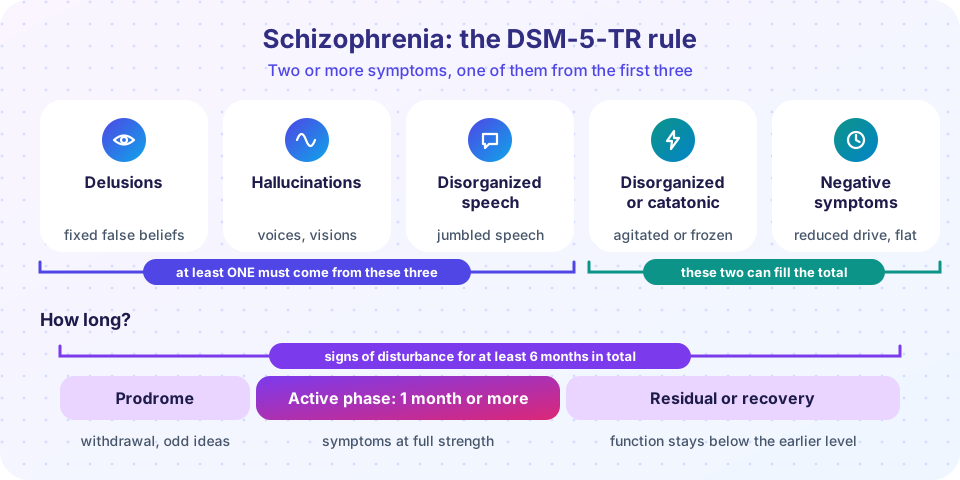
DSM-5-TR names five symptom groups. Any diagnosis of schizophrenia needs two or more, each present for a significant part of a one-month period, and at least one must be delusions, hallucinations or disorganized speech.
- Delusions. Common themes are persecution (people are plotting against me), reference (the news is sending me messages) and grandiosity. A delusion is not simply an unusual belief held by a community. Religious or cultural beliefs shared by a person's group are not delusions.
- Hallucinations. Auditory hallucinations are the most common: one or more voices, sometimes commenting, sometimes commanding. Visual, tactile and other kinds occur less often.
- Disorganized speech. The person slips off topic, answers questions with unrelated replies, or becomes so jumbled that listeners cannot follow.
- Grossly disorganized or catatonic behavior. Unpredictable agitation, childlike silliness, or at the other extreme, remaining rigidly still.
- Negative symptoms. Diminished emotional expression (a flat face and voice) and avolition (little drive to start or finish activities). Alogia (very little speech), anhedonia (reduced pleasure) and social withdrawal are also described.
Researchers often sort these into positive symptoms (something added: hallucinations, delusions, disorganized thinking), negative symptoms (something taken away) and cognitive symptoms (problems with attention, working memory and processing speed). Cognitive and negative symptoms predict everyday functioning, such as holding a job, better than positive symptoms do, yet most medication mainly targets the positive ones.
The time rule and the spectrum
Schizophrenia also requires that signs of disturbance last at least six months (including at least one month of active symptoms) and that work, relationships or self-care fall clearly below the earlier level. Clinicians must rule out substances, medical conditions and mood disorders with psychotic features.
The same symptoms with a different time pattern give related diagnoses:
| Pattern | Duration | Notes |
|---|---|---|
| Brief psychotic disorder | 1 day to under 1 month | Often follows severe stress; full return to usual functioning |
| Schizophreniform disorder | 1 month to under 6 months | Same symptoms as schizophrenia, shorter course; some later meet the full criteria |
| Schizophrenia | 6 months or more | Includes at least 1 month of active symptoms |
| Schizoaffective disorder | Varies | Psychotic symptoms together with major mood episodes |
| Delusional disorder | 1 month or more | Delusions without the other features; behavior otherwise not odd |
The DSM groups all of these, plus schizotypal personality disorder, under "Schizophrenia Spectrum and Other Psychotic Disorders". The word spectrum signals that the boundaries are blurry and that symptoms vary in degree.
Course and outcome
The typical course has three phases.
- Prodrome. Over months or years: social withdrawal, drop in school or work performance, odd ideas, sleep and mood changes. These are hard to recognize because many resemble ordinary adolescence.
- Active phase. Delusions, hallucinations and disorganized speech come to the front. Many people first reach treatment in this phase.
- Residual phase. Positive symptoms ease, while negative and cognitive difficulties may continue. Relapses occur, particularly when treatment stops.
Onset usually falls in the early to mid 20s for men and the late 20s for women (DSM-5-TR). Outcomes are very diverse. Some people recover substantially and live independently, others live with long-term disability. About five in a hundred die by suicide, and people with schizophrenia face a shortened life expectancy, mostly from physical illnesses such as heart disease, smoking-related disease and diabetes, which are not always well managed.
Culture shapes the experience. In a well-known study, Tanya Luhrmann and colleagues (2015) interviewed people with serious psychotic disorders in Chennai (India), Accra (Ghana) and San Mateo (USA). Many participants in India and Ghana described voices that were more benign or relational (like family members), whereas in the USA they were more often harsh and described as part of an illness. The study was small, but it reminds us that the meaning attached to voices can influence distress.
Common misconceptions
"Schizophrenia means a split personality." No. Bleuler's "split" referred to fragmented mental functions. Having multiple personalities is a different (and much debated) dissociative diagnosis.
"People with schizophrenia are dangerous." Most are not violent. They are more likely to be victims of violence than perpetrators. Risk rises mainly with substance misuse and untreated severe symptoms, as it does in the general population.
"Hearing voices equals schizophrenia." Many people who hear voices never develop the disorder or need treatment. Duration, distress and impairment matter.
Try it
The first demonstration is a labelled schematic of the typical course (not data from real people). The second applies the logic of the time rule to test cases. It shows how the rule works and is not a diagnostic test.
Press Run (or Ctrl + Enter) to see the result here.
Program input · what you'd type while the program runs
Type the answers before you press Run, one per line. Each time the program reads a line (with input()), it gets the next line from this box.
Press Run (or Ctrl + Enter) to see the console output here.
No output.
Check your understanding
Quick check · 5 questions
of 5 answered You scored / 5 · perfect!
-
1. How many symptom groups must be present for schizophrenia, and which must be among them?
DSM-5-TR requires two or more symptom groups, and at least one must come from the first three. -
2. A person has symptoms that match schizophrenia for three months. Which label best fits the time pattern?
One month to under six months of symptoms is schizophreniform; six months or more is schizophrenia. -
3. What did Eugen Bleuler mean by the 'split' in schizophrenia?
Bleuler described a loosening of the links between mental functions; multiple personalities are a different matter. -
4. Which statement about negative symptoms is accurate?
Negative symptoms are losses or reductions, and they are harder to treat than hallucinations and delusions. -
5. Which finding does the Luhrmann study illustrate?
Participants in different settings described their voices differently, suggesting that meaning and context influence distress.
Summary
- Schizophrenia needs two or more of five symptom groups (at least one of delusions, hallucinations, disorganized speech) and six months of disturbance.
- Positive symptoms are added experiences; negative and cognitive symptoms are losses that strongly affect daily life.
- Shorter patterns are brief psychotic disorder and schizophreniform disorder; mood and psychosis combine in schizoaffective disorder.
- The course runs from prodrome to active phase to residual phase, with large differences between people.
- Schizophrenia is not a split personality and most people with it are not violent.
Track your progress
Create a free account to tick off lessons and pick up where you left off on any device.
of Abnormal and Clinical Psychology lessons completed