


















Lesson 23 of 47 · Psychotic and Neurodevelopmental Disorders
What Causes Psychosis and What Helps
Review the dopamine and glutamate ideas, genes, environment, the stress-vulnerability model, and the evidence for antipsychotics, CBT and early intervention.
If you could ask one question about schizophrenia, it would probably be "why does it happen?" The honest answer is that there is no single cause. Decades of research point to a mix of inherited vulnerability, differences in early brain development, and later environmental pressures, all acting on brain systems that regulate how we decide what is important.
This lesson walks through the main ideas, the strongest evidence for each, and what we know about treatments that help. Keep in mind throughout that psychosis is not a character flaw and that no parent, partner or friend "caused" it.
Educational information only. Medication decisions belong to a qualified prescriber. Never stop or change a prescribed medicine without medical advice.
What you will learn
- Explain the dopamine and glutamate hypotheses and their limits.
- Summarize what family, twin and genome studies show about genetic risk.
- List the main environmental risk factors and describe how strong the evidence is for each.
- Describe the stress-vulnerability model.
- Compare the main treatments, including medication, psychological therapy and early intervention.
Key terms
- Heritability: the share of differences between people in a population that is linked to genetic differences. It is not the chance that you inherit a condition.
- Polygenic: influenced by many genes, each with a tiny effect.
- Diathesis-stress model: a disorder appears when an underlying vulnerability meets enough stress.
- Duration of untreated psychosis (DUP): the time between first psychotic symptoms and the start of treatment.
- Tardive dyskinesia: involuntary movements, often of the face and mouth, that can follow long use of some antipsychotics.
The dopamine hypothesis
In 1952 French psychiatrists Jean Delay and Pierre Deniker found that the drug chlorpromazine calmed agitated, psychotic patients. In the 1970s researchers such as Philip Seeman showed that the clinical strength of antipsychotic drugs lines up with how strongly they block dopamine D2 receptors. A second clue pointed the same way: amphetamines, which flood the brain with dopamine, can trigger a psychotic state in people who had never been ill.
The original idea, that psychosis is simply "too much dopamine", has been revised. Brain imaging studies find increased dopamine synthesis in the striatum of many people with schizophrenia. Shitij Kapur's aberrant salience idea (2003) proposed that dopamine does not cause hallucinations directly; it makes irrelevant things feel important, and delusions are the mind's attempt to explain that feeling. Oliver Howes and Kapur (2009) called dopamine dysregulation a "final common pathway" through which many different risk factors act.
The glutamate hypothesis
Phencyclidine (PCP) and ketamine block NMDA glutamate receptors. In experiments with healthy volunteers, ketamine can briefly produce changes that resemble positive, negative and cognitive symptoms, something amphetamine does not do for negative symptoms. This points to glutamate signaling, and to the balance between excitation and inhibition in cortex, as another piece. Drugs aimed solely at glutamate have not yet become standard treatments, so the idea remains unproven.
Genes
Family studies show that risk rises with genetic closeness. In the classic 1991 summary by Irving Gottesman, about 1 in 100 people in the general population develop schizophrenia, around 9 in 100 siblings, 13 in 100 children of one affected parent, about 17 in 100 non-identical twins and about 48 in 100 identical twins of an affected person. Because identical twins share all their DNA yet are not always both affected, genes cannot be the whole story. Estimates of heritability from twin studies are high, around 80 percent, but they describe populations and shrink in some modern analyses.
Genome-wide association studies have shown that schizophrenia is highly polygenic. The Psychiatric Genomics Consortium found 108 risk locations in 2014 and nearly 300 in a larger 2022 study. Each variant adds a tiny risk. One striking finding, from Aswin Sekar and colleagues (2016), linked variation in the complement component 4 (C4) gene to risk and to synaptic pruning, the process that removes unneeded connections in adolescence.
Environment and early life
Several non-genetic factors are associated with higher risk:
- Prenatal and birth events. Children whose mothers were pregnant during the Dutch Hunger Winter (1944-45) had roughly double the risk if exposure came in early pregnancy. Maternal infection and obstetric complications are also linked.
- Cannabis. Observational studies find higher risk in heavy users who start in adolescence, especially with high-potency products. Reverse causation (early symptoms leading to use) and confounding are being debated, but most reviewers consider a causal contribution likely.
- Urban life and migration. Growing up in cities and being a migrant, especially in a hostile environment, raise risk. Social defeat and discrimination are suspected mechanisms.
- Childhood adversity. Abuse, neglect and bullying roughly double or triple later risk in meta-analyses, and the risk rises with the amount of adversity.
None of these is enough alone, and most people exposed to them never become ill.
The stress-vulnerability model
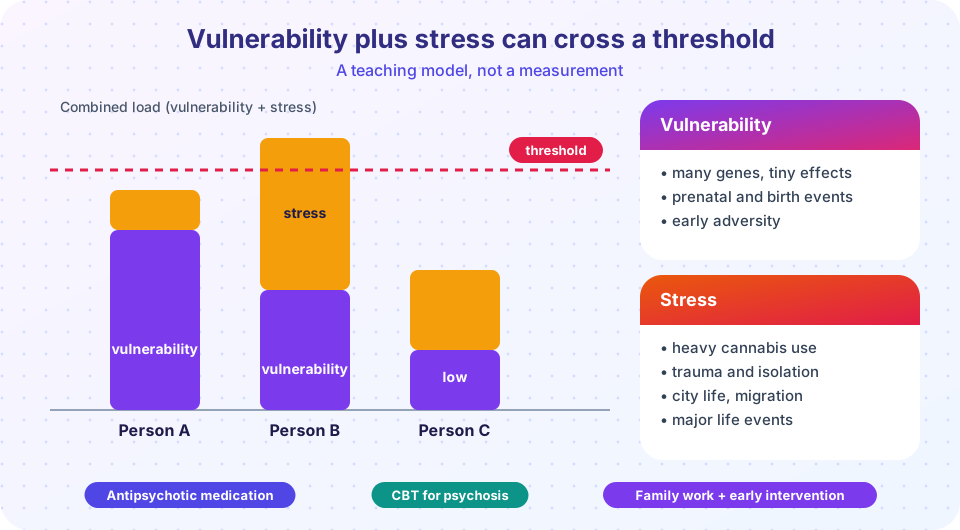
Joseph Zubin and Bonnie Spring (1977) described vulnerability as a threshold. Each person has a baseline vulnerability made up of genes and early development. Stress, drug use and life events add load. When the total passes a threshold, symptoms appear. The model explains why identical twins can differ, why symptoms often follow a stressful period and why reducing stress helps. It is a framework rather than a measured quantity.
Treatments and the evidence
Antipsychotic medication. A large meta-analysis by Stefan Leucht and colleagues (2012) found that within a year about 64 percent of people on placebo relapsed compared with about 27 percent on antipsychotics. Medicines vary in side effects: older drugs such as haloperidol carry more movement side effects, and newer ones such as olanzapine carry more weight gain and metabolic problems. The CATIE trial (2005) in the USA found that around three quarters of participants stopped their assigned drug within 18 months, often because of side effects or limited benefit, and that an older drug performed about as well as several newer ones. Clozapine helps many people who do not respond to other drugs but needs regular blood tests because of a rare, serious risk to white blood cells.
Cognitive behavioral therapy for psychosis (CBTp). CBTp does not argue with a voice or a belief. It explores how thoughts and behavior keep distress going and tests alternative explanations gently. Meta-analyses find small to moderate benefits for positive symptoms and distress.
Family interventions. Research by George Brown in the 1970s found that relapse was higher in homes with high expressed emotion, meaning criticism and over-involvement. Programs that teach problem-solving and communication to families reduce relapse.
Early intervention and coordinated specialty care. The longer psychosis goes untreated, the poorer the outcomes tend to be, although this link may partly reflect more severe illness. Team-based programs that combine medication, therapy, family support, and help with school or work, such as the US RAISE trial (2016), improved quality of life and symptoms compared with usual care. Many countries now run early-psychosis services for young people.
Recovery. The recovery movement, led by people with lived experience, stresses that a good life, with relationships, work and purpose, is possible even when some symptoms persist.
Common misconceptions
"It is caused by bad parenting." The 1950s "schizophrenogenic mother" idea was unsupported and harmed families. Family atmosphere can affect relapse, but it is not the cause.
"It is a pure chemical imbalance." Dopamine and glutamate matter, but brain chemistry is one level of a complex system that includes genes, development, stress and meaning.
"Medication is a cure." Antipsychotics reduce symptoms and relapse in many people, but they do not restore every lost skill. They work best alongside psychological and social support.
Try it
The first demonstration plots the classic family-risk figures. The second is a toy simulation of the stress-vulnerability idea: it is not a model of any real person.
Press Run (or Ctrl + Enter) to see the result here.
Program input · what you'd type while the program runs
Type the answers before you press Run, one per line. Each time the program reads a line (with input()), it gets the next line from this box.
Press Run (or Ctrl + Enter) to see the result here.
Program input · what you'd type while the program runs
Type the answers before you press Run, one per line. Each time the program reads a line (with input()), it gets the next line from this box.
Check your understanding
Quick check · 5 questions
of 5 answered You scored / 5 · perfect!
-
1. What does the aberrant salience idea add to the dopamine hypothesis?
Kapur proposed that dysregulated dopamine assigns salience to neutral events, and delusions arise as an explanation. -
2. Why do identical twin data show that genes are not the whole story?
If genes alone decided, concordance in identical twins would be near 100 percent; it is about 48 percent in classic studies. -
3. Which statement about the genetics of schizophrenia is accurate?
Genome-wide studies have found hundreds of loci, each with a tiny effect. -
4. What does the Leucht meta-analysis (2012) show?
About 27 percent relapsed on antipsychotics versus about 64 percent on placebo. -
5. Which is the best description of the stress-vulnerability model?
Vulnerability and stress combine; neither alone is the whole explanation.
Summary
- Dopamine and glutamate disruptions are central ideas, but they are links in a chain and not the whole cause.
- Schizophrenia is highly heritable yet polygenic; genes raise risk without fixing destiny.
- Environmental risks include prenatal events, adolescent cannabis use, urban life, migration and childhood adversity.
- The stress-vulnerability model combines these into a threshold idea.
- Antipsychotics reduce relapse, CBT for psychosis and family work help, and early coordinated care improves outcomes.
Next: ADHD and autism
Track your progress
Create a free account to tick off lessons and pick up where you left off on any device.
of Abnormal and Clinical Psychology lessons completed