


















Lesson 12 of 47 · Anxiety and Stress Disorders
Anxiety Disorders: Worry, Panic, Phobia and Social Fear
Learn the main anxiety disorders in DSM-5-TR: generalized anxiety, panic, social anxiety, phobias, agoraphobia and separation anxiety, plus causes and exposure-based treatment.
Anxiety disorders share fear and avoidance but differ in what is feared and how it feels. One person worries about everything from money to a late bus. Another is struck by sudden terror in a supermarket. A third dreads being the center of attention so intensely that she skips her own birthday party. The manuals separate these patterns because the best help and the causes can differ. In this lesson you will learn each pattern, the leading explanations and the treatments with the strongest evidence.
Educational information only. The descriptions below summarize diagnostic criteria for learning. They cannot be used to diagnose yourself or another person.
What you will learn
- The key features of each major anxiety disorder.
- Learning, cognitive and biological explanations.
- How exposure and cognitive therapy work, and what medication can and cannot do.
- How avoidance keeps anxiety going.
Key terms
Generalized anxiety disorder (GAD): excessive, hard-to-control worry about many matters, on more days than not for at least six months.
Panic disorder: recurrent unexpected panic attacks followed by at least a month of worry or behavior change.
Phobia: an intense, out-of-proportion fear of a specific object or situation.
Exposure therapy: gradually and safely facing feared stimuli until fear fades.
Safety behaviors: small actions meant to prevent feared outcomes (such as always carrying water or sitting near the exit) that keep fear alive.
The disorders
Generalized anxiety disorder
GAD involves worry that is hard to control, about many things (health, money, work, family), on more days than not for at least six months. It comes with at least three of six symptoms in adults: restlessness, easy fatigue, trouble concentrating, irritability, muscle tension and sleep problems. Thinking researchers such as Thomas Borkovec propose that worry is a way of avoiding vivid imagery and feeling: it keeps a person in the head, and never tests the fear. People with GAD also tend to have intolerance of uncertainty, finding "maybe" harder to bear than "no".
Panic disorder and agoraphobia
A panic attack is an abrupt surge of intense fear that peaks within minutes, with at least four of 13 symptoms such as pounding heart, sweating, trembling, shortness of breath, chest discomfort, dizziness, numbness, fear of losing control or of dying. Many people have an occasional attack. Panic disorder needs recurrent unexpected attacks, followed by at least a month of persistent worry about more attacks or their meaning, or a change in behavior to avoid them. Agoraphobia is intense fear of two or more situations where escape might be difficult or help unavailable: public transport, open spaces, enclosed places, queues or crowds, or being outside the home alone. It can occur with or without panic disorder.
David Clark's cognitive model of panic (1986) explains the loop: a harmless bodily sensation (a skipped heartbeat) is catastrophically misinterpreted ("I'm having a heart attack"); this raises fear; fear causes more sensations; the cycle spirals into panic. Therapy tests the interpretation, for example by deliberately causing sensations (interoceptive exposure), such as breathing fast or spinning, and showing that nothing terrible follows.
Social anxiety disorder
Marked fear of social situations in which one might be scrutinized (talking to strangers, eating in public, performing), lasting typically six months or more and leading to avoidance or intense distress. The Clark and Wells (1995) model describes how people shift attention inward, build a distorted self-image from how they feel, and use safety behaviors (rehearsing sentences, avoiding eye contact) that ironically make them appear awkward. Social anxiety usually begins in the teenage years.
Specific phobia
Intense fear of a specific object or situation (animals, heights, blood and injections, flying, enclosed spaces), almost always provoked, actively avoided and lasting six months or more. Phobias are among the most common anxiety conditions. They often respond very quickly to exposure, sometimes in a single long session.
Separation anxiety and selective mutism
Separation anxiety disorder is fear or anxiety about separation from attachment figures that is excessive for the person's developmental level; it is no longer limited to childhood in the DSM-5. Selective mutism is a consistent failure to speak in specific social situations (such as school) despite speaking in others.
Why do anxiety disorders develop?
Learning. Watson and Rayner's 1920 "Little Albert" demonstration, in which a baby was conditioned to fear a white rat, is the textbook example of classical conditioning of fear. The study is small, poorly controlled and ethically unacceptable today, and later attempts to reproduce conditioning in babies had mixed results. O. Hobart Mowrer's two-factor theory (1947) explains maintenance: fear is acquired by classical conditioning and kept by operant conditioning because avoiding the feared thing is rewarded by relief. Observation also matters: Susan Mineka and colleagues showed that young rhesus monkeys acquired a snake fear by watching other monkeys react fearfully. Seligman's preparedness idea (1971) holds that humans are biologically ready to learn fears of evolutionarily relevant threats such as snakes, spiders and heights more easily than fears of guns or cars.
Biology. Twin studies suggest moderate heritability (very roughly 30 to 50 percent depending on the disorder). The amygdala, a brain structure involved in rapid threat detection, tends to react strongly in people with anxiety, and prefrontal regions that regulate it may be less effective. Temperament matters: Jerome Kagan found that infants who react strongly to novelty ("behaviorally inhibited") are more likely to develop social anxiety later, though most do not.
Thinking. Anxious people tend to attend more to threat, interpret ambiguity negatively and overestimate both the probability and the cost of bad outcomes.
Treatment
- Cognitive behavioral therapy (CBT) is the best-supported psychological treatment. Exposure is the active ingredient: the person gradually faces feared situations (in real life, in imagination or in the body) in a planned sequence called an exposure hierarchy, long enough for fear to fall and for new learning to occur ("I can cope, and the feared outcome did not happen"). Joseph Wolpe's systematic desensitization paired exposure with relaxation. Cognitive work tests catastrophic predictions as if they were hypotheses.
- Medication: SSRIs and SNRIs are first-line drugs for many anxiety disorders; they take weeks to work. Benzodiazepines act quickly but cause tolerance and dependence, so they are generally for short-term use.
- Lifestyle supports such as regular sleep, exercise and reducing caffeine help some people but are usually not enough for a disorder alone.
Exposure is not "just facing your fear and hoping". Good exposure is planned, gradual, repeated and done with the person's agreement. Trained therapists tailor it so that people stay in control.
Common misconceptions
"Relaxation techniques cure anxiety disorders." They help some people manage tension, but exposure-based CBT has the strongest evidence for disorders.
"Anxiety medications are addictive, so they should never be used." SSRIs are not addictive in the usual sense. Benzodiazepines carry dependence risk and should be used with medical guidance.
"Phobias are irrational and silly." Phobias are real, impairing and highly treatable. Fear can be out of proportion without being foolish.
Try it
The first demonstration is a simple learning model (Rescorla-Wagner): fear is learned over repeated pairings, then fades during extinction when the feared cue appears without the bad outcome. Notice that fear does not vanish in one step. It is a model for teaching.
Press Run (or Ctrl + Enter) to see the result here.
Program input · what you'd type while the program runs
Type the answers before you press Run, one per line. Each time the program reads a line (with input()), it gets the next line from this box.
The second demonstration builds an exposure hierarchy: rate how hard each step feels from 0 to 100 and it sorts the steps from easiest to hardest. The example is about a fear of dogs. It is a planning demonstration, not therapy.
Check your understanding
Quick check · 6 questions
of 6 answered You scored / 6 · perfect!
-
1. Which feature best distinguishes generalized anxiety disorder?
GAD is persistent, wide-ranging worry with tension symptoms. -
2. In Clark's cognitive model of panic, what drives the spiral?
Harmless sensations are read as dangerous, which raises fear and sensations further. -
3. According to Mowrer's two-factor theory, avoidance continues because
Classical conditioning acquires the fear; operant reinforcement through relief maintains avoidance. -
4. What is the active ingredient in exposure therapy?
Staying in contact with the feared stimulus teaches the brain that it is safe. -
5. Why are benzodiazepines generally used short term?
They work fast but are not ideal for long-term management. -
6. What did Seligman's preparedness idea propose?
Biological readiness shapes which fears are acquired easily.
Summary
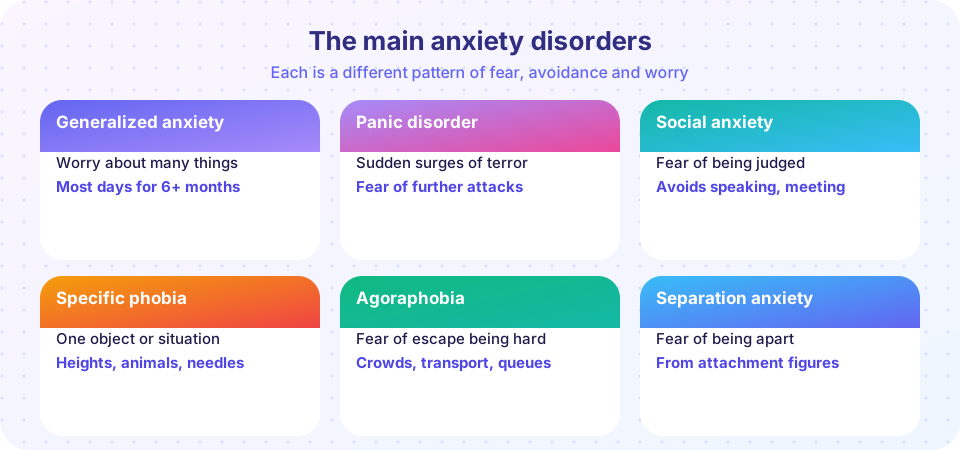
- Anxiety disorders differ in focus: many worries (GAD), sudden attacks (panic), social scrutiny, a specific object, escape-difficult places, or separation.
- Learning (conditioning, observation), biology (genes, amygdala, temperament) and thinking (threat bias) all contribute.
- Avoidance and safety behaviors maintain anxiety; exposure-based CBT breaks the cycle.
- SSRIs and SNRIs help many people; benzodiazepines are short-term tools.
Track your progress
Create a free account to tick off lessons and pick up where you left off on any device.
of Abnormal and Clinical Psychology lessons completed