


















Lesson 30 of 47 · Personality and Other Disorders
Chapter 6 Review: Personality, Eating and Substance Disorders
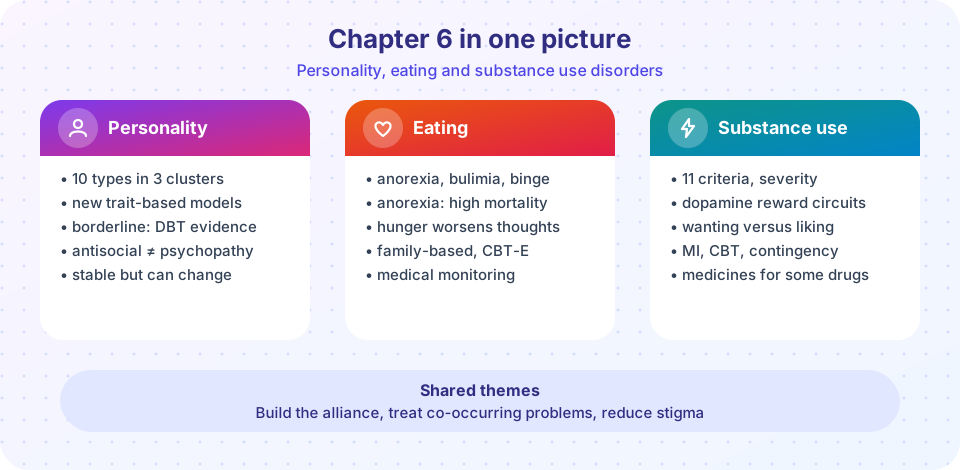
Review chapter 6 with a one-picture summary, a recap table and ten mixed questions on personality, eating and substance use disorders.
This chapter looked at conditions that feel woven into a person's identity and daily routine. Before moving on to assessment and therapy, consolidate what you learned with a picture, a table and a mixed set of questions.
Recap table
| Topic | Key facts | Landmark names |
|---|---|---|
| Personality disorders | Enduring, pervasive, inflexible pattern; ten types in three clusters; about 9 percent in one US survey | Lenzenweger |
| Dimensional models | DSM-5 Section III (functioning plus five trait domains); ICD-11 severity plus trait qualifiers | Alternative Model for Personality Disorders |
| Borderline | Five of nine criteria (256 combinations); biosocial theory; DBT reduces self-harm | Linehan, Zanarini |
| Antisocial and psychopathy | ASPD is behavioral; psychopathy measured by the PCL-R | Cleckley, Hare |
| Eating disorders | Anorexia, bulimia, binge-eating disorder, ARFID; high mortality in anorexia | Hudson, Arcelus |
| Starvation effects | Preoccupation with food, low mood and withdrawal appear in healthy volunteers | Keys |
| Eating disorder treatment | FBT for adolescents, CBT-E for others, medical care | Lock and Le Grange, Fairburn |
| Substance use disorder | 11 criteria in four groups; mild, moderate, severe | DSM-5 |
| Reward circuits | VTA to nucleus accumbens; wanting versus liking; three-stage cycle | Olds and Milner, Berridge and Robinson, Koob and Volkow |
| Treatment | MI, CBT, contingency management, medications, harm reduction | Miller and Rollnick, Marlatt, Project MATCH |
Try it
A helpful habit is to compare screening criteria counts. The demonstration below applies the DSM-5 severity bands for substance use disorder to a count of criteria. It shows how the rule works and is not a screening test.
Press Run (or Ctrl + Enter) to see the console output here.
No output.
Check your understanding
Quick check · 10 questions
of 10 answered You scored / 10 · perfect!
-
1. Which pair of criteria describes a personality disorder in DSM-5?
A personality disorder is a long-standing pattern that shows up across situations and starts by adolescence or early adulthood. -
2. Which disorders belong to cluster C?
Cluster C is the anxious or fearful group. -
3. Why is a dimensional approach to personality disorders appealing?
Overlap, heterogeneity and arbitrary cut-offs are weaknesses of categories. -
4. What did Linehan's 1991 trial of DBT show?
In 44 women with repeated self-harm, DBT outperformed treatment as usual on these outcomes. -
5. What distinguishes bulimia nervosa from binge-eating disorder?
Both involve binges, but compensatory behavior defines bulimia. -
6. What was learned from the Minnesota Starvation Experiment?
Many anorexia symptoms are partly caused by starvation itself. -
7. In the DSM-5, how is a person with five substance use criteria rated?
Two or three criteria is mild, four or five moderate, and six or more severe. -
8. Which brain pathway is most central to reward and wanting?
This pathway, with prefrontal links, is central to reward processing and incentive salience. -
9. What do Robins' Vietnam veteran findings suggest about addiction?
Most who were addicted in Vietnam did not relapse after returning to a very different environment. -
10. Which approach reduces the harms of drug use without requiring abstinence?
Harm reduction lowers deaths and infections and is not shown to increase use.
Summary
- Personality disorders are enduring patterns in three clusters, with a growing shift toward dimensional models.
- Borderline personality disorder is treatable, and DBT is a flagship therapy.
- Eating disorders are serious and sometimes life-threatening; starvation worsens symptoms, and family-based treatment and CBT-E have the best evidence.
- Substance use disorders follow reward-circuit changes, with many routes to recovery: MI, CBT, contingency management, medicines and harm reduction.
- Stigma, co-occurring problems and early help are recurring themes.
Track your progress
Create a free account to tick off lessons and pick up where you left off on any device.
of Abnormal and Clinical Psychology lessons completed