


















Lesson 20 of 47 · Mood Disorders
Chapter 4 Review: Mood Disorders
Review the mood spectrum, depression, bipolar disorders and their causes with a recap table, flashcards and a ten-question mixed quiz covering the whole chapter.
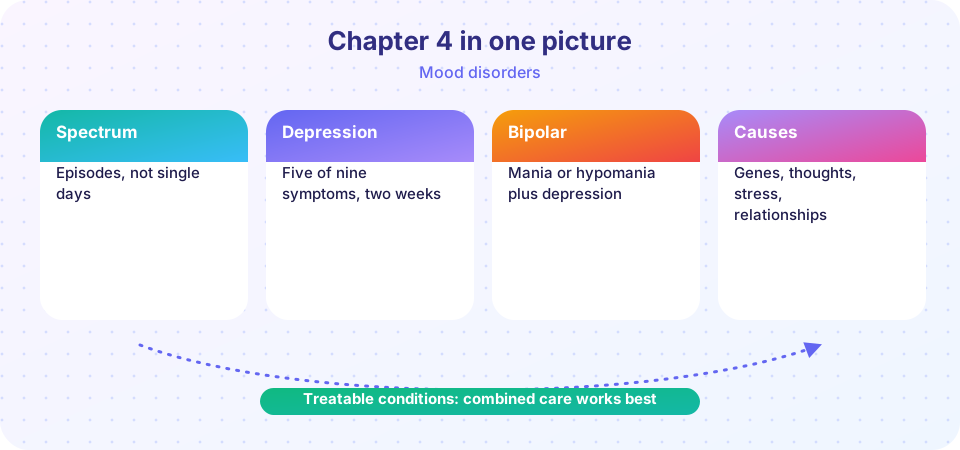
You have covered the two families of mood disorders, the rules that define episodes and the main theories of cause. As you review, notice how often duration, impairment and interaction appear: a mood disorder is defined by how long and how much; causes combine biology, thinking, behavior and life events; and treatment can target any of them.
Reminder. If any of this chapter feels personal, talking to a professional or someone you trust is a good next step. In an emergency, contact your local emergency number or crisis line.
What you will review
- The mood spectrum and the episode definitions.
- The criteria and treatments for depression and bipolar disorders.
- The main causal theories and their evidence.
Recap table
| Topic | Key ideas | Names and numbers |
|---|---|---|
| Episodes | Defined by duration and impact: depressive 2 weeks, hypomanic 4 days, manic 1 week | DSM-5-TR |
| Major depression | 5 of 9 symptoms, including low mood or lost interest; persistent depressive disorder 2 years | Beck, behavioral activation, IPT |
| Treatments for depression | CBT, behavioral activation, IPT, SSRIs and others, ECT and TMS for severe cases | Cipriani et al. (2018), Dimidjian et al. (2006) |
| Bipolar | I: mania. II: hypomania + major depression. Cyclothymia: 2 years milder | Cade (1949), Schou, Jamison |
| Genes | Depression about 35-40% heritable; bipolar about 60-85% | Sullivan et al. (2000) |
| Psychological theories | Cognitive triad, attributional style, rumination, learned helplessness | Beck, Seligman, Abramson, Nolen-Hoeksema |
| Social theory | Severe life events plus vulnerability factors | Brown and Harris (1978) |
| Caution | Serotonin slogan too simple; 5-HTTLPR not replicated | Moncrieff (2022), Caspi (2003) |
Try it
Flip through the flashcards, saying the answer aloud before revealing it.
Check your understanding
Quick check · 10 questions
of 10 answered You scored / 10 · perfect!
-
1. A person has had low mood and no interest in activities nearly every day for three weeks, with poor sleep, fatigue and poor concentration. Which statement fits best?
At least five symptoms over two weeks including a core one; assessment checks impairment and other causes. -
2. A person had 10 days of elevated mood, little sleep and reckless spending that led to hospitalization. Which pattern is this?
Over a week with marked impairment or hospitalization indicates mania. -
3. Which treatment has the best long-term evidence for preventing manic and depressive episodes in bipolar disorder?
Lithium reduces relapse and suicide risk, with monitoring. -
4. Which finding best illustrates the limits of the monoamine hypothesis?
The delay suggests more than a simple chemical shortage. -
5. Which pair best illustrates a cognitive and a behavioral theory of depression?
Beck is cognitive; Lewinsohn is behavioral. -
6. Which statement about suicide and talking is supported?
Evidence supports asking directly and listening. -
7. Which is the best summary of heritability in mood disorders?
Heritability estimates are about 35-40% for depression and 60-85% for bipolar. -
8. What does an internal, stable, global attributional style predict?
It is the pessimistic style in the reformulated learned helplessness theory. -
9. Why is bipolar II not simply 'mild bipolar'?
Severity in bipolar II is often driven by depression. -
10. What does the diathesis-stress model add to a causes lesson on mood disorders?
Combining vulnerability and stress explains why some people develop disorders after the same events.
Summary
- Mood episodes are defined by duration, intensity and impairment.
- Depression and bipolar disorders are common, serious and treatable.
- Causes combine genes, brain systems, thinking, behavior, relationships and stress.
- Evidence-based care includes therapy, medication and, in severe cases, brain stimulation, often together.
- Chapter 5 turns to psychotic and neurodevelopmental disorders.
Next: Psychotic and Neurodevelopmental Disorders: Chapter Overview
Track your progress
Create a free account to tick off lessons and pick up where you left off on any device.
of Abnormal and Clinical Psychology lessons completed