


















Lesson 11 of 47 · Anxiety and Stress Disorders
Chapter 3 Overview: Anxiety and Stress Disorders
A map of chapter 3: fear versus anxiety, the anxiety disorders, OCD, PTSD and the stress response, with a deck of slides and an arousal-and-performance demo.
Your heart pounds before an exam. Your palms sweat before a first date. These are your body's alarm system doing its job: preparing you to meet a challenge. Anxiety only becomes a disorder when the alarm is too loud, too frequent or too long, and when it pushes your life into a smaller and smaller space. Anxiety disorders are among the most common mental health conditions worldwide, and they respond well to treatment. This chapter explains how they work.
Educational information only. This chapter describes conditions and the research on them. It cannot diagnose you or replace professional care. If anxiety is affecting your life, talk to a doctor or a mental health professional.
What you will learn
- The difference between fear, anxiety, panic and stress.
- The main anxiety disorders and how they differ.
- Why OCD and PTSD now have their own DSM-5 chapters.
- What the lessons in this chapter cover.
Key terms
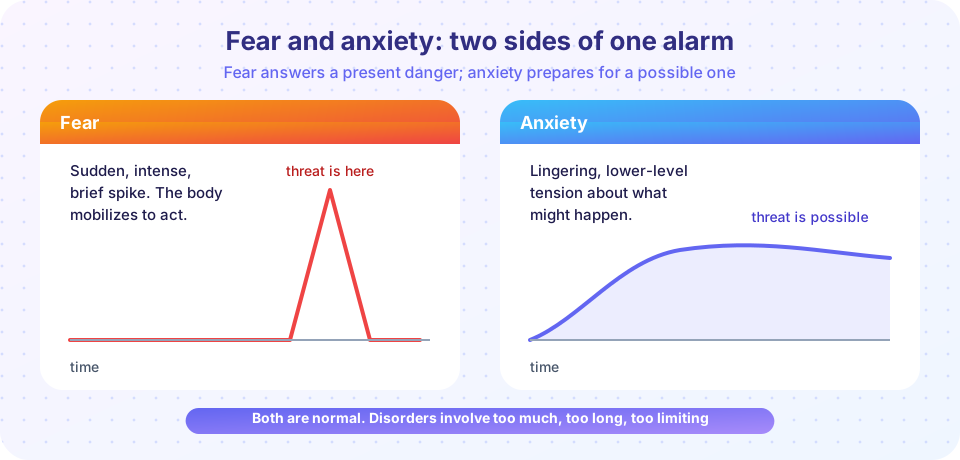
Fear: the emotional response to a real or perceived immediate threat.
Anxiety: anticipation of a future threat, with tension and worry.
Panic attack: an abrupt surge of intense fear peaking within minutes.
Avoidance: staying away from feared situations, which brings relief but maintains fear.
Stress: the response to demands that exceed or tax a person's resources.
The big picture
Alarm system
Anxiety disorders
Related conditions
What is in this chapter
- Anxiety Disorders: generalized anxiety, panic, social anxiety, phobias, agoraphobia and separation anxiety, with causes and treatment.
- OCD and Trauma-Related Disorders: obsessive-compulsive disorder, PTSD and acute stress.
- Stress and Health: Selye, Lazarus, the HPA axis, coping and chronic stress.
- Chapter 3 Review.
A quick look at the evidence
Across the world, anxiety disorders are the most common group of mental health conditions. Treatments work for many: cognitive behavioral therapy (CBT) with exposure is the best-supported psychological treatment, and certain medications such as SSRIs also help some people. Why they begin is a blend of genes (moderate heritability), temperament (behavioral inhibition in childhood), learning (conditioning, observing others), thinking patterns (overestimating threat) and life stress, fitting the diathesis-stress model from Chapter 1.
Common misconceptions
"Anxiety is just being nervous." Everyone is nervous sometimes. A disorder involves intensity, duration, avoidance and impairment.
"Avoiding what scares you is the safest plan." Avoidance gives short-term relief and keeps the fear alive. Gradual, supported exposure is what helps.
"A panic attack means you are dying or going crazy." Panic attacks are frightening but not dangerous in themselves, although chest pain should be medically checked the first time.
Try it
Arousal and performance follow an inverted U, often called the Yerkes-Dodson law (1908). Moderate arousal helps most, too little or too much hurts, and harder tasks peak at lower arousal. Move the slider to see it. This is a simplified model.
Check your understanding
Quick check · 4 questions
of 4 answered You scored / 4 · perfect!
-
1. What is the main difference between fear and anxiety?
Fear is immediate and acute; anxiety is anticipatory and often longer lasting. -
2. Why does avoidance maintain anxiety?
Relief rewards avoidance, so the fear is never tested. -
3. According to the Yerkes-Dodson idea, performance on a hard task is best at
Difficult tasks peak at lower arousal levels than easy ones. -
4. Which treatment has the strongest support for many anxiety disorders?
CBT with exposure is a leading evidence-based approach, with medication also helping some.
Summary
- Fear is a response to present danger; anxiety is anticipation of future danger.
- Anxiety disorders involve excess, duration, avoidance and impairment.
- OCD and PTSD have their own chapters in DSM-5 but are studied with anxiety.
- Exposure-based CBT is a best-supported psychological treatment.
Next: Anxiety Disorders
Track your progress
Create a free account to tick off lessons and pick up where you left off on any device.
of Abnormal and Clinical Psychology lessons completed