


















Lesson 38 of 47 · Prevention, Ethics and Mental Health Systems
Prevention and Public Mental Health: Risk, Resilience and Suicide Prevention
Learn the levels and audiences of prevention, risk and protective factors, the Kauai resilience study, suicide prevention and Rose's prevention paradox.
Treating illness after it appears will never be enough. Mental disorders are common, begin early, and often last a long time, and there are never enough clinicians. Prevention tries to change that equation by reducing how many people develop problems and how severe the problems become.
Public mental health borrows ideas from infectious disease and heart disease prevention: study who is at risk, find the causes that can be changed and act on them at scale. This lesson covers the frameworks, some of the best-known evidence, and a surprising insight from epidemiology about where most cases actually come from.
Educational information only. If you are worried about your own safety or someone else's, contact local emergency services or a crisis line. In the USA you can call or text 988; elsewhere, look for your national helpline.
What you will learn
- Distinguish primary, secondary and tertiary prevention, and universal, selective and indicated programs.
- Explain risk and protective factors and the dose-response pattern in adverse childhood experiences.
- Describe the Kauai study and what it says about resilience.
- Give evidence-based examples of suicide prevention.
- Explain Rose's prevention paradox.
Key terms
- Risk factor: a characteristic that raises the chance of a disorder.
- Protective factor: a characteristic that lowers the chance of a disorder or buffers risk.
- Resilience: doing well despite adversity.
- Means restriction: making a common method of self-harm harder to access.
- Stigma: negative attitudes and discrimination against people because of a condition.
Levels and audiences
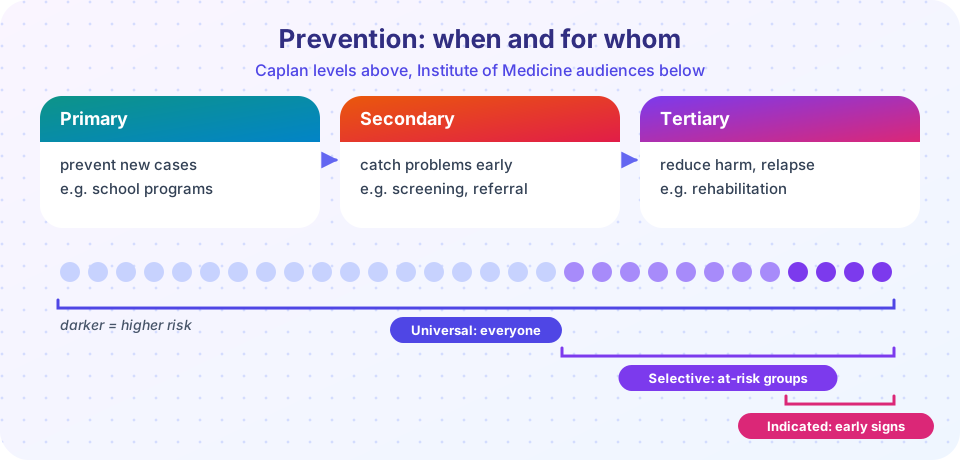
Gerald Caplan (1964) described three levels based on timing:
- Primary prevention aims to stop new cases (for example, teaching coping skills to all children).
- Secondary prevention aims to find and treat problems early, shortening their course (for example, screening for postnatal depression).
- Tertiary prevention aims to reduce disability and relapse in people already ill (for example, rehabilitation and relapse-prevention programs).
The Institute of Medicine (1994) proposed a classification by audience:
- Universal programs target everyone in a population, such as a school curriculum.
- Selective programs target groups with higher-than-average risk, such as children of parents with depression.
- Indicated programs target individuals with early signs but no full disorder, such as young people with mild symptoms.
Risk, protection and adversity
Most disorders have many contributing causes, and risk typically adds up. The Adverse Childhood Experiences (ACE) Study by Vincent Felitti and Robert Anda (1998) surveyed more than 17,000 adults in a health plan in California about childhood abuse, neglect and household dysfunction. The more ACEs a person reported, the higher the rates of depression, substance use, suicide attempts and several physical illnesses in adulthood: a dose-response pattern. Because the data are retrospective and self-reported, the exact numbers should be treated with care, but the pattern has been found repeatedly.
Protective factors work as buffers. They include a stable relationship with at least one caring adult, problem-solving skills, a sense of purpose, good sleep, community connection and access to services. The classic evidence of resilience comes from the Kauai Longitudinal Study by Emmy Werner and Ruth Smith, which followed 698 children born on a Hawaiian island in 1955 for decades. About one third of the children who faced several early risks, such as poverty, family conflict and parental mental illness, nevertheless grew into competent, caring young adults. Protective factors included an easy temperament, at least one dependable adult outside the home, and community supports such as mentors and faith groups. The lesson: risk is not destiny, and resilience can be encouraged.
Prevention programs
- School-based programs. The Good Behavior Game, studied by Sheppard Kellam and colleagues, rewards classroom teams for following rules. Follow-ups of first-graders found lower rates of later substance use, antisocial behavior and suicidal thoughts in some groups, especially boys who were highly aggressive in first grade, although effects varied across studies.
- Parenting programs. Training in positive parenting reduces children's conduct problems and can reduce harsh discipline.
- Depression prevention. Meta-analyses of CBT-based and interpersonal programs found that they reduce the number of new depressive episodes by roughly a fifth compared with controls, with effects strongest for people already at higher risk.
- Perinatal care. Screening and support for parents in pregnancy and after birth is a form of secondary prevention for both parent and child.
Suicide prevention
Suicide is a leading cause of death among young people. Because it is rare in any year, it is hard to predict for individuals (see the assessment lesson), so prevention focuses on population-level measures and on support for people in crisis.
- Means restriction. In England and Wales, domestic gas used to contain carbon monoxide and was a common method of suicide. When the gas supply was changed in the 1960s and 70s, suicides by gas fell to almost zero and the overall suicide rate dropped markedly (Norman Kreitman, 1976); most people did not simply switch to another method. In Sri Lanka, restrictions on the most toxic pesticides coincided with a sharp fall in suicide rates (David Gunnell and colleagues, 2007). Barriers at bridges and railway tracks have a similar effect at those sites.
- Safety planning. A brief intervention in which a person identifies warning signs, coping strategies, contacts and steps to make the environment safer (Barbara Stanley and Gregory Brown) has been associated with fewer later suicidal behaviors.
- Treatment of underlying conditions. Lithium, clozapine and some psychotherapies, such as DBT and CBT for suicide prevention, reduce risk in specific groups.
- Crisis services. Hotlines and text lines provide immediate support. The USA launched the 988 Suicide and Crisis Lifeline in July 2022.
- Responsible media reporting. David Phillips (1974) documented a rise in suicides after publicized suicides, and later research (Thomas Niederkrotenthaler and colleagues, 2010) found that stories of coping and recovery were linked to a protective "Papageno effect". Guidelines recommend avoiding method details and sensational language.
Stigma
Stigma keeps people from seeking help and is itself harmful. Research suggests that contact-based approaches, in which people with lived experience share their stories, change attitudes more than facts alone. England's Time to Change campaign (2009 to 2021) reported improved public attitudes over its life. Language matters too: "a person with schizophrenia" rather than "a schizophrenic", and "died by suicide" rather than "committed suicide".
Rose's prevention paradox
Geoffrey Rose (1981) pointed out something counterintuitive. A few people are at very high risk, but there are many more people at modest risk, and the many produce more cases overall. Treating only the high-risk group therefore misses most future cases, while a small shift across the whole population can prevent more cases than intensive help for the few. The price is that each individual gains little: a "paradox", since a program that benefits the population may offer little to any one person. The simulation below shows the idea with made-up numbers.
Common misconceptions
"Talking about suicide puts the idea in someone's head." Asking directly and calmly does not increase risk and may open the door to help.
"Prevention is only for children." Prevention applies throughout life, including old age, pregnancy and the workplace.
"If someone is determined, nothing can stop them." Means restriction shows that making a method harder to reach saves lives, because crises are often brief.
Try it
The first demonstration simulates Rose's paradox with a made-up risk distribution. The second is a quick sorting exercise for the levels of prevention.
Press Run (or Ctrl + Enter) to see the result here.
Program input · what you'd type while the program runs
Type the answers before you press Run, one per line. Each time the program reads a line (with input()), it gets the next line from this box.
Check your understanding
Quick check · 5 questions
of 5 answered You scored / 5 · perfect!
-
1. A program that teaches coping skills to all pupils in a school is...
It targets everyone in a population, so it is universal (and primary) prevention. -
2. What did the ACE Study find?
Higher ACE scores were linked to higher rates of depression, substance use, suicide attempts and several physical illnesses. -
3. What did the Kauai study suggest about children facing multiple early risks?
Resilience was common and was linked to temperament, caring adults and community supports. -
4. What does the history of domestic gas detoxification in Britain illustrate?
Kreitman found suicides by gas fell and the overall rate dropped. -
5. What is Rose's prevention paradox?
Many people at modest risk produce more cases than the few at high risk.
Summary
- Prevention is described by timing (primary, secondary, tertiary) and by audience (universal, selective, indicated).
- Risk adds up, as the ACE study showed, and protective factors help, as the Kauai study showed.
- Suicide prevention relies on means restriction, safety planning, treatment, crisis services and careful media reporting.
- Stigma harms help-seeking, and contact-based approaches work best.
- Rose's paradox shows why population-wide shifts matter.
Track your progress
Create a free account to tick off lessons and pick up where you left off on any device.
of Abnormal and Clinical Psychology lessons completed