


















Lesson 37 of 47 · Prevention, Ethics and Mental Health Systems
Prevention, Ethics and Mental Health Systems: Chapter Overview
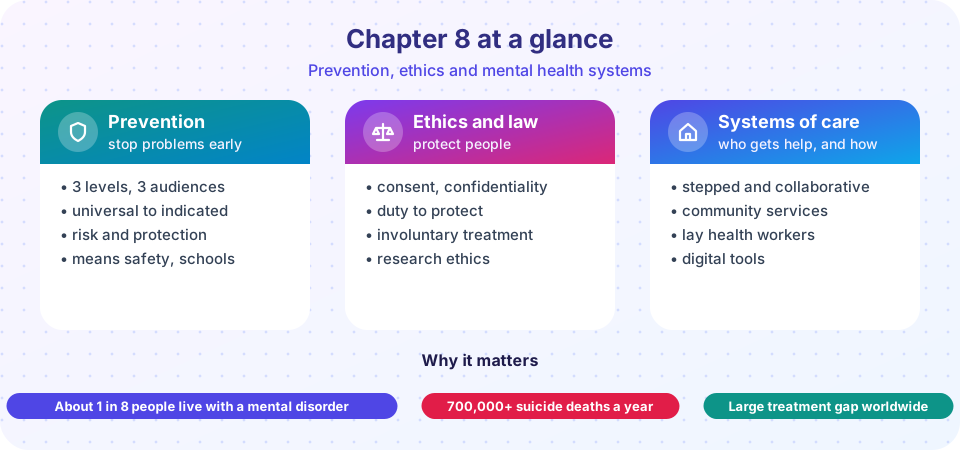
A map of chapter 8: how prevention works across populations, the ethical and legal duties of clinicians, and how mental health care is organized worldwide.
Up to now we have mostly looked at one person and one problem. But mental health is also shaped by things that happen far from the therapy room: poverty, schools, laws, the price of a medicine, whether there is a clinic within a day's travel. And a clinician's work is bound by duties to the person in front of them and to everyone else.
This chapter zooms out in three steps. Prevention asks how to stop problems before they begin or grow. Ethics and law ask what clinicians owe to clients and to the public. Systems ask who actually gets care, and how services can reach more people.
Educational information only. Laws and services vary by country and region. Nothing here is legal advice, and nothing replaces local professional guidance. If you or someone else is in immediate danger, contact local emergency services.
The chapter in five slides
Prevention works at three levels
Risk adds up, protection counts
Ethics guides every decision
The law draws some lines
Systems decide who gets help
What each lesson covers
- Prevention and public mental health: levels and audiences of prevention, risk and resilience, suicide prevention, stigma and the prevention paradox.
- Ethics, law and professional practice: consent, confidentiality, duty to protect, involuntary treatment, research ethics and the history of abuses.
- Mental health care systems: the treatment gap, stepped and collaborative care, community and global models, and digital tools.
- Chapter review: a one-page picture and ten mixed questions.
Try it
The first demonstration plots rough World Health Organization estimates of how many people live with some common conditions. The second is a small calculator for turning counts into rates, a skill every public mental health student needs.
Press Run (or Ctrl + Enter) to see the result here.
Program input · what you'd type while the program runs
Type the answers before you press Run, one per line. Each time the program reads a line (with input()), it gets the next line from this box.
Press Run (or Ctrl + Enter) to see the console output here.
No output.
Check your understanding
Quick check · 3 questions
of 3 answered You scored / 3 · perfect!
-
1. Which level of prevention aims to catch problems early?
Secondary prevention finds and treats problems early, for example through screening and referral. -
2. Why use rates rather than counts when comparing two places?
A small town can have fewer cases but a higher rate. -
3. Which topic belongs to the ethics and law lesson?
Consent, confidentiality, duty to protect and involuntary treatment are covered there.
Summary
- Prevention, ethics and systems shape mental health at the level of populations and professions.
- Prevention works at three levels and for three audiences.
- Ethical codes and laws set boundaries on how clinicians act.
- Systems of care determine who actually receives help; stepped care and lay workers can widen access.
Track your progress
Create a free account to tick off lessons and pick up where you left off on any device.
of Abnormal and Clinical Psychology lessons completed