


















Lesson 21 of 47 · Psychotic and Neurodevelopmental Disorders
Psychotic and Neurodevelopmental Disorders: Chapter Overview
A map of chapter 5: what psychosis is, how schizophrenia is defined, what causes and treats it, and how ADHD and autism fit into neurodevelopment.
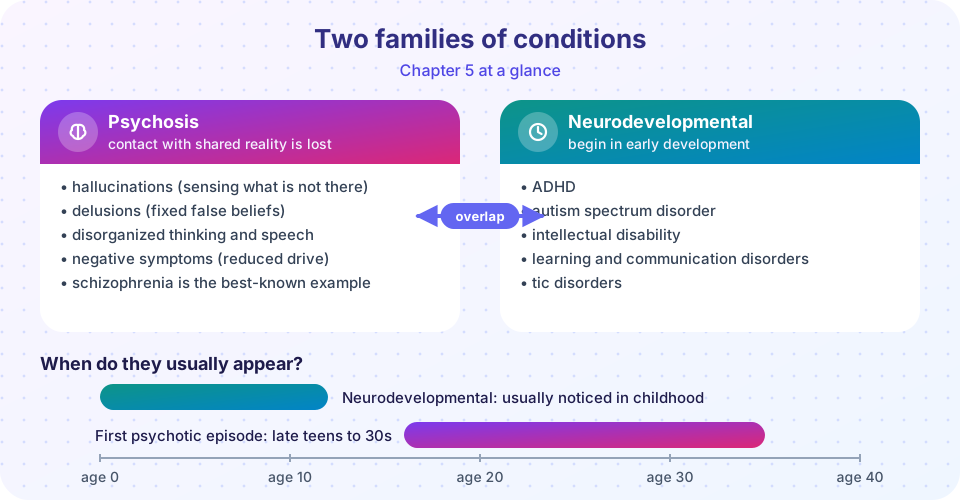
This chapter covers two very different families of conditions that sit side by side in the diagnostic manuals. Psychotic disorders change how a person experiences reality: they may hear voices that no one else hears, hold beliefs that others find impossible to share, or find their thoughts hard to organize. Neurodevelopmental disorders begin early in life, as the brain is still building its networks, and shape attention, communication, learning and behavior.
They belong together in one chapter because researchers now see a thread between them. Many of the same risk genes, and some of the same early brain-development differences, show up in both families. Schizophrenia was even once called "dementia praecox", early dementia, because of its onset in young adults. Today we think of it, in part, as a developmental condition that becomes visible later.
Educational information only. This chapter explains how clinicians and researchers think about these conditions. It is not a diagnostic tool and it is not treatment advice. If you or someone you know is struggling, contact a qualified health professional or a local crisis service.
The chapter in five slides
Psychosis means losing the shared map of reality
Psychosis is a set of symptoms, not one diagnosis.
Schizophrenia is the best-known psychotic disorder
Causes are many and they combine
Neurodevelopmental conditions start early
Support works best when it is early and broad
Recovery is a realistic goal for many people.
What each lesson covers
- Schizophrenia and the psychosis spectrum: the symptom groups, the DSM-5-TR rule, the history of the idea and what the course of the disorder looks like.
- What causes psychosis and what helps: the dopamine and glutamate ideas, genes, environment, the stress-vulnerability model and the evidence for treatments.
- ADHD and autism: definitions, causes, famous theories, what helps, and the neurodiversity debate.
- Chapter review: a one-page picture, a recap table and ten mixed questions.
Key ideas to carry through the chapter
- Dimensions, not cliffs. Hearing a voice once or having an odd belief is common in the general population. What marks a disorder is how persistent, distressing and disabling the experience becomes.
- Many causes, small effects. No single gene, chemical or event explains psychosis or ADHD. Risk adds up.
- Heterogeneity. People with the same label can differ a great deal. Outcomes range from full recovery to long-term disability.
- Language matters. We say "a person with schizophrenia" or "an autistic person" depending on community preference. Many autistic adults prefer identity-first language, and you will see both in research.
Try it
The first demonstration shows rough orders of magnitude for how common these conditions are. The second is a tiny filter over typical ages of onset, so you can ask which conditions usually begin in childhood.
Press Run (or Ctrl + Enter) to see the result here.
Program input · what you'd type while the program runs
Type the answers before you press Run, one per line. Each time the program reads a line (with input()), it gets the next line from this box.
Press Run (or Ctrl + Enter) to see the console output here.
No output.
Check your understanding
Quick check · 4 questions
of 4 answered You scored / 4 · perfect!
-
1. Which pair of terms best describes the two families covered in this chapter?
Chapter 5 covers psychosis (for example schizophrenia) and neurodevelopmental conditions (for example ADHD and autism). -
2. Why are these two families discussed together?
Overlapping genetic and developmental risks link them, although the conditions themselves are distinct. -
3. A first psychotic episode most often appears in which period?
Onset is typically in late adolescence or early adulthood, which is why the timeline in the picture places it there. -
4. What is true about hearing a voice or holding an unusual belief once?
Experiences of this kind exist on a continuum; clinicians look at duration, distress and disability.
Summary
- Psychosis is a set of symptoms (hallucinations, delusions, disorganized thinking); schizophrenia is the best-known psychotic disorder.
- Neurodevelopmental conditions such as ADHD and autism begin early in development.
- Causes combine many genes with environmental influences; no single factor is enough.
- Outcomes vary widely, and support works best when it is early, broad and respectful.
Track your progress
Create a free account to tick off lessons and pick up where you left off on any device.
of Abnormal and Clinical Psychology lessons completed