


















Lesson 27 of 47 · Personality and Other Disorders
Personality Disorders: Clusters, Borderline and Antisocial Patterns
Learn the ten DSM-5 personality disorders and their three clusters, the move to dimensional models, borderline and antisocial patterns, and DBT.
Everyone has a personality: a mix of habitual ways of thinking, feeling and relating that makes us recognizably ourselves. A personality disorder is diagnosed when those habits are so rigid and extreme that they cause persistent distress or trouble with relationships, work or safety. The word "disorder" does not mean the person is bad or broken. It means that a pattern that once may have helped them cope now causes more problems than it solves.
This is one of the most debated areas of clinical psychology. Categories overlap, cut-offs are arbitrary, and many researchers argue that personality problems are better described by how much of a trait someone has than by which box they fit. This lesson covers the official categories, the dimensional alternative, and two well-studied examples.
Educational information only. Personality disorders can only be assessed by trained professionals over time. Do not use these descriptions to label yourself or others.
What you will learn
- State the general DSM-5 criteria for a personality disorder.
- Name the ten types and their three clusters.
- Explain the alternative dimensional models in DSM-5 (Section III) and ICD-11.
- Describe borderline personality disorder and the evidence for dialectical behavior therapy.
- Distinguish antisocial personality disorder from psychopathy.
Key terms
- Personality trait: a stable tendency in thoughts, feelings and behavior, such as shyness or impulsivity.
- Cluster: a grouping of disorders by shared style (A odd, B dramatic, C anxious).
- Emotion dysregulation: difficulty managing the intensity and duration of emotions.
- Invalidating environment: surroundings in which a person's emotional experiences are repeatedly dismissed or punished.
- Psychopathy: a pattern of shallow emotion, manipulation and lack of remorse, measured by Hare's checklist.
The general criteria
DSM-5 defines a personality disorder as an enduring pattern of inner experience and behavior that departs markedly from cultural expectations, shown in at least two areas out of cognition (how one sees self and others), affectivity (emotional range and intensity), interpersonal functioning and impulse control. The pattern must be inflexible and pervasive across situations, cause distress or impairment, be stable and long-lasting with onset in adolescence or early adulthood, and not be better explained by another disorder, substance or medical condition. Around 9 percent of adults in the National Comorbidity Survey Replication (Lenzenweger and colleagues, 2007) met criteria for at least one personality disorder, although that figure depends heavily on method.
The three clusters
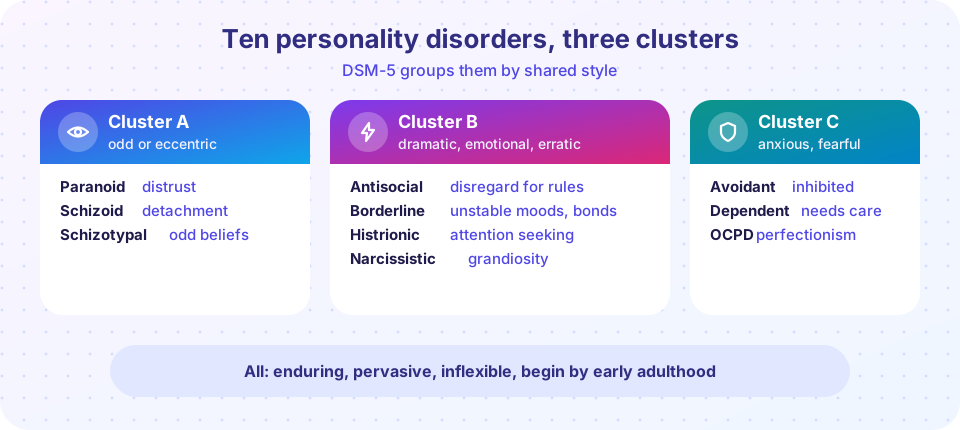
| Cluster | Style | Disorders |
|---|---|---|
| A | Odd or eccentric | Paranoid (distrust and suspicion), schizoid (detachment, limited emotional range), schizotypal (odd beliefs, discomfort in close relationships) |
| B | Dramatic, emotional or erratic | Antisocial (disregard for others' rights), borderline (instability of relationships, self-image and mood), histrionic (excessive emotion and attention seeking), narcissistic (grandiosity, need for admiration, low empathy) |
| C | Anxious or fearful | Avoidant (social inhibition and fear of rejection), dependent (excessive need to be cared for), obsessive-compulsive personality disorder (perfectionism and control) |
Cluster A is related to the psychosis spectrum, and schizotypal disorder is even listed in that chapter of DSM. Obsessive-compulsive personality disorder differs from obsessive-compulsive disorder: people with OCPD usually see their perfectionism as right and reasonable, while people with OCD experience unwanted intrusive thoughts.
Why dimensions may be better
Critics of the categorical system make four main points. First, the categories overlap: people who meet criteria for one personality disorder often meet criteria for others. Second, the diagnoses are heterogeneous. For borderline personality disorder, a person needs five of nine criteria, which allows 256 different combinations (you can check this in the code below), so two people with the same label can look very different. Third, traits vary smoothly, so the cut-off is a convenience. Fourth, the categories do not match the five-factor model of personality (openness, conscientiousness, extraversion, agreeableness, neuroticism).
DSM-5 therefore included an Alternative Model for Personality Disorders in Section III, for further study. It asks first about level of personality functioning (problems with identity and self-direction, and with empathy and intimacy) and then about pathological trait domains: negative affectivity, detachment, antagonism, disinhibition and psychoticism. ICD-11 (in effect from 2022) went further and replaced the separate types with one diagnosis of personality disorder rated as mild, moderate or severe, plus trait qualifiers such as negative affectivity, detachment, dissociality, disinhibition and anankastia (perfectionism). It keeps an optional "borderline pattern" specifier.
Borderline personality disorder
DSM-5 lists nine features, and five are needed: frantic efforts to avoid abandonment; unstable and intense relationships that swing between idealizing and devaluing; unstable sense of self; impulsivity in at least two risky areas; recurrent suicidal behavior or self-harm; rapid mood shifts; chronic feelings of emptiness; intense, hard-to-control anger; and stress-related paranoid thoughts or dissociation. About 1.6 percent of adults have it, according to DSM-5, and women are diagnosed more often in clinical settings.
Causes. Heritability is moderate. Many people report childhood trauma or neglect, though not everyone does. Marsha Linehan's biosocial theory proposes that a biological vulnerability to intense, fast emotional reactions meets an invalidating environment in which feelings are dismissed or punished, so the person never learns to name and manage emotions.
Course. BPD is more hopeful than its reputation. In the McLean Study of Adult Development, which followed patients for many years, most no longer met criteria after several years, although relapses happened and social functioning often lagged behind symptom improvement.
Treatment. Psychotherapy is the main treatment; no medication is approved specifically for BPD. Dialectical behavior therapy (DBT), developed by Linehan, combines acceptance (validation, mindfulness) with change (skills). Standard DBT has four parts: weekly individual therapy, group skills training, phone coaching and a therapist consultation team. The skills groups cover mindfulness, distress tolerance, emotion regulation and interpersonal effectiveness. In Linehan's 1991 trial with 44 women who repeatedly harmed themselves, DBT led to fewer self-harm episodes and fewer days in hospital than usual treatment. Other approaches with evidence include mentalization-based treatment (Bateman and Fonagy), schema therapy and transference-focused psychotherapy.
Antisocial personality disorder and psychopathy
Antisocial personality disorder (ASPD) requires a pervasive pattern of disregard for and violation of the rights of others since age 15, with at least three of seven features (such as law-breaking, deceit, impulsivity, irritability and aggression, recklessness, irresponsibility and lack of remorse). The person must be at least 18 and have shown signs of conduct disorder before age 15.
Psychopathy is a related but separate idea. Hervey Cleckley described it in The Mask of Sanity (1941), and Robert Hare turned it into the Psychopathy Checklist-Revised (PCL-R): 20 items scored from 0 to 2 by a trained rater, with factors for interpersonal/affective traits (superficial charm, shallow emotion) and an antisocial lifestyle. Psychopathy is not a DSM diagnosis. Most people with ASPD would not meet psychopathy cut-offs, and the picture of psychopaths as inevitably violent is a stereotype. Treatment evidence is limited, though structured programs for people in prison and early parenting interventions for children with conduct problems show promise.
Common misconceptions
"Personality disorders cannot change." Traits shift across the life span, and many people improve with therapy and as they get older.
"Borderline means someone is manipulative." Clinicians increasingly stress that behaviors that look manipulative are often attempts to cope with overwhelming distress.
"All psychopaths are violent criminals." Many people with high psychopathic traits are not violent, and most violent offenders are not psychopaths.
Try it
The first demonstration shows why cut-offs are conventions: two people just either side of a threshold are almost identical. The second is a click-through explorer of the three clusters.
Press Run (or Ctrl + Enter) to see the result here.
Program input · what you'd type while the program runs
Type the answers before you press Run, one per line. Each time the program reads a line (with input()), it gets the next line from this box.
Check your understanding
Quick check · 5 questions
of 5 answered You scored / 5 · perfect!
-
1. Which is NOT part of the general DSM-5 definition of a personality disorder?
Personality disorders are defined by stable, enduring, inflexible patterns, not by patterns that vanish from week to week. -
2. Which disorders belong to cluster B?
Cluster B is the dramatic, emotional or erratic group; A is odd or eccentric and C is anxious or fearful. -
3. What is dialectical behavior therapy built around?
DBT combines validation and acceptance with skills training for change. -
4. How does psychopathy differ from antisocial personality disorder?
ASPD is defined by behavior, while psychopathy emphasizes interpersonal and affective traits such as shallow emotion. -
5. Why do many researchers favor dimensional models?
Overlap, heterogeneity and arbitrary thresholds make traits on scales a better fit.
Summary
- A personality disorder is an enduring, pervasive, inflexible pattern that begins by early adulthood and causes distress or impairment.
- DSM-5 lists ten types in three clusters (odd, dramatic, anxious).
- Dimensional models in DSM-5 Section III and ICD-11 describe functioning and trait domains instead.
- BPD has a good outlook for many people, and DBT is a well-studied treatment.
- ASPD is a behavioral diagnosis; psychopathy is a separate construct.
Next: Eating disorders
Track your progress
Create a free account to tick off lessons and pick up where you left off on any device.
of Abnormal and Clinical Psychology lessons completed