


















Lesson 8 of 47 · Defining and Classifying Disorders
Classification: DSM and ICD
Learn how the DSM-5-TR and ICD-11 classify mental disorders, how a diagnosis is made, what changed over time, and why dimensional models such as HiTOP and RDoC exist.
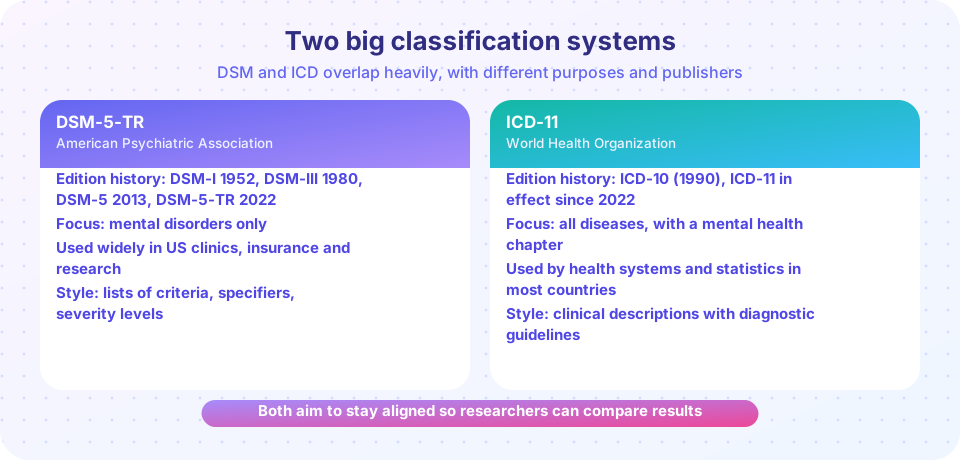
If every clinician described problems in their own words, you could not compare two studies, plan services or even tell a colleague what you meant. Two manuals fill that role. The DSM, the Diagnostic and Statistical Manual of Mental Disorders, is published by the American Psychiatric Association. The ICD, the International Classification of Diseases, is published by the World Health Organization and covers all diseases, with a chapter for mental disorders. This lesson explains how they work, how a diagnosis is made, and where critics see problems.
What you will learn
- The history of the DSM and how the manuals differ.
- How a clinician moves from symptoms to a diagnosis.
- What polythetic criteria are and why they matter.
- Alternatives that stress dimensions: HiTOP and RDoC.
Key terms
DSM-5-TR: the 2022 text revision of the fifth edition of the American manual.
ICD-11: the WHO's eleventh revision, in effect worldwide since 2022.
Polythetic criteria: a rule such as "five of nine symptoms" that allows different symptom combinations to meet the same diagnosis.
Specifier: an add-on that describes subtype, severity or course (for example "with anxious distress").
Differential diagnosis: weighing alternative explanations for the same symptoms.
A short history of the DSM
- DSM-I (1952) and DSM-II (1968) used short, vague descriptions heavily influenced by psychodynamic theory. Agreement between clinicians was poor.
- DSM-III (1980) was a revolution. Led by Robert Spitzer, it listed explicit symptom criteria for each disorder, aimed to be atheoretical about causes, and used a multiaxial system (clinical disorders, personality, medical conditions, stressors, functioning).
- DSM-IV (1994) and DSM-IV-TR (2000) refined criteria with research reviews.
- DSM-5 (2013) dropped the axes, merged several conditions (for example the autism spectrum absorbed Asperger's disorder), added disorders such as binge-eating disorder and disruptive mood dysregulation disorder, and removed the bereavement exclusion for depression (a debated change).
- DSM-5-TR (2022) updated text and added prolonged grief disorder.
The ICD
The ICD has been used since the late 19th century, originally to count causes of death. ICD-10 (adopted 1990) was the standard for decades. ICD-11, approved in 2019 and in effect from 1 January 2022, restructured the mental chapter, added conditions such as complex PTSD, prolonged grief disorder and gaming disorder, and moved gender incongruence out of the mental disorders chapter into a sexual health chapter. In most countries ICD codes are used for health records and billing, while research papers, especially in the US, often cite the DSM. Experts aim to keep the two aligned, but differences remain (for example, how personality disorders are described).
How a diagnosis is made
A clinician typically follows these steps:
- Gather information through a clinical interview, observation, medical history, and sometimes questionnaires, family reports or structured interviews such as the SCID.
- Compare with criteria: Do the symptoms match the listed pattern, for long enough, and cause clinically significant distress or impairment?
- Rule out other causes: medical conditions (thyroid disease, brain injury), substances and medications, and other mental disorders. This is differential diagnosis.
- Add specifiers and severity, for example mild, moderate or severe.
- Formulate the case: a diagnosis names a pattern, while a formulation explains how this particular person's biology, thoughts, relationships and history produced it and what might help.
Polythetic criteria
Many diagnoses use a count: "five or more of the following nine symptoms". Because different combinations qualify, two people can have the same diagnosis while sharing few symptoms. That flexibility reflects reality but also helps explain why diagnoses are heterogeneous, a problem we revisit in the next lesson. The demonstration below counts the possibilities.
Categories or dimensions?
Categorical diagnosis resembles a switch: you have a disorder or you do not. But many problems vary continuously, like blood pressure. Two alternatives have grown out of this criticism:
- RDoC (Research Domain Criteria), launched by the US National Institute of Mental Health around 2009, studies dimensions such as threat response or reward processing across levels from genes to behavior, rather than DSM categories.
- HiTOP (Hierarchical Taxonomy of Psychopathology), proposed by Roman Kotov and colleagues (2017), organizes symptoms by their statistical co-occurrence into broad spectra (for example "internalizing", "externalizing", "thought disorder") and narrower dimensions.
Neither has replaced the manuals in daily practice, but they influence research and some clinicians' thinking. DSM-5 itself added dimensional severity ratings for some conditions.
Benefits and criticisms
Benefits: a shared language, easier research, access to services and insurance, and the validation people feel when their experience has a name. Criticisms: categories may draw lines where nature has none; the lists grow and may medicalize ordinary distress (psychiatrist Allen Frances, who chaired the DSM-IV task force, argued this in Saving Normal); commercial and professional interests can bias committees; and labels can stigmatize. Good clinicians use the system as a tool, not as the whole story.
Common misconceptions
"The DSM tells us what causes disorders." Mostly it does not. It describes symptom patterns; causes are studied separately.
"If a diagnosis is in the DSM, its boundaries are scientifically proven." Boundaries are set by committees reviewing evidence and balancing practical considerations.
"DSM and ICD are rival systems." They are largely compatible, with different purposes and audiences.
Try it
The first demonstration counts how many symptom combinations satisfy a "five of nine, including at least one of the first two" rule, similar in structure to the depressive episode criteria you will meet in Chapter 4. It is a counting exercise about polythetic rules, not a diagnostic tool.
Press Run (or Ctrl + Enter) to see the result here.
Program input · what you'd type while the program runs
Type the answers before you press Run, one per line. Each time the program reads a line (with input()), it gets the next line from this box.
The second demonstration is a small lookup comparing how DSM-5 and ICD-11 file a few conditions. Type in the box to filter. The content is a simplified summary.
Check your understanding
Quick check · 6 questions
of 6 answered You scored / 6 · perfect!
-
1. What was the key innovation of DSM-III (1980)?
DSM-III introduced operational criteria to improve diagnostic agreement. -
2. Which organization publishes the ICD?
The WHO publishes the ICD; the APA publishes the DSM. -
3. What does a polythetic criterion mean?
For example, any five of nine symptoms may qualify. -
4. What is differential diagnosis?
Clinicians must rule out other causes of the same symptoms. -
5. HiTOP is best described as
HiTOP offers a hierarchical, dimensional alternative to categories. -
6. Which is a common criticism of expanding diagnostic categories?
Allen Frances argued this in Saving Normal.
Summary
- The DSM (APA) and ICD (WHO) give clinicians a shared language; DSM-III in 1980 introduced explicit criteria.
- A diagnosis comes from interview, criteria, ruling out other causes, specifiers and, ideally, a case formulation.
- Polythetic criteria let people with different symptoms share a label.
- HiTOP and RDoC point toward dimensional models; critics worry about over-medicalization.
Track your progress
Create a free account to tick off lessons and pick up where you left off on any device.
of Abnormal and Clinical Psychology lessons completed