Review the history of treatment, research methods and causal models in clinical psychology with a one-page summary, a recap table, flashcards and a ten-question quiz.
You now have the foundations. You know how societies explained and treated mental illness, how researchers gather evidence, and why modern models use several causes together. This review pulls the chapter into one picture, one table and one mixed quiz. Try to recall each idea before you look at the answer.
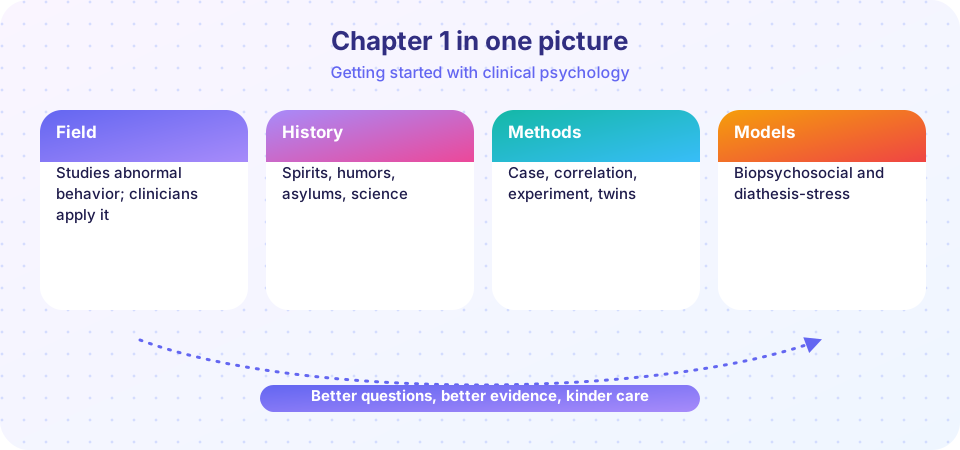
Caption: Chapter 1 in one picture: knowing the history, methods and models helps you ask better questions and weigh claims.
Use the flashcards: think of the answer first, then click to reveal it.
Chapter 1 flashcards
<style>body{font-family: system-ui, sans-serif;margin: 0;padding: 14px;background: #faf5ff;color: #1e1b4b;}.card{background: #fff;border-radius: 20px;padding: 22px;min-height: 120px;box-shadow: 0 10px 26px rgba(67,56,202,.16);cursor: pointer;display:flex;align-items:center;justify-content:center;text-align:center;font-size: 19px;font-weight: 600;}.card.back{background:linear-gradient(135deg,#6366f1,#a78bfa);color: #fff;}.nav{margin-top: 12px;display: flex;gap: 8px;align-items: center;}button{border: 0;border-radius: 999px;padding: 8px 18px;font-weight: 700;cursor: pointer;background: #e0e7ff;color: #3730a3;}span{color: #475569;font-size: 14px;}</style><divclass="card"id="c"></div><divclass="nav"><buttonid="p">Previous</button><buttonid="n">Next</button><buttonid="s">Shuffle</button><spanid="i"></span></div><script>constD=[["Who is credited with unchaining patients at Bicetre in 1793?","Philippe Pinel (moral treatment)."],["What did Kraepelin's 1883 textbook introduce?","Classification of disorders by their typical course over time."],["What happened in 1952 that began the drug era?","Chlorpromazine, the first antipsychotic, was reported by Delay and Deniker."],["Why can a correlation not prove causation?","Direction may be reversed, or a third variable may cause both."],["What makes an RCT strong?","Random assignment (and usually blinding and pre-registration)."],["Falconer's formula for heritability?","h2 = 2 x (r_MZ - r_DZ)."],["What is the diathesis-stress model?","Vulnerability plus stress crossing a threshold produces a disorder."],["What is equifinality?","Different pathways can lead to the same outcome."],["What did the 5-HTTLPR story teach?","Early candidate-gene findings often fail to replicate."],["What is deinstitutionalization?","The shift from large hospitals to community care."]];let i =0, front =true;const c = document.getElementById('c');functiondraw(){ c.className ='card'+(front ?'':' back'); c.textContent =D[i][front ?0:1]; document.getElementById('i').textContent =(i +1)+' / '+D.length;}
c.onclick=()=>{ front =!front;draw();};
document.getElementById('n').onclick=()=>{ i =(i +1)%D.length; front =true;draw();};
document.getElementById('p').onclick=()=>{ i =(i +D.length -1)%D.length; front =true;draw();};
document.getElementById('s').onclick=()=>{for(let k =D.length -1; k >0; k--){const j = Math.floor(Math.random()*(k +1));[D[k],D[j]]=[D[j],D[k]];} i =0; front =true;draw();};draw();</script>