


















Lesson 2 of 47 · Getting Started
A History of Treating Mental Illness
Follow how societies explained and treated mental illness, from ancient healers and asylums to moral treatment, psychotropic drugs and community care.
Every society has had to explain why some people think, feel or act in ways that seem to break from the ordinary. The explanations changed with the available knowledge: spirits, imbalanced fluids, moral weakness, damaged brains, learned habits, and eventually the multi-factor models we use now. Treatments changed with them, sometimes kindly and sometimes cruelly. This lesson walks through the story, because modern debates (medication versus talk therapy, hospitals versus community care, labels versus dimensions) echo much older arguments.
What you will learn
- The main explanations of mental illness from antiquity to the present.
- How asylums arose, how moral treatment reformed them, and why they declined.
- Why the 1950s drug revolution and deinstitutionalization changed care.
- Why history warns us to be humble about today's treatments.
Key terms
Asylum: an institution that housed people with mental illness, ranging from refuges to overcrowded warehouses.
Moral treatment: an early 19th-century approach that stressed kindness, routine, work and dignity.
Psychotropic medication: a drug that mainly affects mood, thinking or behavior.
Deinstitutionalization: the shift from large psychiatric hospitals toward community-based care.
Medical model: viewing mental disorders as illnesses with biological causes and medical treatments.
Ancient ideas: spirits and bodies
Archaeologists have found Neolithic skulls with deliberate holes, a procedure called trepanation. People survived some of these operations, since the bone healed. Why they were done is unknown. A popular guess is that they were meant to release spirits, but the evidence cannot confirm this, so treat any single story with caution.
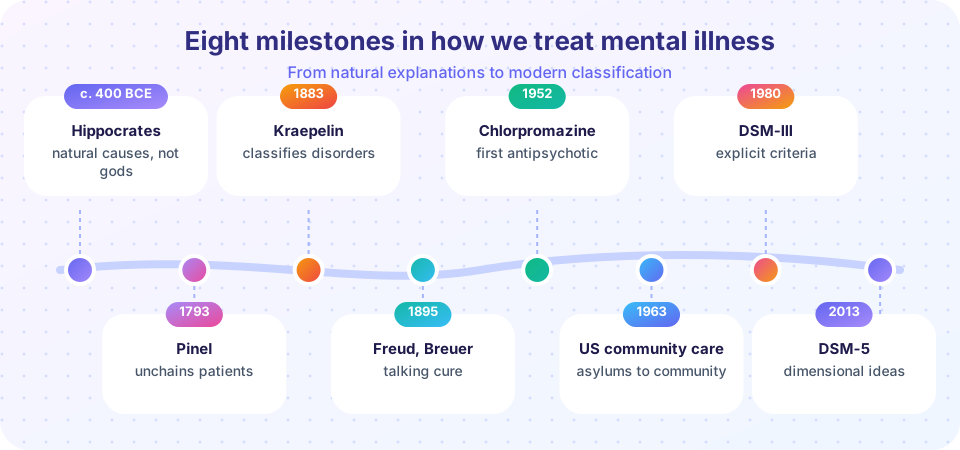
Written records tell us more. Ancient Mesopotamian, Egyptian, Chinese and Greek texts describe states we would recognize as depression, mania and delusion. Explanations mixed religion and medicine. In Greece, a naturalistic view emerged around the 5th century BCE with the physicians associated with Hippocrates. They argued that mental disturbances came from the body, not from angry gods, and in particular from imbalances of four humors: blood, phlegm, yellow bile and black bile. Excess black bile (melancholia in Greek) gave us the word "melancholy". The humoral theory was wrong in detail, but the move toward natural causes was a lasting step.
In the medieval Islamic world, physicians such as Ibn Sina (Avicenna) wrote about mental illness as a medical problem, and hospitals in cities like Baghdad and Cairo included wards for the mentally ill. In medieval Europe, responses varied widely by place and period. Some were religious (care by monasteries, pilgrimage to shrines), some harsh. Historians caution against the popular picture of constant witch-hunts of mentally ill people: the causes of witch trials were complex, and many accused were not mentally ill.
Asylums and moral treatment
From the 1500s, European cities founded institutions to house the mentally ill. London's Bethlem Hospital, nicknamed Bedlam, became infamous for chaos and for visitors paying to watch. Many asylums were overcrowded, and patients could be chained or restrained.
In the 1790s, reformers argued that the insane could be treated with humanity. The French physician Philippe Pinel is credited with removing chains from patients at the Bicêtre hospital in Paris in 1793, and the English Quaker William Tuke founded the York Retreat in 1796, a small, calm institution. Their moral treatment emphasized respect, regular routines and useful work. Historians note that the famous image of Pinel as sole liberator is partly legend and that others worked toward reform too, but the movement was real and influential.
In the 19th century, American reformer Dorothea Dix lobbied legislatures for better state hospitals after seeing prisoners with mental illness held in jails. Hospitals multiplied, then filled beyond capacity, and conditions often declined. The ideal of the humane asylum was undone by overcrowding and little effective treatment.
The birth of classification and psychological theory
In 1883 the German psychiatrist Emil Kraepelin published a textbook that grouped disorders by their typical course over time. He separated what he called dementia praecox (later schizophrenia) from manic-depressive illness. This idea, that disorders have patterns we can describe and predict, is the ancestor of the DSM.
At the same time, psychological explanations rose. In the 1880s, Jean-Martin Charcot in Paris studied hysteria using hypnosis. Sigmund Freud and Josef Breuer published Studies on Hysteria in 1895, and Freud developed psychoanalysis: unconscious conflicts, early childhood, and the "talking cure". Psychoanalysis shaped culture and early therapy, but its claims are difficult to test, and modern research supports other approaches better. In the early 20th century, behaviorists like Watson and later Skinner explained abnormal behavior as learned. Carl Rogers introduced person-centered therapy in the 1940s and 1950s, stressing empathy.
Alongside these ideas, harsh physical treatments appeared. Insulin coma therapy, early electroconvulsive therapy (ECT, 1938, by Cerletti and Bini) and lobotomy, which won Egas Moniz a Nobel Prize in 1949, were used widely and often without proper trials or consent. Modern ECT, given under anesthesia with muscle relaxants, is a very different and evidence-supported treatment for severe depression. Lobotomy, in contrast, is now seen as a serious ethical failure. History is a reminder to require evidence and consent.
The drug revolution and community care
In 1952, French doctors Jean Delay and Pierre Deniker reported striking results with chlorpromazine, the first antipsychotic. Antidepressants and mood stabilizers followed in the 1950s and 1960s. For the first time, many people with severe illness could live outside hospital walls. Together with exposés of bad hospital conditions and civil-rights concerns, this drove deinstitutionalization. In the US, a 1963 law supported community mental health centers, and hospital populations fell sharply in the following decades.
Deinstitutionalization was only partly a success. Community services were often under-funded, and some people ended up homeless, in prison or without care. The lesson is not that hospitals were good or bad but that moving people out requires moving resources into the community.
Classification, rights and recovery
The first DSM appeared in 1952. DSM-III (1980) was a turning point: it described disorders by explicit symptom criteria to improve agreement between clinicians (Chapter 2). In 1973 the American Psychiatric Association removed homosexuality from its list of mental disorders after years of activism and debate, a reminder that classification reflects culture as well as science. Today, the recovery movement, led partly by people with lived experience, stresses that a person can build a meaningful life with or without symptoms, and that care should respect rights and choice.
Common misconceptions
"People in the past were simply cruel or stupid." Many practitioners tried to help with the knowledge they had. The right lesson is humility: some of today's confident beliefs will look wrong later.
"Medication replaced all other treatments." Evidence supports both psychological therapies and medication, often together, depending on the problem.
"Asylums vanished because they were abolished overnight." The change was gradual and driven by drugs, costs, law, activism and shifting views.
Try it
Click a milestone to read what people believed and did in that era. It is a simplified summary for study.
The second demonstration lets you ask what a person in a given year would likely have believed about the cause of "madness". It is a simplified lookup that illustrates how views changed.
Press Run (or Ctrl + Enter) to see the console output here.
No output.
Check your understanding
Quick check · 5 questions
of 5 answered You scored / 5 · perfect!
-
1. What was the key idea of the Hippocratic physicians about mental disturbance?
They favored natural explanations, a lasting shift even though humoral theory itself was wrong. -
2. What did moral treatment emphasize?
Pinel and Tuke stressed humane treatment and a structured, respectful environment. -
3. Which development in 1952 helped many patients leave hospitals?
Chlorpromazine controlled some severe symptoms and helped make community care possible. -
4. What is a lesson of deinstitutionalization?
Without funded community services, many people were left without adequate care. -
5. Why did DSM-III (1980) matter?
Operational criteria were meant to make diagnoses more reliable.
Summary
- Explanations moved from spirits to natural causes (Hippocrates), moral causes, brain disease (Kraepelin), unconscious conflict (Freud), learning, and finally multi-factor models.
- Asylums began as refuges, were reformed by moral treatment, then became overcrowded.
- Chlorpromazine (1952) and later drugs helped begin deinstitutionalization.
- Classification systems and today's recovery movement continue to change care.
- History teaches humility: demand evidence and consent.
Track your progress
Create a free account to tick off lessons and pick up where you left off on any device.
of Abnormal and Clinical Psychology lessons completed