


















Lesson 6 of 47 · Defining and Classifying Disorders
Chapter 2 Overview: Defining and Classifying Disorders
A map of chapter 2: what counts as abnormal, how DSM and ICD classify disorders, and why reliability and validity matter for diagnosis.
Before we can study disorders, we have to decide what we are studying. That sounds easy until you try it. Is intense grief a disorder? Is extreme shyness? Is hearing a loved one's voice after their death? Societies, clinicians and researchers have argued about the boundary for centuries, and the answer shapes who gets care, who gets insurance coverage, and who gets stigma. This chapter explains how the boundary is drawn today and where it is still disputed.
What you will learn
- The big questions of chapter 2 and how the lessons answer them.
- Why a shared classification system exists at all.
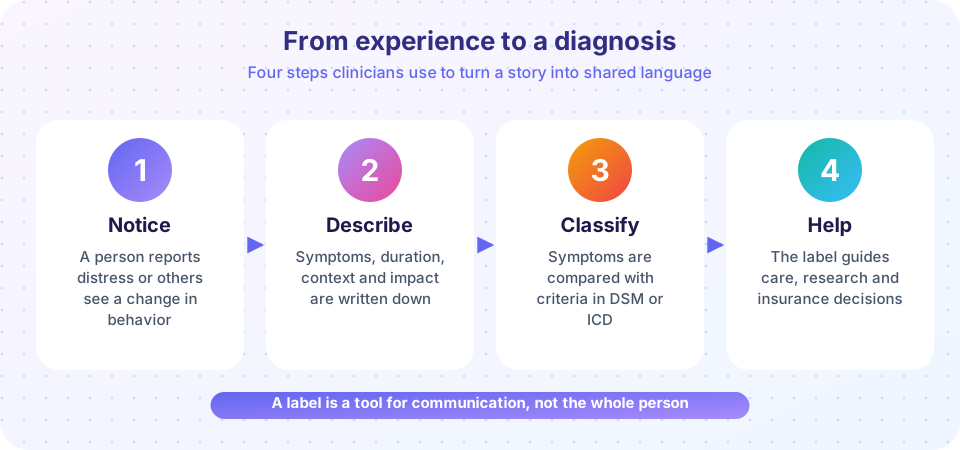
- The difference between defining abnormality and diagnosing a person.
Key terms
Diagnosis: identifying a disorder by comparing a person's symptoms with agreed criteria.
Classification system: an organized list of disorders with criteria, such as the DSM or ICD.
Syndrome: a cluster of symptoms that tend to occur together.
Prevalence: the proportion of people with a condition in a population.
The big picture
Why classify?
The hard questions
The risks
The four lessons in this chapter
- What Is Abnormal? examines statistical infrequency, social norms, dysfunction, the four Ds and the role of culture.
- Classification: DSM and ICD tours the two major manuals, how they changed, and how a diagnosis is made.
- Reliability and Validity of Diagnosis covers Rosenhan's famous study, field-trial agreement, comorbidity and the move toward dimensions.
- Chapter 2 Review recaps with an illustration and a ten-question quiz.
Why it matters
A good definition protects two groups. It protects people who need help from being ignored, and it protects people who are simply different from being pathologized. Think of the history you read in Chapter 1: homosexuality was once classified as a disorder, and political dissent has been labelled mental illness in some regimes. Careful criteria, open debate and cultural humility are the safeguards.
Common misconceptions
"A diagnosis is a fact like a broken bone." Many diagnoses are consensus categories built from symptom clusters, and the boundaries shift between editions.
"If you meet criteria you are defined by the label." The label describes a pattern at a time. People are more than their diagnoses.
Try it
Which of the four Ds do you think each short example shows? Choose, then compare with the explanation. These are examples for thinking, not diagnostic tools.
Check your understanding
Quick check · 4 questions
of 4 answered You scored / 4 · perfect!
-
1. Why do clinicians use a classification system?
Shared categories help communication, research and service planning. -
2. Which statement about diagnosis is the most accurate?
The DSM and ICD have been revised repeatedly. -
3. What is the risk of defining abnormality too broadly?
Over-broad definitions can turn normal differences into disorders. -
4. Which is a term for symptoms that tend to occur together?
A syndrome is a recurring cluster of symptoms.
Summary
- Classification gives clinicians and researchers a shared language, with risks as well as benefits.
- The chapter covers defining abnormality, the DSM and ICD, and reliability and validity.
- Definitions must protect both people who need help and people who are just different.
Next: What Is Abnormal?
Track your progress
Create a free account to tick off lessons and pick up where you left off on any device.
of Abnormal and Clinical Psychology lessons completed