


















Lesson 16 of 47 · Mood Disorders
Chapter 4 Overview: Mood Disorders
A map of chapter 4 on mood disorders: the mood spectrum, depressive episodes, bipolar disorders, causes, and why duration and impact matter more than a single bad day.
Everyone's mood moves. A good exam result lifts it; a loss drags it down; a poor night's sleep makes everything look gray. Those ups and downs are part of life. Mood disorders are different in degree, duration and impact: the mood is persistently low, or abnormally high and energized, for days or weeks, and it changes how a person sleeps, thinks, works and relates to others. Depression is the leading cause of disability worldwide in many analyses, and bipolar disorder carries high risks if untreated. Both are treatable.
Educational information only, with a safety note. This chapter discusses depression and, in places, suicide. It cannot diagnose or treat. If you are struggling, please talk to a doctor, counselor or someone you trust. If you are in immediate danger or thinking about harming yourself, contact your local emergency number or a crisis line (in the US, call or text 988; elsewhere, find your national helpline).
What you will learn
- The mood spectrum and how episodes differ from ordinary mood changes.
- The main mood disorders and where each lesson will take you.
- Why duration, intensity and impairment define a disorder.
Key terms
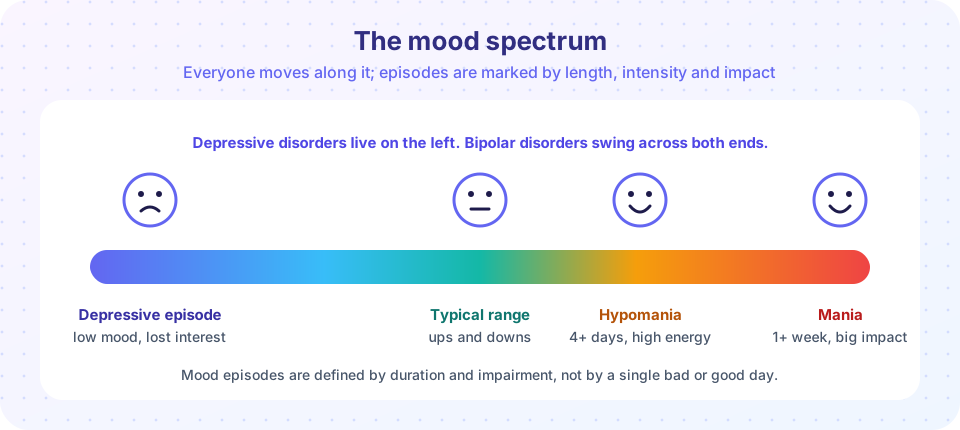
Mood episode: a distinct period of abnormal mood: depressive, manic or hypomanic.
Major depressive episode: at least two weeks of low mood or lost interest plus other symptoms.
Mania: a distinct period of abnormally elevated or irritable mood and increased energy lasting at least a week, or any duration if hospitalization is needed.
Hypomania: a milder, shorter (at least four days) version of mania.
Euthymia: a typical, stable mood.
The big picture
Two families
Depressive disorders
Bipolar disorders
What is in this chapter
- Depression: the nine symptoms, other depressive disorders, course, and treatment, with a safety section.
- Bipolar Disorders: mania, hypomania, bipolar I and II, cyclothymia, and long-term care.
- What Causes Mood Disorders?: genes, brain, Beck's triad, learned helplessness, rumination and social stress.
- Chapter 4 Review.
Why duration and impact matter
Sadness after a loss is not depression, even when it is intense. Several features move low mood into disorder: it lasts nearly every day for at least two weeks, it includes loss of interest or pleasure, and it affects sleep, energy, concentration and self-worth enough to impair work, school or relationships. The same logic applies to high mood: a fantastic day is not mania. Mania lasts days, reduces the need for sleep, sends thoughts racing and often leads to risky decisions. The chart in this chapter's opening shows why time is part of the definition.
Common misconceptions
"Depression is just sadness." It also involves loss of interest, fatigue, sleep and appetite change, slowed thinking and often irritability or numbness.
"Bipolar disorder means mood swings every few hours." Episodes last days to months; rapid mood changes within hours are usually something else.
"You can snap out of it." Willpower does not remove a depressive episode. Effective treatments exist.
Try it
Click each day to record a mood rating for a fictional two weeks, from 1 (very low) to 10 (very high). The tool counts consecutive low days to show why duration matters. It is a demonstration, not a screening tool.
Check your understanding
Quick check · 4 questions
of 4 answered You scored / 4 · perfect!
-
1. What distinguishes a mood episode from an ordinary change in mood?
Episodes last days to weeks and affect sleep, energy, thinking and functioning. -
2. What is hypomania?
Mania lasts at least a week or needs hospitalization; hypomania is less severe. -
3. Which pair of families do mood disorders divide into?
DSM-5 separates depressive disorders from bipolar and related disorders. -
4. Which statement is accurate?
Both are treatable, though response varies.
Summary
- Mood disorders are defined by episodes of abnormal mood with duration, intensity and impairment.
- Depressive disorders and bipolar disorders are the two families.
- Depression is more than sadness; bipolar disorder is more than mood swings.
- Effective treatments exist; help is worth seeking.
Next: Depression
Track your progress
Create a free account to tick off lessons and pick up where you left off on any device.
of Abnormal and Clinical Psychology lessons completed