


















Lesson 25 of 47 · Psychotic and Neurodevelopmental Disorders
Chapter 5 Review: Psychotic and Neurodevelopmental Disorders
Review chapter 5 with a one-picture summary, a recap table and ten mixed questions on schizophrenia, causes, treatment, ADHD and autism.
You have now met two families of conditions that look very different on the surface but share early-development roots and high heritability. This review pulls the chapter together: first a single picture, then a table to scan, then ten questions that mix all the lessons.
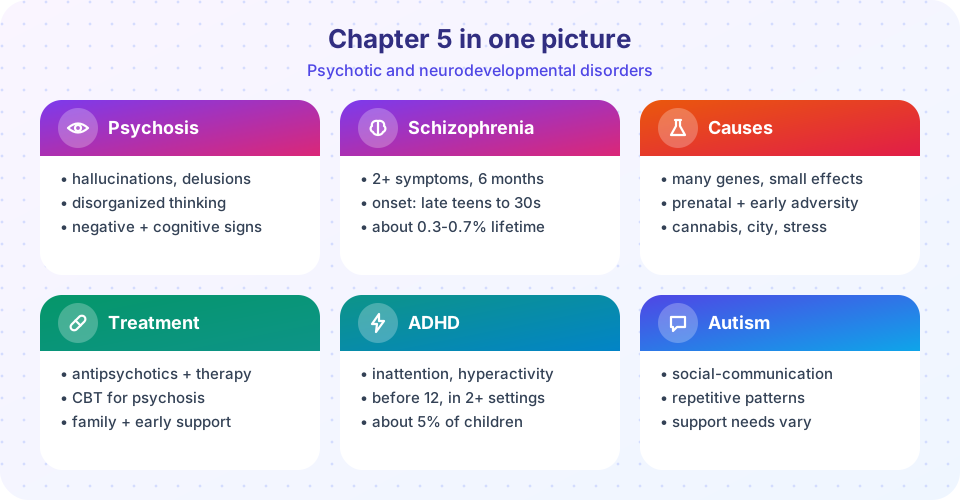
Recap table
| Topic | Key facts | Landmark names |
|---|---|---|
| Psychosis | Hallucinations, delusions, disorganized thinking; a symptom set rather than one diagnosis | Kraepelin, Bleuler, Schneider |
| Schizophrenia | Two or more symptom groups (one of the first three), six months of disturbance, functional decline | DSM-5-TR |
| Neurochemistry | Dopamine (aberrant salience), glutamate (NMDA) | Seeman, Kapur, Howes |
| Genes | Polygenic; identical twins about 48 percent concordant in classic data | Gottesman, Sekar |
| Environment | Prenatal events, cannabis, urban life, migration, childhood adversity | Dutch Hunger Winter |
| Model | Vulnerability plus stress crosses a threshold | Zubin and Spring |
| Treatment | Antipsychotics, CBT for psychosis, family work, early intervention | Leucht, RAISE |
| ADHD | Inattention and hyperactivity-impulsivity, before 12, in 2+ settings; heritability about 74 percent | Faraone, Barkley, MTA |
| Autism | Social-communication differences plus restricted, repetitive patterns; heritability about 80 percent | Baron-Cohen, Milton, Wakefield (retracted) |
Try it
A tool used in the review of trials is the number needed to treat (NNT): how many people must be treated for one extra person to benefit. Use the numbers from the Leucht meta-analysis (relapse in a year: about 64 percent on placebo, about 27 percent on antipsychotics) and try your own.
Press Run (or Ctrl + Enter) to see the console output here.
No output.
Check your understanding
Quick check · 10 questions
of 10 answered You scored / 10 · perfect!
-
1. Which combination satisfies the symptom rule for schizophrenia in DSM-5-TR?
Two or more symptom groups are needed, and at least one must be delusions, hallucinations or disorganized speech. -
2. A person shows symptoms that meet the criteria for four months. The best time-based label is...
One to under six months of symptoms is schizophreniform; six months or more is schizophrenia. -
3. What did Gottesman's classic figures show about identical twins?
Concordance of about 48 percent in identical twins shows a strong genetic role and a clear role for other factors. -
4. In the stress-vulnerability model, what happens when the combined load rises above the threshold?
Vulnerability plus stress is thought to tip a person over a threshold for an episode. -
5. Which finding supports a role for glutamate in psychosis?
NMDA-blocking drugs can mimic positive, negative and cognitive symptoms, pointing to the glutamate system. -
6. What did the Dutch Hunger Winter studies suggest?
Exposure to famine in early gestation increased risk, supporting a prenatal contribution. -
7. The MTA study of ADHD found that...
The study showed short-term benefit of medication-based care and a fading of group differences later. -
8. Which statement about autism and vaccines is accurate?
The Lancet paper was retracted in 2010; large registry studies found no association. -
9. What is the double empathy problem?
Milton's idea is that both sides struggle to read each other when their ways of understanding differ. -
10. Which type of service has evidence for improving outcomes after a first psychotic episode?
Trials such as RAISE showed better quality of life and symptoms with team-based early care.
Summary
- Psychosis is a set of symptoms; schizophrenia requires two or more symptom groups and six months of disturbance.
- Causes combine many genes with early and later environmental factors, summarized by the stress-vulnerability model.
- Antipsychotics reduce relapse, and psychological, family and early-intervention services add important benefits.
- ADHD and autism are highly heritable neurodevelopmental conditions with different definitions and frequent overlap.
- Neurodiversity, theory-of-mind and double-empathy ideas help us talk about autism respectfully and accurately.
Next: Chapter 6 overview: personality, eating and substance disorders
Track your progress
Create a free account to tick off lessons and pick up where you left off on any device.
of Abnormal and Clinical Psychology lessons completed