


















Lesson 39 of 47 · Prevention, Ethics and Mental Health Systems
Ethics, Law and Professional Practice in Clinical Psychology
Learn the five APA principles, informed consent, limits of confidentiality, the Tarasoff duty to protect, involuntary treatment and research ethics history.
People come to clinicians at some of the most vulnerable moments of their lives, and they share things they may never have told anyone. That trust gives clinicians power, and power needs guardrails. Professional ethics is the set of principles and rules that protect clients, guide difficult decisions and keep the profession trustworthy.
This lesson looks at the central ethical ideas, where the law steps in, and the history that explains why these protections exist. It also takes up a hard question that keeps reappearing: how do clinicians balance a client's privacy and freedom against safety?
Educational information only. Laws differ by country, state and profession. This lesson is not legal advice, and the code below is a teaching simplification, not a rulebook.
What you will learn
- State the five general principles of the APA Ethical Principles and Code of Conduct.
- Explain informed consent and capacity.
- Describe the limits of confidentiality and the Tarasoff duty to protect.
- Outline involuntary treatment and the insanity defense.
- Trace the history that led to modern research ethics.
Key terms
- Informed consent: agreement to treatment or research given with understanding, voluntarily and by someone with capacity.
- Capacity: the ability to understand, appreciate and reason about a decision, and to communicate a choice.
- Confidentiality: the duty not to share a client's information without permission.
- Dual relationship: a second role with a client, such as friend or business partner, which can impair judgment or exploit the client.
- Duty to protect: a duty to take steps to protect a third party from serious harm by a client.
Five principles
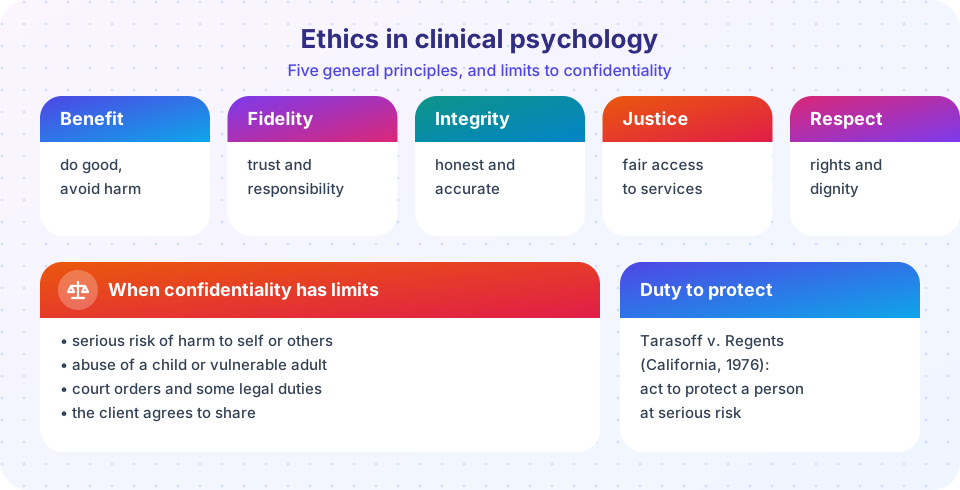
The American Psychological Association's Ethical Principles of Psychologists and Code of Conduct (first published in 1953, and revised several times since) rests on five general principles, which are aspirational and guide the specific standards. Similar codes exist in other countries, such as those of the British Psychological Society.
- A. Beneficence and nonmaleficence: benefit those you work with and take care to do no harm.
- B. Fidelity and responsibility: build trust, accept professional responsibility and manage conflicts of interest.
- C. Integrity: be honest and accurate and avoid deception.
- D. Justice: ensure fair access to the benefits of psychology, and recognize the limits of your competence.
- E. Respect for people's rights and dignity: respect privacy, confidentiality and self-determination, and be aware of cultural, individual and role differences.
Informed consent and capacity
Before treatment, clients should be told in plain language what the treatment involves, its risks and benefits, alternatives, fees, and the limits of confidentiality. They must also agree voluntarily and have capacity to decide. Capacity is specific to the decision and can fluctuate. For children, parents or guardians usually consent, but young people are increasingly involved in decisions, and in some places they can consent to some services themselves. When capacity is in question, clinicians assess it and, if needed, involve a legal process.
Confidentiality and its limits
Confidentiality is a cornerstone because people will not speak honestly if they fear exposure. It is not absolute. Common limits, which should be explained at the start of treatment, include:
- Serious risk of harm to self or others.
- Suspected abuse or neglect of a child (and, in many places, of an older or vulnerable adult), which many jurisdictions require clinicians to report.
- Court orders and certain legal proceedings.
- Client consent to share information with named people.
The landmark case is Tarasoff v. Regents of the University of California (1976). A young man told his therapist at a university counseling center that he intended to kill a woman, Tatiana Tarasoff. The therapist alerted campus police, but nobody warned her, and she was killed. The California Supreme Court ruled that when a therapist determines, or should determine, that a patient presents a serious danger of violence to another, the therapist has a duty to use reasonable care to protect the intended victim. Responses vary across US states: some impose a duty to warn or protect, others only allow disclosure. In practice, protective steps range from more frequent sessions, safety planning and hospitalization to warning the person at risk.
Involuntary treatment and the law
In many places a person can be held for assessment or treatment against their wishes only if they have a mental disorder and are at serious risk of harming themselves or others, or are "gravely disabled" and cannot care for themselves. Procedures include an emergency hold (for example 72 hours in several US states) followed by review by a court or tribunal, rights to a lawyer and the right to appeal. Rules and terms differ widely. Many critics, including disability rights groups and the UN Convention on the Rights of Persons with Disabilities (2006), push for supported decision-making and less coercion, and research is ongoing on alternatives such as crisis plans and advance directives written in good health.
Criminal law also meets mental health. Competence to stand trial asks whether a defendant understands the proceedings and can assist their lawyer. The insanity defense asks about the mental state at the time of the offense. Under the M'Naghten rule (1843), a defendant may be not guilty if, because of a disease of the mind, they did not know the nature of the act or that it was wrong. Standards differ by place, and the defense is rarely used.
Boundaries and competence
Clinicians must keep to the limits of their training, seek supervision, avoid exploiting clients and avoid sexual relationships with clients. Dual relationships are not always avoidable (in a small town, a therapist may meet clients in other settings), but they require careful handling. Cultural humility means recognizing how culture, power and identity shape therapy. New technologies raise fresh questions: telehealth requires privacy and a plan for emergencies in the client's location, and the growing use of AI chatbots for emotional support raises concerns about privacy, quality and safety, and the evidence for them remains limited.
Research ethics and history
Modern protections grew out of abuses:
- Nuremberg Code (1947), after Nazi medical experiments, put voluntary consent first.
- The Declaration of Helsinki (1964) set standards for medical research.
- The Belmont Report (1979), written after the US Tuskegee syphilis study, named three principles: respect for persons, beneficence and justice.
- Psychiatry has its own dark chapters: overcrowded asylums, forced sterilizations and the lobotomy. Egas Moniz won a Nobel Prize in 1949 for the frontal lobotomy, and in the following years tens of thousands of procedures were done in the USA and elsewhere, many on people who could not meaningfully consent, with serious and often devastating effects.
- Today, research with people requires review by an ethics committee (an institutional review board in the USA), informed consent, minimization of harm and protection of privacy.
Common misconceptions
"Everything said in therapy is secret." Confidentiality has limits that should be explained up front.
"Clinicians can predict who will become violent." Predicting rare events is very hard, and the limits of prediction are part of why decisions are cautious and case by case.
"Involuntary treatment means a person has no rights." Legal safeguards, reviews and appeals apply in most systems.
Try it
The first demonstration is a simplified scenario helper that prints which ethical considerations are triggered. It is not legal advice. The second shows, with hypothetical numbers, why predicting rare events such as suicide produces many false alarms.
Press Run (or Ctrl + Enter) to see the result here.
Program input · what you'd type while the program runs
Type the answers before you press Run, one per line. Each time the program reads a line (with input()), it gets the next line from this box.
Press Run (or Ctrl + Enter) to see the result here.
Program input · what you'd type while the program runs
Type the answers before you press Run, one per line. Each time the program reads a line (with input()), it gets the next line from this box.
Check your understanding
Quick check · 5 questions
of 5 answered You scored / 5 · perfect!
-
1. Which of these is NOT one of the five APA general principles?
The five principles are beneficence and nonmaleficence, fidelity and responsibility, integrity, justice, and respect for people's rights and dignity. -
2. What did the Tarasoff case establish?
The California Supreme Court recognized a duty to protect when a patient presents a serious danger of violence to another. -
3. Which is a typical limit to confidentiality?
Serious risk, mandated reporting and court orders are common limits. -
4. What are the three Belmont Report principles?
The Belmont Report (1979) set these as the foundation for research with human participants. -
5. Why is predicting individual suicide so difficult?
A low base rate leads to a low positive predictive value.
Summary
- Five principles (benefit, fidelity, integrity, justice, respect) guide clinical ethics.
- Informed consent requires information, voluntariness and capacity.
- Confidentiality has limits: serious risk, mandated reporting, court orders and client consent.
- Involuntary treatment is allowed only under strict criteria with safeguards.
- Research ethics came out of abuses; the Nuremberg Code, Helsinki and Belmont set standards.
- Predicting rare events is hard, so ethical practice relies on careful, case-by-case judgment.
Track your progress
Create a free account to tick off lessons and pick up where you left off on any device.
of Abnormal and Clinical Psychology lessons completed