


















Lesson 17 of 47 · Mood Disorders
Depression: Major Depressive Disorder and Related Conditions
Learn the nine symptoms of a major depressive episode, persistent depressive disorder, DMDD and PMDD, how depression differs from grief, and what treatments work.
Depression is not the same as feeling sad. A depressive episode can feel like being weighed down, flat and cut off: pleasures stop pleasing, small tasks look huge, sleep and appetite go awry, and the mind keeps returning to self-criticism. Depression is among the most common and most disabling health conditions in the world. It is also one of the most treatable. This lesson explains how it is defined, how it varies, how it differs from grief, and what the evidence says about help.
Educational information and safety. The criteria below are for learning, not self-diagnosis. If you recognize these experiences in yourself, speak with a doctor or mental health professional. If you are thinking about ending your life or harming yourself, contact your local emergency number or a crisis line right now (in the US, call or text 988).
What you will learn
- The DSM-5-TR criteria for a major depressive episode.
- Persistent depressive disorder, DMDD, PMDD and common specifiers.
- How depression differs from normal grief.
- Course, risk and the treatments with the best evidence.
- How to talk about suicide safely.
Key terms
Anhedonia: loss of interest or pleasure in activities once enjoyed.
Psychomotor change: observable slowing (retardation) or restlessness (agitation).
Persistent depressive disorder: depressed mood most of the day, more days than not, for at least two years in adults.
Recurrence: a new episode after recovery.
Behavioral activation: a therapy that increases rewarding activity to lift mood.
Major depressive disorder
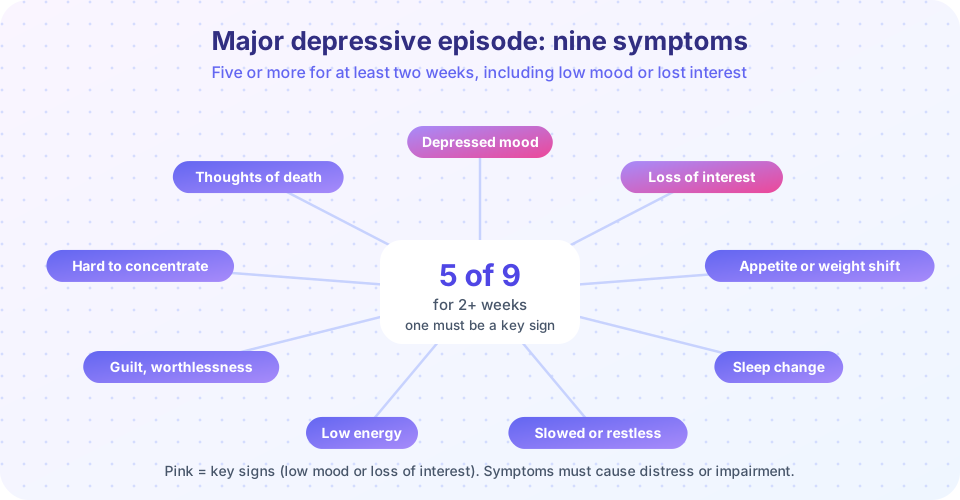
A major depressive episode requires at least five of nine symptoms during the same two-week period, nearly every day, representing a change from before. At least one must be depressed mood or loss of interest or pleasure.
- Depressed mood most of the day (feeling sad, empty, hopeless; in children and adolescents, it may look like irritability).
- Markedly diminished interest or pleasure in nearly all activities.
- Significant weight or appetite change.
- Insomnia or sleeping too much.
- Psychomotor agitation or slowing that others can observe.
- Fatigue or loss of energy.
- Feelings of worthlessness or excessive, inappropriate guilt.
- Diminished ability to think, concentrate or decide.
- Recurrent thoughts of death, suicidal thoughts or a suicide attempt.
The symptoms must cause clinically significant distress or impairment and must not be due to a substance, a medical condition (thyroid problems, for example) or a history of mania. The diagnosis of major depressive disorder requires one or more episodes without a manic or hypomanic episode ever occurring. Severity (mild, moderate, severe), psychotic features and specifiers such as with anxious distress, melancholic features, seasonal pattern and peripartum onset (during pregnancy or after birth) refine the picture.
Notice how polythetic the rule is: with nine symptoms and a "five of nine" threshold, two people can both qualify with only one symptom in common (Chapter 2). Depression is a family of experiences rather than a single sensation.
Other depressive disorders
- Persistent depressive disorder (formerly dysthymia): low mood most days for at least two years in adults, with at least two other symptoms such as poor appetite or sleep, low energy, low self-esteem, poor concentration or hopelessness. It is less severe but chronic, and people can also experience major depressive episodes on top ("double depression").
- Disruptive mood dysregulation disorder (DMDD): severe, frequent temper outbursts and persistent irritability in children aged 6 to 18, introduced in DSM-5 partly to reduce over-diagnosis of pediatric bipolar disorder.
- Premenstrual dysphoric disorder (PMDD): marked mood symptoms in the week before menstruation that improve soon after it begins.
- Substance- or medication-induced and due to another medical condition depressive disorders.
Depression versus grief
Grief after a bereavement can look like depression: sadness, sleeplessness, loss of appetite. Yet there are differences. Grief tends to come in waves triggered by reminders, with positive memories mixed in, and self-esteem is usually preserved. Major depression involves pervasive low mood and worthlessness. DSM-IV excluded a depression diagnosis in the first two months after a loss. DSM-5 removed that "bereavement exclusion" because bereavement can also trigger real depressive episodes, a controversial decision; clinicians are asked to use judgment. DSM-5-TR (2022) also added prolonged grief disorder, for intense grief persisting for at least 12 months in adults that impairs functioning.
How common, and what course?
Depressive disorders are very common: lifetime prevalence estimates vary by country, but are often in the range of roughly 10 to 20 percent. Women are diagnosed about twice as often as men from adolescence on, a pattern explained by a mix of hormonal, social, stress-exposure, rumination and reporting differences, and debated. Onset is most often between the teens and thirties. Many people recover from a first episode, but depression often recurs, and each episode raises the risk of another. Depression also increases the risk of physical illness and the reverse: heart disease, diabetes, chronic pain and stroke all raise the risk of depression.
Treatment
Treatment depends on severity, preferences and history. The evidence base is large.
- Psychological therapies. Cognitive behavioral therapy (CBT) (Aaron Beck) helps people notice and test negative thoughts and plan rewarding activities. Behavioral activation has been found to work about as well as full CBT in trials such as Dimidjian et al. (2006) and is simpler to deliver. Interpersonal therapy (IPT) targets relationship problems, role transitions and grief. Mindfulness-based cognitive therapy reduces relapse for people with recurrent depression.
- Medication. Antidepressants include SSRIs, SNRIs and others. A major 2018 analysis by Andrea Cipriani and colleagues (522 trials, more than 116,000 people) found all 21 drugs more effective than placebo on average, with modest differences between them. Effects on average are moderate, and the size of the benefit over placebo, especially for mild depression, is debated (Irving Kirsch has argued it is small). Drugs take weeks to work, many people need more than one try, and stopping should be done with medical advice because of discontinuation symptoms.
- Combination. For moderate to severe depression, therapy plus medication often does better than either alone.
- Brain stimulation. Electroconvulsive therapy (ECT), done under anesthesia, is the most effective treatment for severe, treatment-resistant depression, with memory side effects that need discussion. Transcranial magnetic stimulation (TMS) is a non-invasive option.
- Lifestyle supports. Regular exercise has evidence as an adjunct, and sleep regularity and social contact matter.
Many people improve substantially with treatment, but not everyone responds to the first approach: persistence and adjustment help. The picture is one of treatable illness, not hopelessness.
Suicide: facts and safe talk
Depression is a major risk factor for suicide, though most people with depression do not die by suicide, and not everyone who dies by suicide was depressed. Risk is higher with previous attempts, substance use, access to lethal means, isolation and recent loss. Warning signs include talking about wanting to die or being a burden, withdrawal, giving things away and sudden calm after agitation. Asking directly about suicide does not plant the idea; it can open the door to help. If someone is at immediate risk, stay with them, remove access to means if safely possible, and contact emergency services or a crisis line. Follow safe-messaging guidance in public talk: avoid describing methods, and emphasize that help works and recovery is common.
Common misconceptions
"Depression is a sign of weakness." It is a medical and psychological condition with biological, psychological and social causes.
"Antidepressants change your personality or are addictive." They are not addictive in the way of opioids or benzodiazepines, and they are not meant to change who you are. They do have side effects and should be managed with a prescriber.
"Talking about suicide makes it more likely." Evidence suggests the opposite: asking directly and listening reduces isolation.
"Depression always has an obvious reason." It can arise after a clear loss or seemingly out of the blue.
Try it
The first demonstration applies the symptom-count rule to fictional cases. For each case, decide whether the rule (five or more symptoms including a key one, for two weeks) is met. It teaches how the criteria work and cannot assess real people.
The second demonstration is a toy model of behavioral activation: mood and activity feed each other. When mood is low, people do less, which lowers mood further. Scheduling even small rewarding activities can break the spiral. It is a simple illustration, not a prediction.
Press Run (or Ctrl + Enter) to see the result here.
Program input · what you'd type while the program runs
Type the answers before you press Run, one per line. Each time the program reads a line (with input()), it gets the next line from this box.
Check your understanding
Quick check · 5 questions
of 5 answered You scored / 5 · perfect!
-
1. How many symptoms are needed for a major depressive episode, and for how long?
At least one of the two core symptoms must be among the five. -
2. Which describes persistent depressive disorder?
It was formerly called dysthymia. -
3. Why does asking about suicide not increase risk?
Reviews of the evidence support asking directly and listening. -
4. What did the Cipriani et al. (2018) analysis conclude about antidepressants?
Effects are on average moderate; individual response varies. -
5. Which therapy increases rewarding activity to lift mood?
Behavioral activation targets the cycle of withdrawal and low mood.
Summary
- A major depressive episode needs five of nine symptoms for two weeks, including low mood or lost interest, with impairment.
- Related conditions include persistent depressive disorder, DMDD and PMDD; grief can resemble depression but differs.
- Depression is common, often recurrent and treatable with therapy (CBT, behavioral activation, IPT), medication, brain stimulation in severe cases, and combinations.
- Asking about suicide directly is safe and important; help and recovery are real.
Next: Bipolar Disorders
Track your progress
Create a free account to tick off lessons and pick up where you left off on any device.
of Abnormal and Clinical Psychology lessons completed