


















Lesson 19 of 47 · Mood Disorders
What Causes Mood Disorders?
Explore the causes of mood disorders: genes, the monoamine hypothesis and its limits, Beck's cognitive triad, learned helplessness, rumination and social stress.
If you ask ten people why someone becomes depressed, you may hear ten answers: a chemical imbalance, bad thoughts, a bad childhood, a bad job, bad luck. The honest scientific answer is that mood disorders have many contributing causes that interact over time. In this lesson you will meet the main theories, the evidence for each and the reasons that none is enough alone. You will also see how a good theory leads to a treatment you can test.
What you will learn
- Genetic and brain-based explanations, and why the "chemical imbalance" slogan is too simple.
- Beck's cognitive theory, Seligman's learned helplessness and Nolen-Hoeksema's rumination.
- Social and life-event risk factors, including Brown and Harris's work.
- How the explanations combine in the diathesis-stress model.
Key terms
Monoamine hypothesis: the idea that low activity of serotonin, noradrenaline or dopamine causes depression.
Cognitive triad: negative views of the self, the world and the future (Beck).
Learned helplessness: passivity after experiencing uncontrollable bad events.
Attributional style: a person's habitual way of explaining the causes of events.
Rumination: repetitive passive focus on one's distress and its causes.
Biological explanations
Genes. Twin studies suggest the heritability of major depression is roughly 35 to 40 percent (Sullivan, Neale and Kendler, 2000), and of bipolar disorder far higher, about 60 to 85 percent. Large genome-wide studies identify many gene variants, each with a tiny effect. Genes also appear to influence how sensitive a person is to stress.
Neurotransmitters. In the 1950s and 1960s, doctors noticed that the drug reserpine, which lowers monoamines, could cause low mood, whereas iproniazid and imipramine, which raise them, lifted it. The monoamine hypothesis was born. It inspired SSRIs, which raise serotonin availability within hours, but their benefit appears over weeks, a puzzle that suggests deeper adaptation (for example, changes in neural plasticity). A widely discussed 2022 umbrella review by Joanna Moncrieff and colleagues concluded that there is no consistent evidence that depression is caused by lowered serotonin activity or concentrations; critics responded that the review did not rule out roles for serotonin and that treatments still help. The balanced reading: neurotransmitters are involved in mood circuits, but the "simple chemical imbalance" slogan misleads.
Brain circuits and stress systems. Imaging studies find, on average, differences in networks involving the prefrontal cortex, amygdala and hippocampus in depression. Many people with depression show an overactive HPA axis and raised cortisol (Chapter 3), and inflammation is an active area of study. These group differences are small and overlap with healthy people, and it is hard to separate cause from consequence.
For bipolar disorder, strong inheritance, circadian rhythm disturbance and a highly sensitive reward system are emphasized.
Psychological explanations
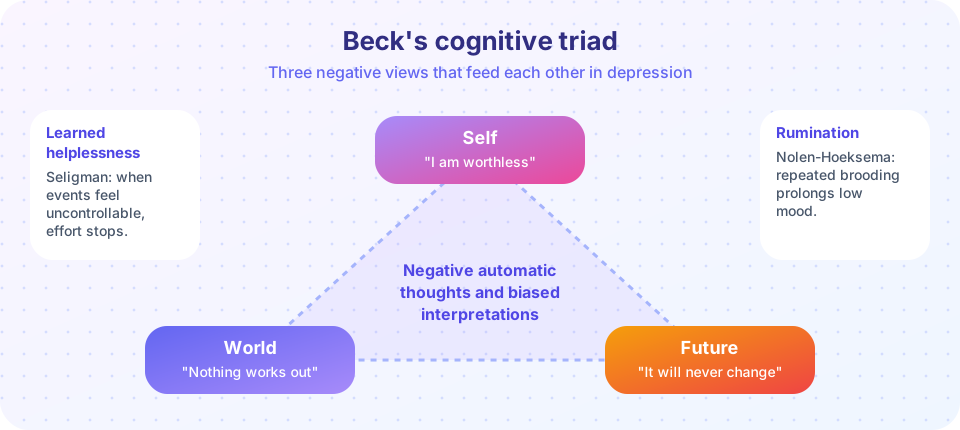
Beck's cognitive theory. Aaron Beck (1967) observed that depressed patients had pervasive negative thinking and proposed the cognitive triad: negative views of the self ("I'm worthless"), the world ("Nothing works out") and the future ("It will never improve"). These beliefs come from schemas formed in early experience and activated by stress, and are maintained by biased thinking such as overgeneralization, all-or-nothing thinking and selective attention to negatives. Studies show that depressed people do show these biases, though whether they cause depression or are produced by it is debated. They also provide an effective treatment target: cognitive therapy tests the thoughts as hypotheses.
Learned helplessness. In the late 1960s Martin Seligman found that dogs exposed to uncontrollable shocks later failed to escape shocks they could have avoided. He proposed that people become passive and depressed when they learn that their actions do not matter. The theory was reformulated by Abramson, Seligman and Teasdale (1978) around attributional style: people who explain bad events as internal ("it's my fault"), stable ("it will last") and global ("it affects everything") are more prone to depression after negative events. Later work by Steven Maier and Seligman (2016) revised the animal story: passivity is the default response to prolonged adversity, and what has to be learned, through prefrontal control circuits, is that control is possible.
Rumination. Susan Nolen-Hoeksema showed that people who respond to low mood by brooding ("Why do I feel this way? What is wrong with me?") have longer and more severe depressions than those who distract themselves or problem-solve, and rumination predicts later onset. Women on average ruminate more, a possible contributor to the gender difference in depression.
Behavioral theory. Peter Lewinsohn proposed that depression follows a drop in response-contingent positive reinforcement: fewer rewards lead to less activity, which leads to even fewer rewards. Behavioral activation (Lesson 4.2) is built on this.
Social and environmental explanations
George Brown and Tirril Harris (1978) studied women in Camberwell, London, and found that depression often followed severe life events involving loss or humiliation, especially in those with vulnerability factors: lack of a close confiding relationship, several young children at home, no employment outside the home, and early loss of mother. Later research confirms that adversity (poverty, bullying, abuse, neglect, discrimination, isolation) raises risk. Social support is protective. Culture shapes how depression is expressed, such as somatic symptoms (aches, fatigue) in many cultures, and stigma shapes whether people seek help.
The gene-by-environment idea, and its cautionary tale
The diathesis-stress model (Chapter 1) combines these: genes and early experience create vulnerability, and later stress triggers episodes. Caspi and colleagues' 2003 finding that a variant of the serotonin transporter gene (5-HTTLPR) interacted with stressful life events to predict depression was celebrated, but large later analyses failed to support it. The sound lesson is not to doubt the importance of both genes and stress. It is to be skeptical of single-gene claims and to prefer findings that large, independent studies confirm.
Putting it together
A typical pathway might look like this: a person with genetic and temperamental vulnerability, and an early experience of loss, develops a negative self-schema. A job loss (a severe life event) activates it; sleep and routine break down; ruminating deepens low mood; withdrawal reduces rewards; the HPA axis stays active. Each element offers a target: sleep regulation, medication, cognitive therapy, behavioral activation, relationships, work and money problems. That is the biopsychosocial model in action.
Common misconceptions
"A chemical imbalance causes depression, so a pill fixes the balance." Neurotransmitters are involved, but there is no simple, measurable imbalance. Medications work through complex changes and help many people anyway.
"Negative thinking is just a bad habit you choose." Biased thinking is a symptom and a maintaining factor, often automatic. Therapy teaches skills to notice and test it.
"Depression is either genetic or caused by life events." Genes and experience interact.
"If depression has a social cause, treatment is useless." Treatment and social change complement each other.
Try it
The first demonstration is a thought record, a core CBT tool. Write a negative thought, choose a thinking trap, then write a balanced alternative. The tool builds a printable summary. It is a practice exercise, not therapy.
The second demonstration is a toy model of learned helplessness and its reformulation. An agent estimates how much control it has over outcomes. In an uncontrollable world its estimate falls, and its effort falls with it; in a controllable world the estimate rises. It is a simplified illustration, not a model of depression.
Press Run (or Ctrl + Enter) to see the result here.
Program input · what you'd type while the program runs
Type the answers before you press Run, one per line. Each time the program reads a line (with input()), it gets the next line from this box.
Check your understanding
Quick check · 6 questions
of 6 answered You scored / 6 · perfect!
-
1. What are the three parts of Beck's cognitive triad?
Beck proposed that depressed thinking centers on these three domains. -
2. What did the 2022 Moncrieff et al. umbrella review conclude, and how was it received?
The monoamine slogan is too simple, while the picture remains complex. -
3. Which attributional style is linked to depression after failure?
Abramson, Seligman and Teasdale (1978) described this pessimistic style. -
4. What did Nolen-Hoeksema find about rumination?
Active distraction and problem-solving tend to work better than brooding. -
5. In Brown and Harris (1978), what combination predicted depression in women?
It showed social stress interacting with vulnerability. -
6. Why should we be cautious about the 5-HTTLPR by stress finding?
Single candidate-gene findings often fail to replicate.
Summary
- Mood disorders arise from interacting genes, brain systems, thinking styles, behavior and life events.
- The monoamine slogan is too simple; Beck's cognitive triad, attributional style, rumination and reduced reward each explain part of depression.
- Bipolar disorder is highly heritable and sensitive to sleep and rhythm disruption.
- Social adversity and support matter; single-gene stories need caution.
Next: Chapter 4 Review
Track your progress
Create a free account to tick off lessons and pick up where you left off on any device.
of Abnormal and Clinical Psychology lessons completed