


















Lesson 26 of 47 · Personality and Other Disorders
Personality, Eating and Substance Disorders: Chapter Overview
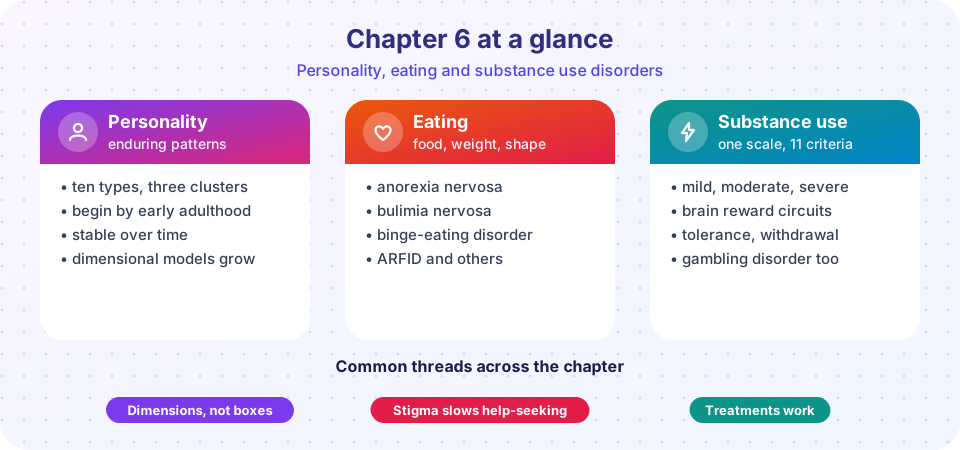
A map of chapter 6: how personality disorders, eating disorders and substance use disorders are defined, why they are hard to treat and what helps.
The conditions in this chapter share one feature that sets them apart from many others: they are tied up with who a person is and what they do every day. A personality disorder describes a lasting style of thinking, feeling and relating. An eating disorder changes the most basic daily act of eating and a person's relationship with their body. A substance use disorder is a pattern of use that continues despite harm.
Because these patterns feel like part of the person, they invite blame and stigma. Good clinical psychology starts from the opposite assumption: these are understandable patterns with causes, and with the right support, change is possible.
Educational information only. These lessons describe how professionals think about these conditions. They do not diagnose and they contain no treatment instructions. If you are struggling with eating, substance use or your safety, contact a health professional or a local crisis service.
The chapter in five slides
Personality disorders are lasting styles
Ten types, three clusters.
Dimensions help more than boxes
Eating disorders are serious illnesses
Substance use runs on reward circuits
Recovery is common with the right help
What each lesson covers
- Personality disorders: the ten types, the dimensional models and a close look at borderline and antisocial patterns.
- Eating disorders: anorexia, bulimia, binge-eating disorder and ARFID, with causes and treatments.
- Substance use disorders: the eleven criteria, the brain's reward system and treatments that work.
- Chapter review: a one-picture summary and ten mixed questions.
Why these conditions are often misunderstood
- They look like choices. A person who restricts food or uses a drug seems to be choosing. Research shows that biology, learning and context shape these behaviors strongly.
- They overlap with other disorders. Depression, anxiety, trauma and substance use often go together, and treating one can help the others.
- Labels carry stigma. The label "personality disorder" in particular has made some people feel judged for who they are.
Try it
The first demonstration plots rough lifetime prevalence figures from large surveys in the USA; they differ across countries and methods. The second is a small lookup.
Press Run (or Ctrl + Enter) to see the result here.
Program input · what you'd type while the program runs
Type the answers before you press Run, one per line. Each time the program reads a line (with input()), it gets the next line from this box.
Press Run (or Ctrl + Enter) to see the console output here.
No output.
Check your understanding
Quick check · 4 questions
of 4 answered You scored / 4 · perfect!
-
1. Which pair is correct about what these three families share?
They differ in content, but each involves patterns that persist, each is stigmatized and each has evidence-based treatments. -
2. Which is a feature of a personality disorder?
Pervasive, stable and inflexible patterns present since adolescence or early adulthood define personality disorders. -
3. Why do clinicians increasingly prefer dimensional models for personality disorders?
Personality traits vary continuously, and categories overlap a lot. -
4. Which statement about alcohol use disorder in the chart is true?
Lifetime prevalence of alcohol use disorder in US surveys is far higher than that of individual eating disorders.
Summary
- The chapter covers personality disorders, eating disorders and substance use disorders.
- Each involves patterns that feel like part of the person, which invites stigma.
- Dimensional thinking and co-occurring problems are recurring themes.
- Effective treatments exist, and the alliance between client and clinician matters.
Next: Personality disorders
Track your progress
Create a free account to tick off lessons and pick up where you left off on any device.
of Abnormal and Clinical Psychology lessons completed