


















Lesson 28 of 47 · Personality and Other Disorders
Eating Disorders: Anorexia, Bulimia and Binge-Eating Disorder
Understand how DSM-5 defines anorexia, bulimia, binge-eating disorder and ARFID, what raises risk, what the Minnesota study showed and which treatments work.
Eating disorders are among the most dangerous psychiatric conditions, yet they are often seen as lifestyle choices or vanity. They are neither. They are serious illnesses in which eating, weight and body image become tangled with emotion, self-worth and control, and they can cause lasting medical harm.
This lesson covers how the main diagnoses are defined, what raises risk, what a famous wartime experiment taught us about starvation, and which treatments have the best evidence. It deliberately contains no weight numbers beyond what is needed for classification and no advice about food: if you recognize yourself in these descriptions, speak to a doctor or an eating disorder service.
Educational information only. If you or someone you know has a serious problem with eating, seek help from a doctor or a specialist service now. Eating disorders can be medically urgent.
What you will learn
- State the core features of anorexia nervosa, bulimia nervosa, binge-eating disorder and ARFID.
- Describe the risk factors, including genes, perfectionism and sociocultural pressures.
- Explain what the Minnesota Starvation Experiment showed.
- Summarize the evidence for family-based treatment and CBT-E.
- Recognize the medical seriousness of eating disorders.
Key terms
- Binge eating: eating an unusually large amount in a short period with a sense of losing control.
- Compensatory behavior: actions aimed at preventing weight gain after eating, such as vomiting, laxative misuse, fasting or excessive exercise.
- Body image disturbance: a distorted experience of one's own body weight or shape, or giving them undue weight in self-worth.
- Refeeding: carefully supervised restoration of nutrition after starvation.
- Family-based treatment (FBT): a therapy for adolescents in which parents take an active role in restoring eating.
The main diagnoses
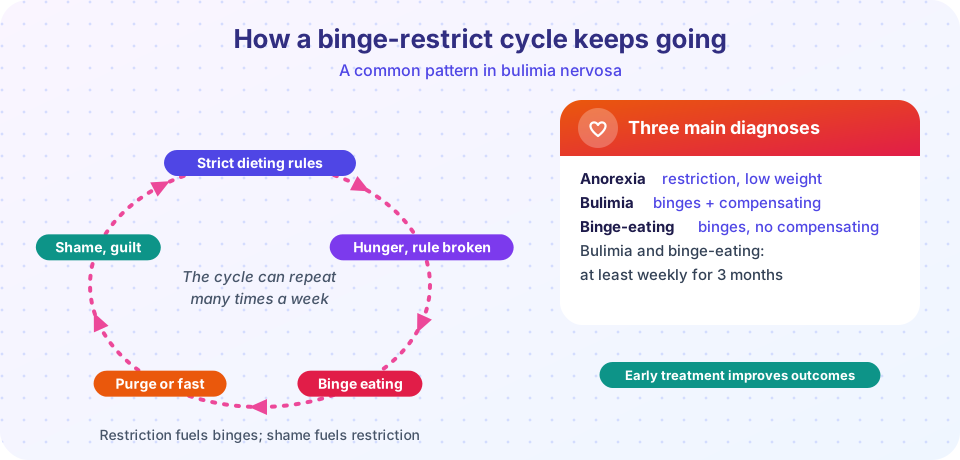
Anorexia nervosa. DSM-5 requires (1) restriction of energy intake leading to a significantly low body weight for age, sex, development and health; (2) intense fear of gaining weight or persistent behavior that prevents weight gain; and (3) a disturbed experience of body weight or shape, undue influence of weight on self-evaluation, or lack of recognition of how serious the low weight is. There are two subtypes, restricting and binge-eating/purging. Severity for adults is rated using body mass index bands (mild 17 or above, moderate 16 to 16.99, severe 15 to 15.99, extreme below 15), and DSM-5 dropped the earlier requirement for missed periods.
Bulimia nervosa. Recurrent binge episodes (a large amount of food in a discrete period with loss of control) are followed by recurrent compensatory behavior. Both must occur at least once a week for three months, and self-evaluation is unduly influenced by shape and weight. Body weight is often in the normal range, which can hide the disorder.
Binge-eating disorder (BED). Recurrent binges, at least once a week for three months, with features such as eating very quickly, eating until uncomfortably full or eating alone from embarrassment, followed by distress, but without regular compensatory behavior. DSM-5 (2013) made it a full diagnosis.
Avoidant/restrictive food intake disorder (ARFID). Avoidance or restriction of food because of sensory aversions, fear of choking or vomiting, or lack of interest, leading to nutritional problems, and without concern about body shape. It is more common in children and in autistic people.
Many people have symptoms that do not fit neatly into one box, and over time people may shift from one diagnosis to another.
How common and how dangerous?
The large US survey by James Hudson and colleagues (2007) estimated lifetime prevalence in women of about 0.9 percent for anorexia nervosa, 1.5 percent for bulimia nervosa and 3.5 percent for binge-eating disorder, with lower rates in men (about 0.3, 0.5 and 2.0 percent). Onset is typically in adolescence or young adulthood. Anorexia nervosa has one of the highest death rates among psychiatric disorders. A 2011 meta-analysis by Jon Arcelus and colleagues found a mortality rate for anorexia about five to six times that of people of the same age and sex, from medical complications and suicide. Complications include heart rhythm problems, low bone density, and effects on the digestive system, hormones and brain.
Why do they develop?
No single cause is known. The evidence points to a mix:
- Genes. Twin studies suggest heritability of roughly 50 to 60 percent for anorexia and substantial heritability for bulimia and binge-eating disorder.
- Temperament. Perfectionism, anxiety and rigid thinking are common in anorexia; impulsivity and emotional reactivity are common in bulimia and binge eating.
- Dieting. Strict dieting is one of the strongest known risk factors for developing an eating disorder, although most people who diet never develop one.
- Sociocultural pressures. Cultures that idealize thinness have higher rates of disordered eating attitudes. In a much-cited study of adolescent girls in Fiji, Anne Becker and colleagues (2002) found that the share with high scores on an eating-attitudes questionnaire rose after television arrived. The study was observational and small, so it cannot prove cause, but it fits a wider pattern.
- Life experiences. Teasing about weight, trauma, and puberty or sports with weight demands raise risk.
- Starvation itself maintains the problem, as the next section shows.
The Minnesota Starvation Experiment
During World War II Ancel Keys and colleagues at the University of Minnesota (1944-45) studied 36 healthy young men who volunteered as an alternative to military service. For six months they received about half their usual food intake. The men became preoccupied with food: they collected recipes, read cookbooks and talked about meals. They also became depressed, irritable, anxious and withdrawn, lost interest in sex, and found concentration hard. Many of these changes persisted into the refeeding period, which proved difficult and lengthy.
The lesson for clinical psychology is that many symptoms of anorexia, including food preoccupation, rigid rituals, emotional flatness and social withdrawal, are partly effects of starvation itself, not only their cause. That is why restoring nutrition is a first priority in treatment.
Treatments with evidence
Medical care first. Some patients need hospital care for dangerous heart rate, low blood pressure or electrolyte problems. Refeeding must be supervised because refeeding too fast can cause a dangerous shift in body chemistry.
Family-based treatment (FBT), also called the Maudsley approach, is the best-supported treatment for adolescent anorexia. In its first phase parents take charge of refeeding, which is how the family and the illness are tackled together, and responsibility is returned to the young person gradually. Trials, such as that by Daniel Le Grange and James Lock (2010) comparing FBT with individual therapy, found better remission at follow-up for FBT.
Cognitive behavioral therapy (CBT-E). Christopher Fairburn's enhanced CBT is a "transdiagnostic" treatment of about 20 sessions that targets the overvaluation of shape and weight, and builds regular eating. Evidence is strongest for bulimia nervosa and binge-eating disorder, and it is also used for adults with anorexia.
Medication. Fluoxetine is approved in the USA for bulimia nervosa, and lisdexamfetamine (a stimulant prodrug) was approved in 2015 for moderate to severe binge-eating disorder. No medication is effective for the core features of anorexia nervosa, though medicines may treat co-occurring anxiety or depression.
Outlook. Many people recover, especially with early treatment, but relapse is common and recovery can take years.
Common misconceptions
"It is a diet gone too far or just vanity." Eating disorders are complex illnesses with genetic, psychological and social roots; most people who diet never develop one.
"You can tell by looking." Bulimia and binge-eating disorder often occur at normal or higher weights, and even people with anorexia may not look "sick".
"Only young white women get eating disorders." They occur across genders, ages, ethnicities and income levels, and are often missed in boys, men and older adults.
Try it
The first plot compares lifetime prevalence by sex from the 2007 survey. The second is a toy simulation of how hunger can build when meals are skipped and a loss-of-control episode follows. It is not a model of any real person and carries no advice.
Press Run (or Ctrl + Enter) to see the result here.
Program input · what you'd type while the program runs
Type the answers before you press Run, one per line. Each time the program reads a line (with input()), it gets the next line from this box.
Press Run (or Ctrl + Enter) to see the result here.
Program input · what you'd type while the program runs
Type the answers before you press Run, one per line. Each time the program reads a line (with input()), it gets the next line from this box.
Check your understanding
Quick check · 5 questions
of 5 answered You scored / 5 · perfect!
-
1. What separates bulimia nervosa from binge-eating disorder?
Both involve recurrent binges, but only bulimia includes regular compensatory behavior. -
2. What does the Minnesota Starvation Experiment suggest?
Healthy volunteers developed food preoccupation, depression and withdrawal on a restricted diet. -
3. Which treatment has the best evidence for adolescents with anorexia nervosa?
FBT, in which parents support refeeding, has the best support in trials for adolescent anorexia. -
4. Which statement about bulimia nervosa is accurate?
People with bulimia usually have normal or near-normal weight. -
5. Which is a limitation of the Fiji television study?
Observational designs cannot rule out other changes that happened over the same period.
Summary
- DSM-5 recognizes anorexia nervosa, bulimia nervosa, binge-eating disorder and ARFID, along with other specified types.
- Anorexia has high mortality, and many symptoms are worsened by starvation, as the Minnesota study showed.
- Genes, temperament, dieting and sociocultural pressures all contribute.
- Treatments with evidence include medical care, family-based treatment for adolescents and CBT-E.
- Early help improves outcomes, and eating disorders occur across genders and body sizes.
Next: Substance use disorders
Track your progress
Create a free account to tick off lessons and pick up where you left off on any device.
of Abnormal and Clinical Psychology lessons completed