


















Lesson 14 of 47 · Anxiety and Stress Disorders
Stress and Health: Appraisal, Coping and the Body
Learn how stress works: fight-or-flight, Selye's general adaptation syndrome, the HPA axis, Lazarus's appraisal model, life-event scales, coping styles and stress management.
Stress is not a disease. It is the body's and mind's response to demands, and in the right dose it sharpens attention and builds strength. The trouble starts when demands are heavy, long-lasting and uncontrollable, and when resources run low. Researchers have spent a century working out how stress becomes illness, and why two people facing the same demand react so differently. This lesson gives you the main models, the evidence and the ways people cope.
What you will learn
- Cannon's fight-or-flight response and Selye's general adaptation syndrome.
- The two biological stress systems: the SAM and the HPA axes.
- Lazarus and Folkman's appraisal model and coping styles.
- Evidence linking stress to health, and its limits.
- Practical, evidence-based ways of managing stress.
Key terms
Stressor: a demand or event that challenges a person's resources.
Appraisal: judging the meaning of an event and one's ability to cope with it.
HPA axis: the hypothalamic-pituitary-adrenal system that releases cortisol.
Allostatic load: the cumulative wear and tear of repeated stress responses.
Coping: efforts to manage demands that feel taxing.
The body's response
In 1915 the physiologist Walter Cannon described the fight-or-flight response: in danger, the sympathetic nervous system and adrenal medulla release adrenaline and noradrenaline (the SAM system), speeding heart rate, raising blood pressure and mobilizing energy within seconds. A slower system, the HPA axis, begins when the hypothalamus signals the pituitary gland, which signals the adrenal cortex to release cortisol. Cortisol mobilizes glucose and influences immunity and mood, and normally it turns itself off through feedback. Shelley Taylor (2000) proposed that many women and men also show a "tend and befriend" pattern: protecting offspring and seeking social support. Humans also freeze.
Selye's general adaptation syndrome
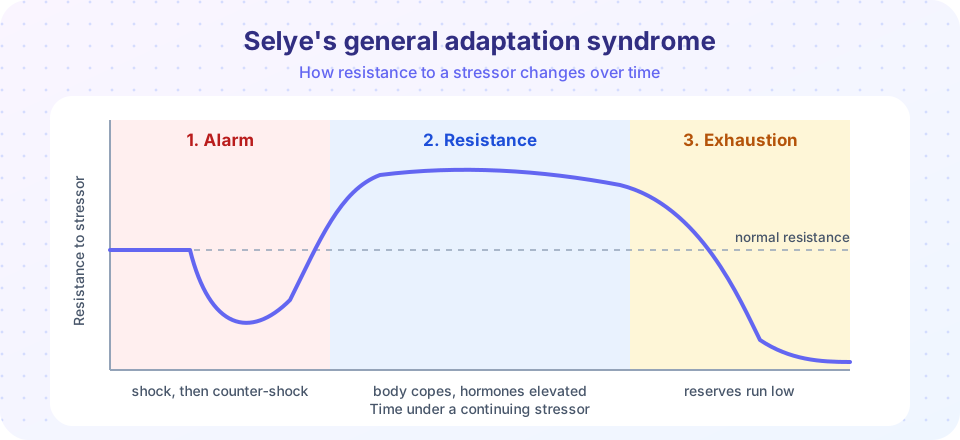
Hans Selye, working with laboratory rats from the 1930s, noticed that very different harms produced a common pattern of responses. He called it the general adaptation syndrome (GAS), with three stages:
- Alarm: shock and counter-shock; the body mobilizes.
- Resistance: the body adapts and copes; hormone levels stay elevated, resistance is high.
- Exhaustion: if the stressor continues, reserves run low and vulnerability to illness rises.
Selye's model was influential and popularized the word "stress". Critics note that it was derived mostly from animals subjected to physical stressors, treats stress as the same whatever the cause, and ignores the person's interpretation, which is where the next model comes in.
The mind's response: appraisal and coping
Richard Lazarus and Susan Folkman (1984) proposed the transactional model: stress is not in the event or in the person but in the transaction between them.
- Primary appraisal: "Is this relevant to me? Is it irrelevant, benign, or stressful?" Stressful appraisals divide into harm, threat or challenge.
- Secondary appraisal: "What can I do about it? Do I have the resources?"
- When demands seem to exceed resources, the person feels stressed and starts coping.
Coping is often split into problem-focused (changing the situation: planning, seeking information, asking for help) and emotion-focused (managing feelings: reappraising, seeking comfort, relaxing). Neither is always better: problem-focused coping suits controllable stressors, emotion-focused coping suits uncontrollable ones. Another useful distinction is approach versus avoidant coping; chronic avoidance, as in anxiety disorders, usually costs more than it saves. Personality and context matter: Suzanne Kobasa (1979) described hardiness (commitment, control and challenge) as a buffer, and social support is among the best-documented protective factors.
Measuring life stress
Thomas Holmes and Richard Rahe (1967) built the Social Readjustment Rating Scale by asking people to rate 43 life events by how much readjustment they needed. Death of a spouse scored 100, divorce 73, marital separation 65, jail term 63, death of a close family member 63, personal injury or illness 53, marriage 50, being fired 47 and retirement 45 life-change units. Total scores were weakly linked to later illness. The scale is a landmark, but it has well-known limits: it counts positive and negative changes alike, ignores how a person appraises an event, ignores severity and context, and depends on retrospective reports. Daily hassles such as commuting or arguments (Kanner et al., 1981) predict health and mood as well as or better than big events. Chronic stress, such as caring for a relative with dementia, is also powerful.
Stress and illness: the evidence
- Immunity. In a famous study, Sheldon Cohen and colleagues (1991) gave 394 healthy adults nasal drops containing a cold virus: those with higher measured life stress were more likely to develop a clinical cold. Later work supports the link between chronic stress and weaker immune responses, though effects are modest.
- Heart disease. The Whitehall II study of British civil servants found that low job control and high demands were associated with a higher risk of cardiovascular disease, helping to show that the social environment gets "under the skin" (Michael Marmot).
- Allostatic load. Bruce McEwen proposed that repeated stress responses accumulate costs across systems, a possible route from stress to many illnesses.
- Mental health. Stress is a trigger in the diathesis-stress model for depression, anxiety and psychosis.
Causality is hard to prove, since people who are unwell may also feel more stress, but the weight of evidence supports a real link.
Managing stress
- Change the situation: set priorities, build skills, negotiate workload, increase control.
- Change the thinking: CBT techniques test catastrophic appraisals and build realistic coping.
- Body-based skills: regular exercise, sleep, relaxation and breathing training, and biofeedback.
- Mindfulness-based stress reduction (MBSR), developed by Jon Kabat-Zinn, has moderate evidence for reducing stress and anxiety, with effect sizes similar to other active treatments in many reviews.
- Social support: confiding relationships and community buffer stress.
Small and regular beats big and rare. Short daily habits (a walk, a fixed bedtime, a conversation) usually do more for stress than occasional dramatic fixes.
Common misconceptions
"All stress is bad." Short-term stress can improve performance and motivation; the problem is prolonged and uncontrollable stress.
"Stress is purely in your head." Stress involves measurable hormone, nervous and immune changes, though appraisal shapes them.
"The same event stresses everyone equally." Appraisal, resources, history and support differ, so reactions differ.
Try it
The first demonstration adds up life-change units from the Holmes-Rahe scale for a few events. It illustrates how the scale works and why it has limits. It is not a health predictor.
Press Run (or Ctrl + Enter) to see the result here.
Program input · what you'd type while the program runs
Type the answers before you press Run, one per line. Each time the program reads a line (with input()), it gets the next line from this box.
The second demonstration applies Lazarus and Folkman's idea: it compares your perceived demands with perceived resources and shows the likely appraisal and a coping style that fits. It is a simplified teaching model.
Check your understanding
Quick check · 6 questions
of 6 answered You scored / 6 · perfect!
-
1. What are the three stages of Selye's general adaptation syndrome?
Alarm, resistance and exhaustion describe how response to a prolonged stressor changes. -
2. In Lazarus and Folkman's model, secondary appraisal asks
Primary appraisal judges relevance and threat; secondary appraisal judges coping resources. -
3. Which hormone is released by the HPA axis?
The HPA axis ends with cortisol release from the adrenal cortex. -
4. What is a limitation of the Holmes-Rahe scale?
It treats all change as stress and ignores appraisal and context. -
5. Which finding is associated with the Whitehall II study?
It showed that work conditions are related to health. -
6. When is emotion-focused coping most likely to fit?
When you cannot change the situation, managing your response is often more useful.
Summary
- The SAM system acts in seconds; the HPA axis releases cortisol more slowly.
- Selye's GAS has alarm, resistance and exhaustion stages; Lazarus and Folkman add appraisal.
- Coping can be problem-focused, emotion-focused, approaching or avoidant; fit matters.
- Chronic stress is linked with illness; life-event scales have limits.
- Evidence-based stress management combines changing the situation, thinking, body skills and support.
Next: Chapter 3 Review
Track your progress
Create a free account to tick off lessons and pick up where you left off on any device.
of Abnormal and Clinical Psychology lessons completed