


















Lesson 3 of 47 · Getting Started
How Clinical Researchers Gather Evidence
Compare case studies, correlational studies, experiments, randomized trials, longitudinal and twin studies, and learn why correlation is not causation in mental health.
Claims about mental illness are everywhere: "sugar causes hyperactivity", "this therapy cures anxiety", "video games make teenagers depressed". How do researchers find out which are true? Every method gives a different kind of answer, and each has a blind spot. Learning the methods now will make every later chapter easier to judge, because you will always be able to ask: how do they know?
What you will learn
- The main research designs in clinical psychology and what each can and cannot show.
- Why a randomized controlled trial is the gold standard for testing treatments.
- How twin and adoption studies estimate the roles of genes and environment.
- Why correlation does not prove causation, and why replication matters.
Key terms
Case study: an in-depth description of one person or a small group.
Correlation: a statistical relationship between two variables, measured from -1 to +1.
Randomized controlled trial (RCT): participants are randomly assigned to treatment or control groups.
Longitudinal study: following the same people over time.
Heritability: the share of variation in a trait, in a particular population, associated with genetic differences.
Case studies
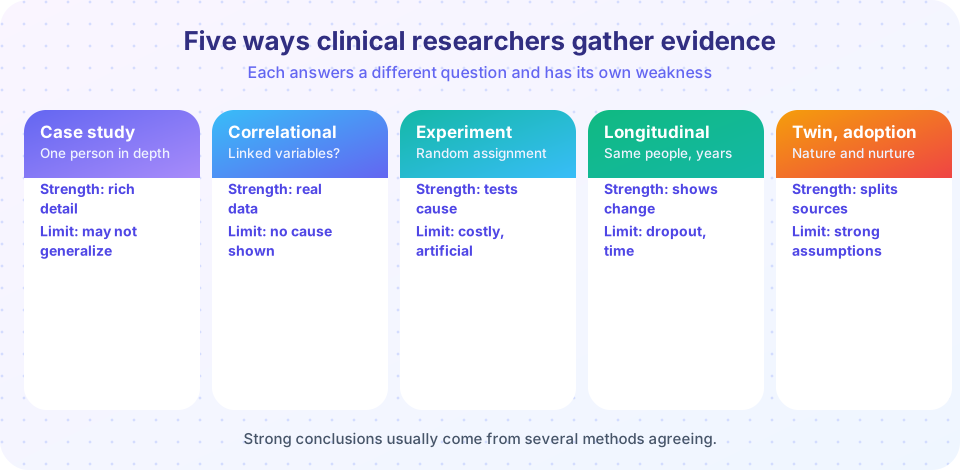
A case study describes one person in depth. Freud's patient "Anna O." (Bertha Pappenheim), "Little Hans", and the Genain quadruplets, four sisters all diagnosed with schizophrenia, are famous examples. Case studies are rich and suggest hypotheses, and they are the only practical way to study very rare conditions. But one case cannot show how typical it is, and the researcher's interpretation can color the account. Freud's cases also show how published stories can be tidier than reality.
Correlational studies
Correlational studies measure two or more variables as they naturally occur, for example anxiety scores and hours of sleep. The correlation coefficient r describes the direction and strength: r = +1 means a perfect rise together, r = -1 a perfect opposite, and r near 0 no linear relationship. They allow large samples and real-world data. Their limit is famous: correlation does not prove causation. If anxiety and poor sleep are linked, anxiety may cause bad sleep, bad sleep may cause anxiety, or a third variable such as stress may cause both.
Mind the third variable. Cities with more ice-cream sales also have more drownings, but ice cream does not cause drowning: hot weather drives both. Whenever you meet a correlation, name at least two alternative explanations before accepting a cause.
Experiments and randomized controlled trials
An experiment changes one variable (the independent variable) and measures its effect on another (the dependent variable), holding other things constant. In clinical psychology the standard is the randomized controlled trial. Participants with, say, depression are randomly assigned to a new therapy, to a standard treatment, or to a waiting list or placebo. Random assignment spreads other differences evenly across groups, so a difference in outcomes can be attributed to the treatment. Good trials add blinding (people who assess outcomes do not know who got which treatment) and pre-register their plans to prevent cherry-picking results.
RCTs have limits. They are expensive, they use strict inclusion rules that may not match real patients, psychotherapy cannot be blinded for the therapist, and ethics forbid withholding treatment from people at high risk. Researchers also check effect sizes (how big is the improvement?) and confidence intervals (how precise is the estimate?), not only whether a result is "significant".
Longitudinal studies
Longitudinal studies follow the same people over years. The Dunedin Multidisciplinary Health and Development Study in New Zealand has followed about a thousand people born in 1972 and 1973 from birth into mid-life, and it has shown that many adult mental disorders begin in adolescence. Longitudinal designs reveal how problems start and change, but they are slow and costly, and people drop out, which can bias results.
Twin and adoption studies
Identical (monozygotic, MZ) twins share nearly all their genes; fraternal (dizygotic, DZ) twins share about half of the genes that vary. If a trait is more similar in MZ than DZ pairs raised together, genes probably play a role. A rough estimate from the classic Falconer formula is heritability h² = 2 × (r_MZ − r_DZ), where r is the correlation within twin pairs. Adoption studies compare adopted children to their biological and adoptive relatives. These studies suggest, for example, substantial genetic influence on schizophrenia and bipolar disorder, more modest influence on depression, and large environmental influence everywhere. Heritability, though, describes a population and an environment, not an individual's destiny, and twin designs assume that identical twins share the same environment to the same degree as fraternal twins, an assumption critics question.
Replication and open science
Around 2011 to 2015, psychology faced a replication crisis: many classic findings did not reproduce when other labs repeated them. A large 2015 project by the Open Science Collaboration found that fewer than half of 100 studies replicated with the same results. Clinical psychology is not immune. Responses include pre-registration, larger samples, sharing data and publishing negative results. In practice, trust a finding more when several independent groups, using different methods, reach the same conclusion.
Common misconceptions
"A vivid case study proves the theory." It illustrates and suggests. It does not test.
"A significant result means a big or important effect." Statistical significance depends on sample size. Always ask how large the effect is.
"Heritability of 50 percent means a trait is half caused by genes in you." Heritability describes variation in a population, and it can change with the environment.
Try it
The first demonstration shows how a hidden third variable creates a correlation. Stress drives both anxiety and poor sleep, so the two correlate even though neither causes the other in this simulation. This is a simulation of a model, not real data.
Press Run (or Ctrl + Enter) to see the result here.
Program input · what you'd type while the program runs
Type the answers before you press Run, one per line. Each time the program reads a line (with input()), it gets the next line from this box.
The second demonstration applies Falconer's formula to illustrative twin correlations. The numbers are made up for practice; they are not published results.
Press Run (or Ctrl + Enter) to see the result here.
Program input · what you'd type while the program runs
Type the answers before you press Run, one per line. Each time the program reads a line (with input()), it gets the next line from this box.
Check your understanding
Quick check · 5 questions
of 5 answered You scored / 5 · perfect!
-
1. Why can a randomized controlled trial support a causal claim better than a correlational study?
Randomization is the key. Without it, groups might differ in other ways that explain the outcome. -
2. Anxiety and poor sleep are correlated. Which is NOT a possible explanation?
Correlation alone cannot establish direction or rule out a third variable. -
3. What is the main strength of a case study?
Case studies give depth and generate hypotheses but do not generalize. -
4. If MZ twins correlate 0.70 and DZ twins 0.40 on a trait, Falconer's estimate of heritability is
h2 = 2 x (0.70 - 0.40) = 0.60, a rough estimate under strong assumptions. -
5. What did the Open Science Collaboration (2015) find?
It prompted reforms such as pre-registration and larger samples.
Summary
- Case studies give depth; correlations give association; experiments and RCTs test cause.
- Random assignment and blinding make RCTs the standard for testing treatments.
- Longitudinal studies show how problems develop; twin and adoption studies separate genes from environment, with assumptions.
- Look at effect sizes, not just significance, and trust results that replicate.
Track your progress
Create a free account to tick off lessons and pick up where you left off on any device.
of Abnormal and Clinical Psychology lessons completed