


















Lesson 31 of 47 · Assessment and Therapy Approaches
Assessment and Therapy Approaches: Chapter Overview
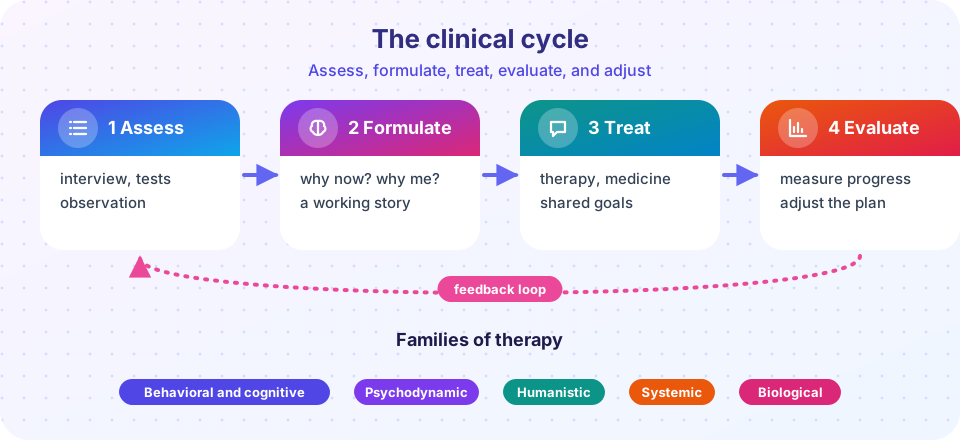
A map of chapter 7: how clinicians assess problems, build a formulation, choose among therapies and medicines, and check whether treatment is working.
So far you have learned what the main disorders look like. This chapter is about what clinicians do: how they find out what is going on, how they decide what to try, and how they check that it is helping. Good clinical practice is not a list of tricks. It is a loop of careful listening, informed guessing and honest testing, and it relies on evidence at every step.
You will meet the toolkit of assessment, the major families of psychotherapy (cognitive-behavioral, psychodynamic, humanistic, systemic and interpersonal), the biological treatments, and the research designs that tell us what works.
Educational information only. This chapter explains how treatments are studied and used. It is not a guide to treating yourself or anyone else. Choosing a treatment is a decision to make with a qualified professional.
The chapter in five slides
Start with careful assessment
Build a formulation
Choose among the therapy families
Medicines and brain stimulation
Often combined with therapy.
Test whether it works
What each lesson covers
- Clinical assessment: interviews, rating scales, tests, reliability, validity and why base rates matter.
- Cognitive-behavioral therapies: conditioning roots, Beck's cognitive model, exposure, behavioral activation and the third wave.
- Psychodynamic, humanistic and systemic therapies: the other major families, common factors and the dodo bird debate.
- Biological treatments: medicines, brain stimulation, placebo effects and reading trial evidence.
- Chapter review: one picture, a table and ten mixed questions.
Ideas to hold onto
- Effect size tells you how much a treatment helps, not just whether it helps. You will see Cohen's d throughout.
- Controls matter. A treatment compared with "waiting" can look better than the same treatment compared with another active treatment.
- Relationship matters. Across therapy types, the working alliance between client and therapist predicts outcome modestly but reliably.
- Measure and adjust. Good clinicians track progress and change course if it is not working.
Try it
The first demonstration shows what effect sizes of 0.2, 0.5 and 0.8 look like as overlapping bell curves. The second is a simple lookup for matching techniques to their therapy family.
Press Run (or Ctrl + Enter) to see the result here.
Program input · what you'd type while the program runs
Type the answers before you press Run, one per line. Each time the program reads a line (with input()), it gets the next line from this box.
Press Run (or Ctrl + Enter) to see the console output here.
No output.
Check your understanding
Quick check · 3 questions
of 3 answered You scored / 3 · perfect!
-
1. In the clinical cycle, what comes immediately after assessment?
After gathering information, clinicians build a formulation that explains the problem and guides treatment. -
2. What does an effect size of d = 0.8 indicate?
By Cohen's rule of thumb, 0.2 is small, 0.5 medium and 0.8 large. -
3. Which is a reason to track progress during treatment?
Measuring progress lets clinicians change course when improvement is slow.
Summary
- Clinical work is a loop of assessment, formulation, treatment and evaluation.
- The major therapy families are cognitive-behavioral, psychodynamic, humanistic, systemic and interpersonal, alongside biological treatments.
- Effect sizes, controls and the working alliance help us judge evidence fairly.
- Measuring progress and adjusting is part of good care.
Next: Clinical assessment
Track your progress
Create a free account to tick off lessons and pick up where you left off on any device.
of Abnormal and Clinical Psychology lessons completed