


















Lesson 13 of 47 · Anxiety and Stress Disorders
OCD and Trauma-Related Disorders
Understand obsessive-compulsive disorder, PTSD and acute stress disorder: symptoms, the OCD loop, how trauma memories work, and treatments such as ERP and trauma-focused therapy.
Two conditions that older manuals filed under anxiety now sit in their own DSM-5 chapters. Obsessive-compulsive disorder (OCD) is grouped with related conditions such as hoarding and body-focused repetitive behaviors, and post-traumatic stress disorder (PTSD) belongs to the trauma- and stressor-related disorders. They are still close relatives of anxiety, and they matter hugely in practice. This lesson explains what they look like, why they persist and what helps.
Educational information only. This describes diagnostic ideas and research. If you or someone you know has been through a trauma or has distressing rituals, a qualified professional can help. In an emergency, contact your local emergency number.
What you will learn
- The features of OCD and the obsession-compulsion loop.
- The DSM-5 criteria clusters for PTSD, and how it differs from acute stress disorder.
- Why traumatic memories behave differently.
- The best-supported treatments: exposure and response prevention, trauma-focused therapies.
Key terms
Obsession: a recurrent, intrusive thought, image or urge that causes distress.
Compulsion: a repetitive behavior or mental act performed to reduce distress or prevent a feared outcome.
Exposure and response prevention (ERP): facing triggers while resisting the compulsion.
Trauma: exposure to actual or threatened death, serious injury or sexual violence.
Flashback: a vivid re-experiencing in which the person feels the event is happening again.
Obsessive-compulsive disorder
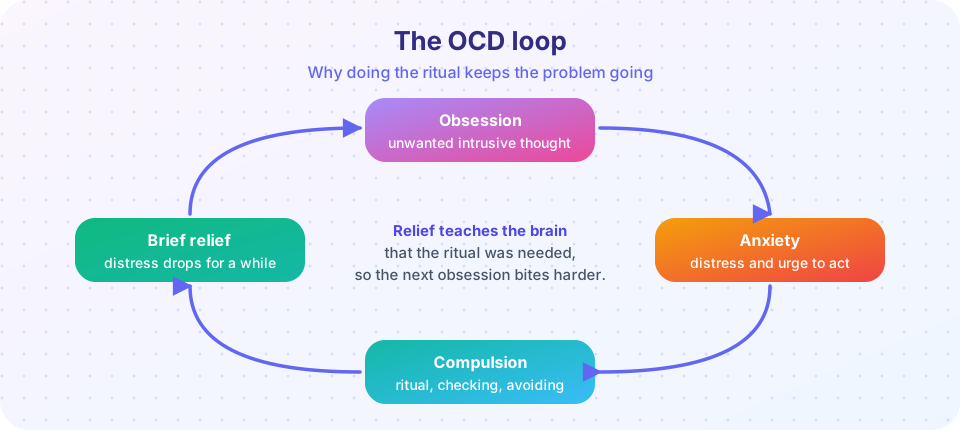
Nearly everyone has odd intrusive thoughts: what if I shouted in church, or left the stove on? In OCD such thoughts become obsessions, repeated, unwanted and distressing, often about contamination, harm, symmetry, or taboo themes. The person then performs compulsions: washing, checking, counting, arranging, repeating words silently, or seeking reassurance. Compulsions are not enjoyable. They are meant to reduce distress or prevent a feared event, though the link is excessive or unrealistic. The diagnosis requires that these consume more than about an hour a day or cause significant distress or impairment. Insight varies: many people know the fears are unreasonable, some are less sure.
Why the loop persists
The loop in the picture explains the stickiness. An obsession triggers anxiety, a compulsion brings relief, and relief reinforces the compulsion. Worse, the person never learns what would have happened without it. Cognitive models (Paul Salkovskis, Stanley Rachman) stress inflated responsibility, the belief that having a thought is as bad as acting on it (thought-action fusion), and the belief that one must control all thoughts. Trying to suppress an unwanted thought tends to make it return more often, as Daniel Wegner's famous "white bear" experiments suggest, although replications show the rebound effect is modest and not found in every study.
Biology and treatment
OCD is moderately heritable and involves circuits linking the frontal cortex, basal ganglia and thalamus. ERP, a form of CBT, is the best-supported psychological treatment: the person gradually faces triggers (touching a "dirty" doorknob) and resists the ritual (not washing) until anxiety falls on its own. SSRIs, often at higher doses than for depression, help many people. For severe, treatment-resistant cases, specialist options such as deep brain stimulation exist.
Reassurance feels kind but feeds OCD. Family members who repeatedly answer "Are you sure the door is locked?" often strengthen the loop. Therapists teach supportive but non-reassuring responses.
Trauma and stressor-related disorders
Acute stress disorder and adjustment disorder
After a traumatic event, many people feel shaken for days or weeks. Acute stress disorder describes severe symptoms lasting from three days to one month after the event. Adjustment disorder is an excessive emotional or behavioral reaction to an identifiable stressor, such as divorce or job loss, within three months, which does not meet criteria for another disorder.
Post-traumatic stress disorder
PTSD is diagnosed when symptoms last more than one month after exposure to a traumatic event, directly, as a witness or through learning of an event to a loved one or repeated exposure to details (for example, as a first responder). DSM-5 describes four clusters:
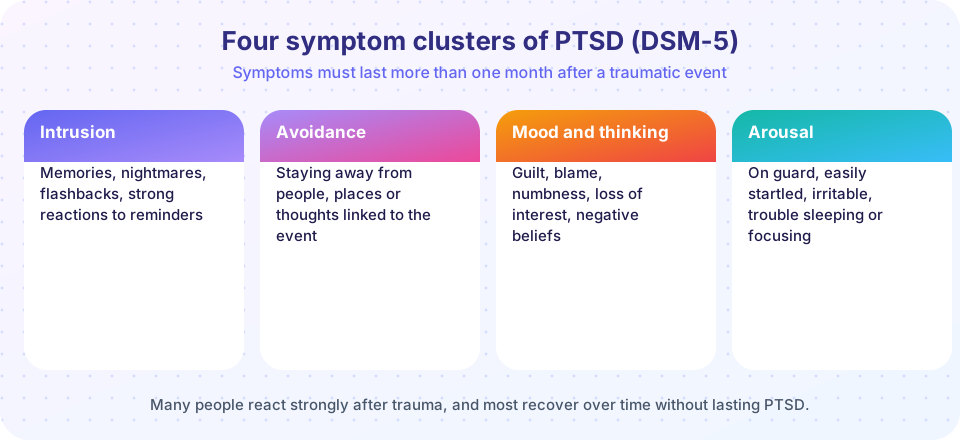
- Intrusion: unwanted memories, nightmares, flashbacks, intense distress or body reactions to reminders.
- Avoidance: of thoughts, feelings, people or places tied to the event.
- Negative changes in mood and thinking: guilt, blame, persistent fear or shame, numbness, loss of interest, detachment, trouble recalling parts of the event.
- Arousal and reactivity: irritability, hypervigilance, startle, concentration and sleep problems, reckless behavior.
ICD-11 uses a narrower core (re-experiencing, avoidance, sense of current threat) and adds complex PTSD, which includes difficulties regulating emotions, negative self-concept and relationship problems, typically after prolonged or repeated trauma such as childhood abuse.
Who develops PTSD?
Most people exposed to trauma do not develop PTSD. Risk is higher with severe or interpersonal trauma (sexual assault, combat, torture), prior adversity, lack of social support, and peri-traumatic dissociation. Protective factors include social support and effective coping. Resilience is common, and recovery over the first months is the usual pattern.
How trauma memories behave
Ehlers and Clark's cognitive model (2000) proposes that PTSD persists when the event is encoded as fragmented, sensory memories that are poorly integrated into the autobiographical story, so reminders bring back the feeling of "now" rather than "then". Biological research notes changes in the amygdala, hippocampus and prefrontal cortex and in the stress hormone system, though these are averages and not diagnostic.
Treatment
- Trauma-focused CBT, including prolonged exposure (Edna Foa) and cognitive processing therapy, have strong evidence.
- EMDR (eye movement desensitization and reprocessing, Francine Shapiro) is recommended by many guidelines; reviews suggest the eye movements are probably not the key ingredient, and the exposure and processing of the memory is.
- Medication: certain SSRIs (sertraline, paroxetine) have support for some.
- Psychological debriefing immediately after trauma, once routine, was found in trials not to prevent PTSD and may sometimes harm. Practical support, safety and "psychological first aid" are recommended instead.
Common misconceptions
"OCD means being neat and clean." The everyday joke trivializes a distressing disorder in which rituals and fears take hours and are not enjoyed.
"Only soldiers get PTSD." It follows many kinds of trauma: accidents, assault, disasters, medical events and abuse.
"Everyone exposed to trauma develops PTSD." Most do not. Distress is common; persistent PTSD is not.
"Talking about the trauma right away prevents PTSD." Forced early debriefing does not help. Gentle support and choice do.
Try it
The first demonstration simulates the OCD loop over a week with and without compulsions: when the person resists, anxiety peaks, then falls on its own. It is a simplified model illustrating exposure and response prevention, not a prediction for any person.
Press Run (or Ctrl + Enter) to see the result here.
Program input · what you'd type while the program runs
Type the answers before you press Run, one per line. Each time the program reads a line (with input()), it gets the next line from this box.
The second demonstration is a self-check list for learning the PTSD clusters. Click each symptom to see its cluster. It is for study and cannot assess anyone.
Check your understanding
Quick check · 6 questions
of 6 answered You scored / 6 · perfect!
-
1. What are compulsions in OCD?
They are driven by obsessions and bring only brief relief. -
2. What is the main ingredient of ERP?
Resisting the ritual lets anxiety fall by itself and teaches that the ritual is not needed. -
3. How long must symptoms last for a PTSD diagnosis, according to DSM-5?
Symptoms of one to three days to one month fit acute stress disorder instead. -
4. Which is NOT one of the four DSM-5 PTSD clusters?
The clusters are intrusion, avoidance, negative changes in mood and cognition, and arousal and reactivity. -
5. What did research find about routine psychological debriefing right after trauma?
Guidelines now favor supportive practical help and monitoring. -
6. What does complex PTSD in ICD-11 add to the core PTSD symptoms?
It typically follows prolonged or repeated trauma.
Summary
- OCD is a loop of obsessions and compulsions; ERP breaks it by resisting rituals; SSRIs help many.
- PTSD requires more than a month of intrusion, avoidance, negative mood and thinking, and arousal after trauma; acute stress disorder covers the first month.
- Most people exposed to trauma do not develop PTSD.
- Trauma-focused CBT (prolonged exposure, cognitive processing) and EMDR have evidence; routine debriefing does not.
Next: Stress and Health
Track your progress
Create a free account to tick off lessons and pick up where you left off on any device.
of Abnormal and Clinical Psychology lessons completed