


















Lesson 35 of 47 · Assessment and Therapy Approaches
Biological Treatments: Medication, Brain Stimulation and Trial Evidence
Learn the main psychiatric medicine classes, how ECT, TMS, DBS and esketamine work, why placebo-controlled trials matter, and how to read effect sizes and NNT.
Biological treatments change brain function directly, through chemicals or electrical and magnetic stimulation. They have helped millions of people, but they are also surrounded by myths in both directions: that pills are a cure for "chemical imbalances", or that psychiatric drugs are no better than placebo.
The truth sits between those poles, and to see it you need two skills: knowing what the main treatments do, and knowing how to read the trials that test them.
Educational information only. This lesson gives no dosing or switching advice. Never start, stop or change a psychiatric medicine without a prescriber's guidance: stopping some drugs suddenly can cause withdrawal or relapse.
What you will learn
- Name the major medication classes and what they are used for.
- Describe ECT, TMS, DBS and esketamine, and what the evidence says about them.
- Explain why placebo-controlled randomized trials are needed.
- Interpret effect sizes and the number needed to treat (NNT).
- Describe why simple "chemical imbalance" explanations are misleading.
Key terms
- Randomized controlled trial (RCT): a study that randomly assigns participants to treatment or comparison, ideally blinded.
- Placebo: an inactive treatment used as a comparison; people often improve on it.
- Therapeutic window: the range of doses that work without causing unacceptable side effects.
- Number needed to treat (NNT): how many people must be treated for one additional person to benefit.
- Treatment-resistant: not improving after adequate trials of standard treatments.
Medication classes
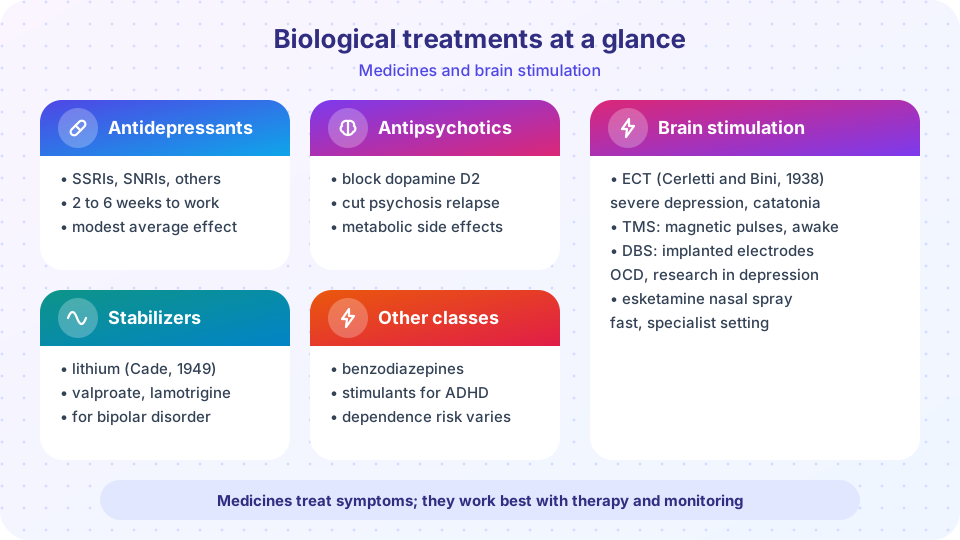
Antidepressants. The most commonly used are SSRIs (such as fluoxetine and sertraline), SNRIs, tricyclics and MAOIs. They are used for depression, anxiety disorders, OCD and some other conditions. They usually take two to six weeks to show a benefit. The 2018 network meta-analysis by Andrea Cipriani and colleagues, covering 522 trials and more than 116,000 participants, found that all 21 antidepressants beat placebo, with odds ratios from about 1.4 to 2.1, and that effects were modest on average. Debates continue about how much of the average effect reflects drug action: the benefit appears larger in severe depression (Jay Fournier and colleagues, 2010), and Irving Kirsch argued that the average advantage over placebo is below some thresholds for clinical importance. In large practice-based studies such as STAR*D (2006), about one third of patients reached remission with the first drug, and more reached remission with later steps. In young people, regulators warn that antidepressants can slightly raise suicidal thoughts in the first weeks (in FDA analyses, about 4 percent versus 2 percent on placebo), so monitoring is important.
Antipsychotics. They block dopamine D2 receptors (and, for newer drugs, act on serotonin and other receptors) and are used for psychosis, bipolar mania and as add-ons in some depression. They reduce relapse (see chapter 5) but can cause weight gain, metabolic problems and movement disorders.
Mood stabilizers. John Cade discovered the effect of lithium on mania in Australia in 1949. Lithium reduces relapse in bipolar disorder and appears to lower suicide risk, but its therapeutic window is narrow, so blood levels and kidney and thyroid function are monitored. Anticonvulsants such as valproate and lamotrigine are other options.
Benzodiazepines and other anxiolytics. Drugs such as diazepam enhance the brain's main inhibitory transmitter, GABA. They work quickly against anxiety and insomnia, but tolerance and dependence make them suitable mainly for short-term use.
Stimulants and non-stimulants for ADHD. See the ADHD lesson for the evidence.
The popular claim that depression is "a chemical imbalance, fixed by raising serotonin" is a simplification. Medicines change neurotransmitter signaling, but the causes of depression involve many systems, and a simple serotonin deficit has not been established. This does not mean the medicines do nothing; many people benefit.
Brain stimulation
Electroconvulsive therapy (ECT). Ugo Cerletti and Lucio Bini introduced it in 1938. Today ECT is given under general anesthesia with a muscle relaxant, so no convulsion is visible; a brief electrical current triggers a controlled seizure. A course is often 6 to 12 sessions over several weeks. Reviews, including the UK ECT Review Group (2003), show it is an effective short-term treatment for severe depression and is used for catatonia and some other conditions, especially when other treatments have failed or when rapid response matters. Side effects include temporary confusion and memory loss around treatment; some people report longer-lasting memory problems. Films portrayed ECT as torture, and that image still shapes attitudes, although modern practice is very different.
Transcranial magnetic stimulation (TMS). A magnetic coil placed on the scalp stimulates the cortex without anesthesia or seizure. The FDA cleared it for depression in 2008. Typical courses involve daily sessions for several weeks. It helps some people who did not respond to medication; the most common side effect is headache, and seizures are rare.
Deep brain stimulation (DBS). Electrodes are surgically implanted and connected to a pacemaker-like device. DBS is used for Parkinson's disease and has regulatory approval in some places for severe OCD, while trials in treatment-resistant depression have given mixed results.
Esketamine and ketamine. Ketamine, which blocks NMDA receptors, can lift depressed mood within hours in some people, unlike conventional antidepressants. A nasal spray version, esketamine, was approved in the USA in 2019 for treatment-resistant depression, given under observation in a clinic. Questions remain about long-term effects and misuse.
Psychedelic-assisted therapy. Early trials of psilocybin for depression and MDMA-assisted therapy for PTSD have been promising, but the drugs' obvious effects make blinding difficult, and expectations may inflate results. In 2024, US regulators declined to approve MDMA-assisted therapy for PTSD, citing concerns about trial design and data. This is an active field in which findings should be treated as preliminary.
Reading the evidence
Why placebo controls? Many people improve over time, regardless of treatment, and expectations can lift mood. Placebo response in depression trials is often substantial. Only a comparison group (ideally randomized and blinded) lets us see what the treatment adds. Pitfalls include unblinding through side effects, short follow-up, publication bias and industry funding, which is why meta-analyses including unpublished data (as Cipriani's did) are valuable.
Effect sizes and NNT. A small average effect can hide a large benefit for some people and none for others. The NNT translates results into a clinical sense: if 50 percent respond to a drug and 40 percent to placebo, the difference is 10 percentage points, so the NNT is 10. As you saw in the review of chapter 5, antipsychotics preventing relapse had an NNT of under 3. Typical NNTs for antidepressants in depression are larger, often in the range of 6 to 10 or more, depending on how response is defined.
Combination. For moderate to severe depression and for many anxiety disorders, trials often find that therapy plus medication does somewhat better than either alone, and therapy tends to protect better after treatment ends.
Common misconceptions
"Psychiatric drugs just mask symptoms." Some medicines, such as lithium and antipsychotics, reduce relapse, which is more than masking.
"Antidepressants are addictive." They do not cause craving, but stopping some of them suddenly can cause discontinuation symptoms, so reductions should be supervised.
"ECT is barbaric." Modern ECT uses anesthesia and carefully controlled dosing, and it is among the most effective treatments for severe depression.
"If a drug beats placebo, it works for everyone." Average effects hide big differences between people.
Try it
The first demonstration simulates a randomized trial and shows why a modest average effect still means overlapping groups. The second compares NNT values for different response rates. Both use made-up numbers to teach the reasoning.
Press Run (or Ctrl + Enter) to see the result here.
Program input · what you'd type while the program runs
Type the answers before you press Run, one per line. Each time the program reads a line (with input()), it gets the next line from this box.
Press Run (or Ctrl + Enter) to see the result here.
Program input · what you'd type while the program runs
Type the answers before you press Run, one per line. Each time the program reads a line (with input()), it gets the next line from this box.
Check your understanding
Quick check · 5 questions
of 5 answered You scored / 5 · perfect!
-
1. What did the 2018 Cipriani network meta-analysis find about antidepressants?
The analysis of 522 trials found all included drugs superior to placebo, with differences in efficacy and tolerability. -
2. Who discovered the effect of lithium on mania, and in which year?
Cade, an Australian psychiatrist, reported lithium's effect in 1949. -
3. How is ECT given today?
Modern ECT is done under anesthesia and a muscle relaxant, and a brief current triggers a controlled seizure. -
4. If 50 percent respond to a drug and 40 percent to placebo, what is the NNT?
NNT = 1 divided by 0.10 = 10. -
5. Why do trials use placebo controls?
Without a comparison, natural improvement and expectation effects could be mistaken for drug effects.
Summary
- Main medicine classes are antidepressants, antipsychotics, mood stabilizers, benzodiazepines and ADHD drugs; each has benefits and risks.
- ECT, TMS, DBS and esketamine are brain stimulation options, with ECT and TMS best established for depression.
- The "chemical imbalance" idea oversimplifies; medicines help many people, but average effects are modest.
- RCTs with placebo controls, effect sizes and NNT are needed to judge treatments.
- Combining therapy and medication often helps, and decisions should be made with a prescriber.
Next: Chapter review
Track your progress
Create a free account to tick off lessons and pick up where you left off on any device.
of Abnormal and Clinical Psychology lessons completed